
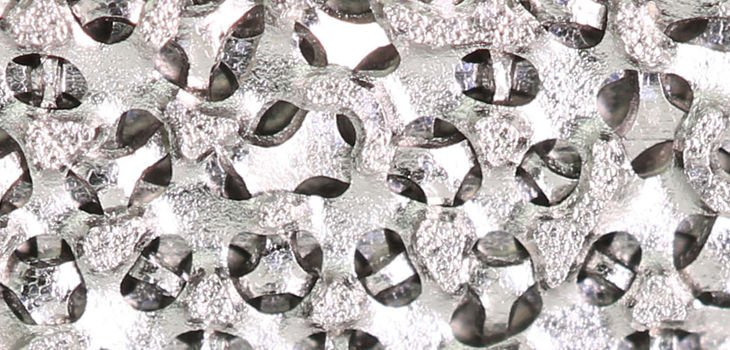
Indiana-based Nanovis claims its nanotube surface is the “only nanotechnology in the spine market with which scientists can customize and control the spacing of the nanofeatures.”
Clearance and $5.5MM for FortiCore Nanotech
2 min read Premium comments
Secondary#fusion#nanotechnology#spinepain
The claim comes with the August 21, 2018 announcement of the completion of a $5.5 million round of investment from Indiana venture capitalists. They will use the funds to meet increased working capital and sales needs from “surging demand” from surgeons and distributors for Nanovis’ nanotechnology enhanced spinal implants.
510(k) Clearance
FortiCore, the company’s proprietary nanotechnology which received FDA 510(k) clearance this past March, offers interbodies with “the best combination of a deeply porous bone interface scaffold with a tailored nanotube surface and bridging bone visualization,” according to the company.
The FortiCore TLIF and PLIF interbody implants feature a nanosurface-enhanced deeply porous titanium scaffold intermolded with a PEEK core.
Thomas Webster, Ph.D., chemical engineering department chair, Northeastern University, said implant nano surface science “has advanced from the early days when we simply created nanoroughness for implants because tissues have nanoroughness. Now we understand the mechanisms by which nanotopographies can interact with cellular signaling pathways…. With Nanovis’ implants, patients can now benefit from a carefully designed and controlled nanotopography that harnesses this groundbreaking research.”
The company says its technology platform is well proven with over 4,250 implanted to date.
“Most” Advanced Technology
Alan McGee, M.D., of Orthopedics Northeast in Fort Wayne, said Nanovis offers “the most advanced interbody fixation technology with the best imaging profile on the market. My partners and I have implanted over 300 FortiCore interbodies. I can tell my patients I’m giving them the most advanced technology available today, and they have recovered quickly and have been very satisfied. It’s easy for me to assess bone growth through and around the FortiCore implants with plain X-ray. It’s a struggle to assess bone growth through 3D printed titanium interbodies with plain X-ray and I’m hesitant to expose my patients to the extra radiation from an unnecessary CT scan.”
Matt Hedrick, the company’s CEO, says the company’s clinical and scientific goals are to reduce fixation and infection related complications. “In the short term, this nanopatterned surface targets fixation related complications and in the intermediate term this nanopatterned surface is the foundation of a bactericidal program targeting infection related complications.”
“The technology platforms provide differentiated surface advantages enabling the potential for existing medical devices to achieve new outcomes,” stated a company press release announcing the 510(k) clearance.
Indications
According to FDA documents, FortiCore devices are intended for spinal fusion procedures in skeletally mature patients with degenerative disc disease at one or two contiguous spinal levels from L2-S1. “These patients should have had six months of nonoperative treatment. These patients may have had a previous non-fusion spinal surgery and/or may have up to Grade 1 spondylolisthesis or retrolisthesis at the involved spinal level(s).”
The devices are to be used with autograft and/or allograft comprised of cancellous and/or corticocancellous bone graft and with supplemental fixation indicated for lumbar spinal fusion procedures.
Additionally, FortiCore can be used as an adjunct to fusion in patients diagnosed with degenerative scoliosis.
Author
React:
Discussion
This is a fascinating development. In my practice we've seen similar outcomes with the revised protocol. The key differentiator seems to be patient selection criteria. Has anyone else noticed the correlation with BMI thresholds?
Great point. I'd push back slightly on the conclusion, the sample size in the cited study is too small to draw population-level inferences. That said, the directional signal is compelling and worth a larger RCT.
We implemented a similar approach last year. Early results are promising but we're still gathering 12-month follow-up data. Happy to share our protocol if anyone is interested.
Join the conversation
Orthopedic professionals are discussing this. Sign in and upgrade to read every comment and add your voice.