
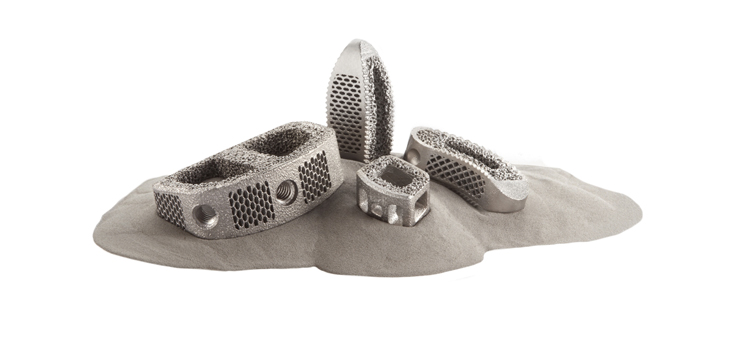
On July 27, 2018, CoreLink, LLC’s 3D Foundation anterior lumbar (ALIF) interbody device was cleared for sale in the U.S. by the FDA.
“Biggest” 3D ALIF Cage Cleared by FDA
2 min read Premium comments
Secondary#3dprinting#fdaclearance#spinepain
Jay Bartling, the CEO of the St. Louis-based company said CoreLink now has the largest ALIF cage footprint on the market, “which will allow surgeons to maximize endplate contact area and hold up to 8cc’s of graft.”
The company said the device uses CoreLink’s proprietary mimetic metal technology, which mimics natural bone characteristics, including 100% open-pore architecture and micro-roughened porosity with hydro-wicking properties.
Before this 510(k) clearance, the company released three other sterile-packaged Foundation 3D interbody cages: cervical, straight lumbar, and curved lumbar.
In June, CoreLink acquired the privately held Israeli medical device company Expanding Orthopedics and its FDA-cleared expanding and articulating FLXfit and FLXfit 15 titanium transforaminal lumbar interbody fusion systems.
According to FDA documents, predicate devices for the device were the company’s own Foundation 3D interbody devices. The purpose of the notification was to add additional anterior lumbar interbody cage footprints and sizes to the existing system.
The Foundation system consists of additively manufactured interbody cages, re-usable instruments and a sterilization tray.
The FDA documents state the implants “are indicated for intervertebral body fusion procedures in skeletally mature patients with degenerative disc disease (DDD) of the lumbar spine at one or two contiguous levels from L2-S1. These DDD patients may also have up to Grade I spondylolisthesis or retrolisthesis at the involved level(s). Foundation implants are to be used with autogenous bone graft and supplemental fixation. Patients should have at least six (6) months of nonoperative treatment prior to treatment with an intervertebral cage.”
The new sizes of cages are inserted between vertebral bodies in the anterior column of the lumbar spine and are “designed to provide mechanical support to the lumbar spine while arthrodesis occurs. The lumbar line features a wide variety of lordosis and footprint options with fully porous architectures and varying pore sizes to offer increased room for bone growth with mechanical stability.”
The cages are made from the titanium alloy Ti-6AL-4V ELI (conforming to ASTM F136 in terms of mechanical properties only) and are open in the center to accept autogenous bone graft material and come in sizes: 25mm x 35mm, 25mm x 40mm, 27mm x 35mm, 27mm x 40mm, 30mm x 40mm, and 30mm x 45mm. Each footprint offers cage heights ranging from 10mm to 21mm in 1mm increments along with lordosis angles of 8° and 15°.
Author
React:
Discussion
This is a fascinating development. In my practice we've seen similar outcomes with the revised protocol. The key differentiator seems to be patient selection criteria. Has anyone else noticed the correlation with BMI thresholds?
Great point. I'd push back slightly on the conclusion, the sample size in the cited study is too small to draw population-level inferences. That said, the directional signal is compelling and worth a larger RCT.
We implemented a similar approach last year. Early results are promising but we're still gathering 12-month follow-up data. Happy to share our protocol if anyone is interested.
Join the conversation
Orthopedic professionals are discussing this. Sign in and upgrade to read every comment and add your voice.