
Spare the muscles, but sacrifice the exposure quality? That shouldn’t have to be, says new work from Texas researchers.
Novel Muscle-sparing Thoracotomy Improves Exposure
1 min read Premium comments
Secondary#rexmarco#thoracotomy
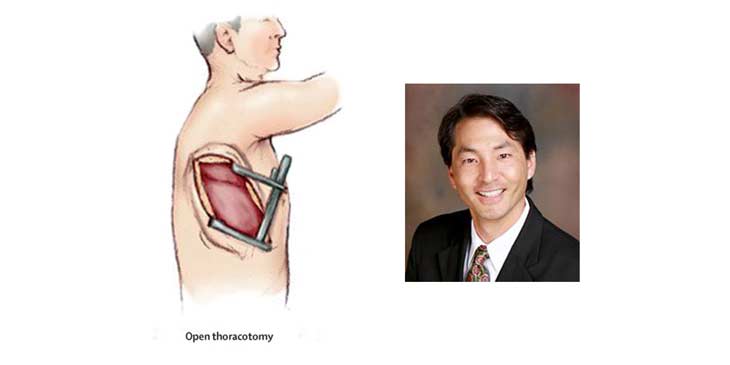
Their work, “A novel muscle-sparing high thoracotomy for upper thoracic spine resection and reconstruction,” was published in the European Spine Journal.
The authors wrote, “A novel muscle-sparing, high thoracotomy approach is described, utilizing a midline posterior incision with lateral extension from the lateral decubitus position. Five patients are presented to illustrate the application of this technique in thoracic tumors with intimate spinal involvement.”
Rex Marco, M.D. with the department of orthopedic surgery at Houston Methodist Hospital and co-author told OTW, “The topic was of interest to me as all previous descriptions of high thoracotomy approaches have required transection of the shoulder girdle muscles to access spinal column tumors with large soft tissue masses.”
The authors wrote, “The muscle-sparing, high thoracotomy approach afforded gross total resection and spinal reconstruction in five consecutive patients, including stage IV lung carcinoma with invasion of the T5 and T6 vertebral bodies, two malignant fibrous histiocytomas causing thoracic cord compression, a metastatic T6 lesion of unknown primary with associated cord compression; and a Pancoast tumor. All patients seen at 6 months had full symmetric shoulder range of motion postoperatively.”
“This technique allows surgeons to access the upper thoracic spine with a muscle sparing thoracotomy, which allows en bloc removal of malignant primary spinal column tumors and lung carcinoma invading the spinal column while sparing transection of the shoulder girdle muscles.”
“The most important result was that we were able to perform a muscle sparing high thoracotomy. Surgeons now have the option to use a muscle sparing high thoracotomy to access the upper thoracic spine.”
Author
React:
Discussion
This is a fascinating development. In my practice we've seen similar outcomes with the revised protocol. The key differentiator seems to be patient selection criteria. Has anyone else noticed the correlation with BMI thresholds?
Great point. I'd push back slightly on the conclusion, the sample size in the cited study is too small to draw population-level inferences. That said, the directional signal is compelling and worth a larger RCT.
We implemented a similar approach last year. Early results are promising but we're still gathering 12-month follow-up data. Happy to share our protocol if anyone is interested.
Join the conversation
Orthopedic professionals are discussing this. Sign in and upgrade to read every comment and add your voice.