
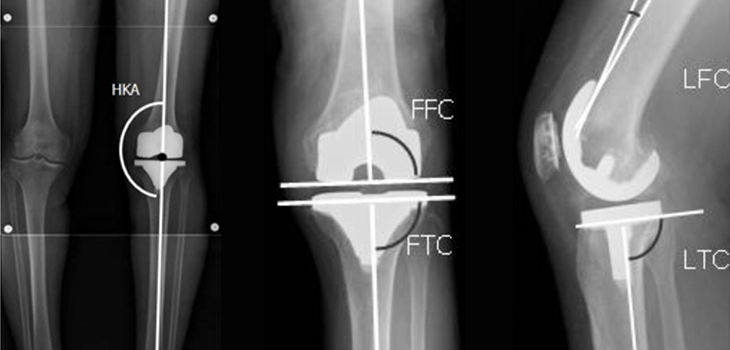
A new study has pitted customized knee implants against off-the-shelf implants. The resulting paper, “In Vivo Tibial Fit and Rotational Analysis of a Customized, Patient-Specific TKA versus Off-the-Shelf TKA,” appears in the May 25, 2018 edition of the Journal of Knee Surgery.
Knees: Off-the-Shelf vs. Customized Implants
1 min read Premium comments
#totalkneearthroplastySecondary#tka#customizedimplants
Gregory Martin, M.D., with the department of orthopedic surgery at Preferred Orthopaedics of the Palm Beaches, Palm Beaches, Florida, and co-author on the study, told OTW, “We were interested in undertaking this study because many people have persistent pain after total knee arthroplasty using off the shelf implants that could be explained by poor implant fit and/or malrotation. We hypothesized that a customized knee implant would outperform off-the-shelf implants concerning fit and achieving correct rotation.”
“The most important result was that with off-the-shelf implants there is a serious compromise between tibial sizing and tibial rotation, both known sources of pain after total knee arthroplasty. This compromise is basically eliminated with the use of customized implants.”
“With approximately 20% of total knee patients not satisfied after the procedure, customized implants need to be taken seriously as a means to reducing persistent pain and improving patient satisfaction.”
“These results just make sense. We wouldn’t wear a shirt or a pair of shoes that doesn’t fit right, so why would we accept any less for our patients when we are implanting a medical device in them!”
Author
React:
Discussion
This is a fascinating development. In my practice we've seen similar outcomes with the revised protocol. The key differentiator seems to be patient selection criteria. Has anyone else noticed the correlation with BMI thresholds?
Great point. I'd push back slightly on the conclusion, the sample size in the cited study is too small to draw population-level inferences. That said, the directional signal is compelling and worth a larger RCT.
We implemented a similar approach last year. Early results are promising but we're still gathering 12-month follow-up data. Happy to share our protocol if anyone is interested.
Join the conversation
Orthopedic professionals are discussing this. Sign in and upgrade to read every comment and add your voice.