
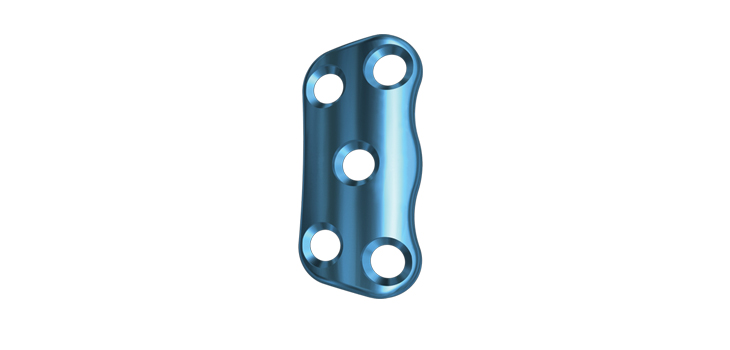
K2M Group Holdings, Inc. has received FDA 510(k) clearance and a CE Mark for its Cayman United Plate System following completion of its first surgical cases.
K2M’s 3D Printed Plate System Wins FDA Clearance
1 min read Premium comments
Secondary#fdaclearance#k2m
In a July 17, 2018 announcement, the company stated the system was designed for rigid fixation to K2M’s Cascadia Lateral 3D Interbody System featuring Lamellar 3D Titanium Technology, “the first and only 3D-printed cage with modular fixation capabilities.”
Robert Lee, FRCS (Tr&Orth), a spine surgeon at Royal National Orthopaedic Hospital NHS Trust in Stanmore, UK, said the system’s “streamlined technique and versatile insertion options provide an elegant solution” for his minimally invasive lateral cases, “while also utilizing a 3D-printed device to encourage bony integration throughout the implant.”
The company says the system’s single level, 1- and 2-hole plate configurations precisely match all Cascadia Lateral 3D height and lordosis options, “allowing surgeons to customize the construct using a lateral approach.”
Additionally, the single-level plate sizes “minimize retraction required for placement and an assembly alignment feature keys into the Cascadia implants to resist rotation. Versatile insertion options allow for plate assembly with a central assembly screw prior to implantation, or in-situ after the cage has been placed.”
K2M Chairman, President, and CEO, Eric Major noted that the clearance makes the Cayman the first and only 3D-printed cage available on the market with modular fixation capabilities. “As a leading innovator of 3D-printed spinal solutions, we remain committed to developing advanced technologies that when complemented by our comprehensive Balance ACS [Axial, Coronal, Sagittal] platform, help surgeons facilitate 3D spinal balance in their patients.”
Author
React:
Discussion
This is a fascinating development. In my practice we've seen similar outcomes with the revised protocol. The key differentiator seems to be patient selection criteria. Has anyone else noticed the correlation with BMI thresholds?
Great point. I'd push back slightly on the conclusion, the sample size in the cited study is too small to draw population-level inferences. That said, the directional signal is compelling and worth a larger RCT.
We implemented a similar approach last year. Early results are promising but we're still gathering 12-month follow-up data. Happy to share our protocol if anyone is interested.
Join the conversation
Orthopedic professionals are discussing this. Sign in and upgrade to read every comment and add your voice.