
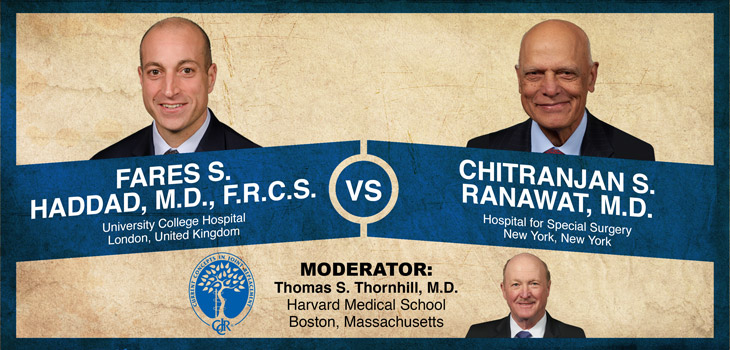
This week’s Orthopaedic Crossfire® debate was part of the 33rd Annual Current Concepts in Joint Replacement® (CCJR®), Winter meeting, which took place in Orlando. This week’s topic is “The Medial Stabilized Knee: The “Post-Cam” Replacement.” For is Fares S. Haddad, M.D., F.R.C.S., University College Hospital, London, United Kingdom. Opposing is Chitranjan S. Ranawat, M.D., Hospital for Special Surgery, New York, New York. Moderating is Thomas S. Thornhill, M.D., Harvard Medical School, Boston, Massachusetts.
Haddad v Ranawat: The Medial Stabilized Knee: The “Post-Cam” Replacement
7 min read Premium comments
Great Debates#ccjr#medialstabilizedknee#postcamreplacement
Mr. Haddad: It’s a huge privilege to debate Chit. Chit was designing knee replacements when I was learning how to walk and has done a phenomenal job over the last few decades. But the reality is that the world has moved on.
We’ve shown knee replacement to be an effective strategy, but there are some poor satisfaction rates out there and our patients’ expectations and our own expectations are increasing. We really should be at the stage where technology allows us to recreate the stability and the kinematic profile of the native knee.
And we haven’t really moved very far. We’ve been arguing at this meeting about the same things ever since I started: alignment, fixation, patella resurfacing and so forth. We should be interested in the medial pivot discussion.
Let’s begin with the anatomy of the knee. We know that the medial side is ball and socket; and the lateral side moves around the medial side. That’s been well documented. So we know that there is a concept that sagittal stability medially may be the key to optimal function.
Knee replacement technology developed along the route it did because of a number of surgical limitations. The Freeman medial pivot route was superseded by other techniques, but maybe the time has come to revisit that. Because there is good data suggesting that if you use a medial pivot knee, survivorship can be excellent.
And the really interesting thing is now there are a number of designs out there that use this concept, so perhaps the time has come to think about it a little bit harder.
If you look at medial stabilized knee designs under fluoroscopy, they do exactly what you expect them to do. If you look at the knees, they are made to do difficult tasks that our patients struggle with like stepping up and kneeling and what you find is you get the same graphs as when you’re studying the native knee.
Perhaps we’re achieving what we set out to achieve.
What about the data? In a prospective randomized study we are trying to drill down and compare a knee not too unfamiliar to our moderator (PFC Sigma PS, n = 40 knees) with a medial pivot knee (MRK, n = 40 knees) and randomizing patients trying to see if we can see a difference.
These are patients that had a standardized surgery, standardized follow-up, all by the same team in the same way. They’re pretty similar, both clinically and radiographically pre-operatively and didn’t really have very big differences in their post-operative journey. They had the typical sort of complications that patients get after knee surgery (2 DVT, 1 hematoma, no revisions, no infections, 3 unrelated deaths, 4 lost to follow-up).
But when we look at their range of motion, we saw much bigger, statistically significant (p = 0.0035) range of motion in the medial pivot knees and this was maintained after 5 years.
When looking at the Total Knee Function score, which is one of the more sophisticated knee scores, the medial pivot knee data suggests better function in that group.
And if you look at the Forgotten Knee, which is what we’re really aiming for in our knee replacement patients, we’re seeing more forgotten knees in the medial pivot knees in this Level 1 prospective randomized study than we are in the standard knees.
We’ve learned something. They both do well. Let’s not say that the standard knees do badly. They both do extremely well. But the reality is we’ve seen some advantage in the medial pivot group.
I want to share with you some interesting data from Bill Walter who’s looked at another standard, very popular knee design (Triathlon CR) and compared it to a medial pivot design (SAIPH). He picked his best knees.
These are the ones that were really happy and then tried to look at their sagittal stability. The population numbers between the two groups are pretty similar. They’ve got good range of motion and good stability in terms of coronal alignment. And there’s much better sagittal stability both in the Lachman Test and in the Anterior Drawer for the medial pivot knee.
I think there are important conclusions to make here. The contributions that Chit has made to knee surgery have been immense and we got to a stage where we’ve got knee replacements working relatively well for the majority, but we probably didn’t set the bar high enough.
There are some patients who probably need to achieve more and want to achieve more, and that’s where sagittal stability through knee conformity might come in. It can give us the potential for better motion and better tracking and, hopefully, better function and higher satisfaction.
Dr. Ranawat: I’m going to show you where we are with the implants that we use. I’m going to present long-term results for the PFC Sigma Rotating Platform Posterior Stabilized (RPPS) total knee in young, active patients with no less than a 10-year follow-up.
The RPPS design was brought to the marketplace almost 15 years ago as an alternative to the LCS Meniscal Bearing knee design. It increased range of motion while also reducing polyethylene wear and, therefore, offering a potential for increased survivorship.
The objective of this presentation is to investigate long-term clinical and radiographic results and survivorship of the RPPS knee in young, active patients.
In 2000, I did 43 consecutive, cemented RPPS knees in 33 patients (21 males, 12 females). And followed them a minimum of 10 years; age between 35 to 65 with a mean of 59 years, and the functional criteria that we used was UCLA activity score. All patellae were resurfaced. Mean pre-operative UCLA score was 5.3. Mean pre-operative range of motion was 109 degrees. Clinical results were analyzed according to the Knee Society Score, range of motion, WOMAC and a patient-admission questionnaire (PAQ) which I designed and published in JOA in 2012.
Radiographic analysis was performed for loosening, osteolysis, and Kaplan-Meier survivorship—failure for all causes and failure for mechanical reasons.
At a mean follow-up of 11 years, the mean post-operative range of motion was 117 degrees. Knee Society and WOMAC mean scores improved dramatically to 94.1 and 32.9, respectively.
Ninety percent (30 patients) had good to excellent results. Ninety three percent (21 patients) were satisfied with a mean PAQ satisfaction score of 8.6 out of 10.
At 10 years, radiographic analysis showed there were no failures. One hundred percent survivorship for mechanical failure; and 98% survivorship for all causes as 2 patients required scar excisions.
So, we’re reporting 10-year results in young, active patients with a high quality of function including sporting activities. We attribute this to design features of the RPPS knee.
In conclusion, results appear to support RPPS TKA in the young, active patient. Many have almost 20-year follow-up; 90% good to excellent results; no osteolysis; 100% survivorship.
My point here is that new innovation is good. But the medial pivot design has been tried since the time of Michael Freeman, which goes back almost 30 years.
Moderator Thornhill: Seth, this is great. On behalf of the 16,000 people you’ve trained over the years, and especially for me…I get to ask these 2 experts some things that I really want to know. Thanks!
Fares, you talked about…everybody’s talked about 15-20% of people are not fully satisfied. Do you think by driving the implant to reproduce the kinematics of the normal knee, you will be able to reduce that?
Mr. Haddad: I think that there are a number of factors that contribute to that 15-20% rate. Patient selection. Accuracy factors and surgical factors. And technology. I think the reality is we need to move from a world whereby there was one solution for everybody towards actually understanding everyone’s anatomy; understanding everyone’s gait and their pathology, and choosing the right solution for each patient.
Moderator Thornhill: Do you think that the knee should be driven by the soft tissues that were abnormal or be driven by the prosthesis?
Mr. Haddad: I think, in principle, the knee should be driven by the patient’s native anatomy when they functioned well, when they were younger. We need to unravel that and for many patients that is a ball and socket on the medial side.
Moderator Thornhill: Okay. Chit, Fares said that when he looked at the medial pivot knee compared to one that wasn’t, that there was a higher incidence of forgotten knees with the medial pivot design. What is your comment on that?
Dr. Ranawat: God made the knee with p-substance fibers on the front because most of the activities that we do, hardworking, living, sporting activities, kneeling, require flexion and load bearing on the knee and therefore it’s a protective phenomena that God has created. You can make the knee better, but you will not be able to eliminate anterior pain in about 11%.
Moderator Thornhill: So, Fares, Chit’s saying that none of this stuff that we’re talking about is really it. It’s literally the factors around the soft tissues and the anterior surfaces of the knee. Your comment?
Mr. Haddad: I don’t think so. I think we confuse a lot of anterior knee pain after knee surgery with the anterior knee structures and the patellofemoral joint, but in reality a lot of that pain may be about sagittal stability. If you’ve got good sagittal stability, that may be the difference when you try and load the knee in flexion, particularly in up or down slope, or when you try to kneel or put weight through the knee.
Moderator Thornhill: So Chit, what are your comments about maintaining or preserving sagittal stability?
Dr. Ranawat: I think stability in both planes is important, however, the artificial knee cannot provide range of motion beyond 125 degrees with stability in all planes.
Moderator Thornhill: I think ongoing, clinical studies are important. The difficulty is we really don’t have equipoise. We don’t necessarily have an equal position on one side or the other and there are so many confounding variables, including patient variables. But gentlemen, thank you so much. You did a great job, both of you.
Please visit www.CCJR.com to register for the 2018 CCJR Winter Meeting, – December 12 – 15 in Orlando.
Author
React:
Discussion
This is a fascinating development. In my practice we've seen similar outcomes with the revised protocol. The key differentiator seems to be patient selection criteria. Has anyone else noticed the correlation with BMI thresholds?
Great point. I'd push back slightly on the conclusion, the sample size in the cited study is too small to draw population-level inferences. That said, the directional signal is compelling and worth a larger RCT.
We implemented a similar approach last year. Early results are promising but we're still gathering 12-month follow-up data. Happy to share our protocol if anyone is interested.
Join the conversation
Orthopedic professionals are discussing this. Sign in and upgrade to read every comment and add your voice.