
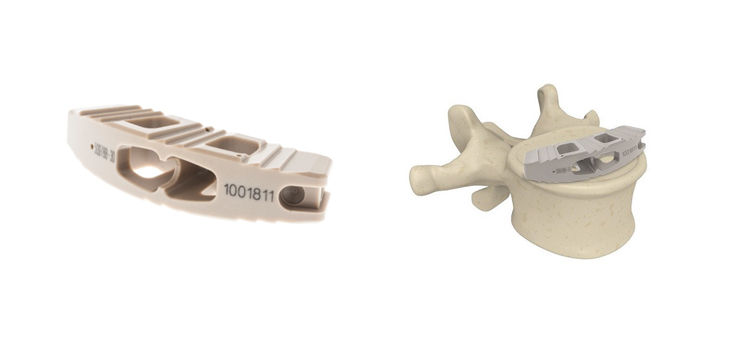
Acron Medical, LLC says it has “the new gold standard for a safe & stable thoracolumbar interbody fusion” after receiving FDA 510(k) clearance for its Acron PEEK TLIF (transforaminal lumbar interbody fusion) Interbody system.
FDA Clearance for Acron Medical’s TLIF System
2 min read Premium comments
Secondary#spinefusion#acronmedical
Christian Schawrda, the company’s co-founder and CEO said on July 16, 2018, that the engineering behind the development of the cage “makes it the gold standard for surgeons looking for solid anchorage and optimal load distribution between the implant to protect osteoporotic patients from bone subsidence.”
The cage, added Schawrda, is designed to be “strategically placed along the outer rim of the endplates, or ring apophysis, with superior load-bearing capacity. That approach, maximizes the strength of the fusion construct, increases fusion rates and minimizes the risk of subsidence.”
Werner Lack, M.D., Associate Professor of Orthopaedic Surgery, University of Vienna, says he has been successfully using the cage for nearly three years.
“I see some key benefits to the technology. First, the cage has a greater contact surface than normal TLIF or PLIF cages, solving the problem of subsidence often seen with osteoporotic bone. Second, its shape facilitates the implantation bone graft behind the cage. Third, by positioning the banana shape cage, in transverse position, in the anterior part of the vertebrae, we can place the vertebral segment in ideal lordosis.”
The Acron is made of PEEK-OPTIMA and comes with a graft chamber and side windows to facilitate the formation of a “robust” fusion column and can be used with a neuromonitoring system to avoid neural damage.
The system includes a full range of implant sizes and heights that are designed to accommodate different types of vertebral anatomy, and to allow surgeons to address each patient’s sagittal plane requirements. The cage shape, according to the company, allows numerous options for insertion.
The other company co-founder, Andreas Bernegger, said the system comes to the U.S. after three years of clinical validation in Austria, Germany and Switzerland. “The launch of the technology in the U.S. is [a] major milestone for our group. We are currently looking for distributors and strategic partners around the country.”
Acron Medical, founded in 2017, is the U.S. subsidiary of the Austria-based spineMED group.
Author
React:
Discussion
This is a fascinating development. In my practice we've seen similar outcomes with the revised protocol. The key differentiator seems to be patient selection criteria. Has anyone else noticed the correlation with BMI thresholds?
Great point. I'd push back slightly on the conclusion, the sample size in the cited study is too small to draw population-level inferences. That said, the directional signal is compelling and worth a larger RCT.
We implemented a similar approach last year. Early results are promising but we're still gathering 12-month follow-up data. Happy to share our protocol if anyone is interested.
Join the conversation
Orthopedic professionals are discussing this. Sign in and upgrade to read every comment and add your voice.