
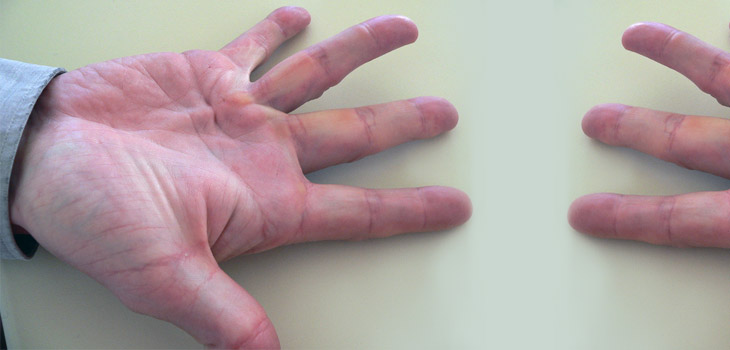
Dupuytren’s disease is a condition of the hand that causes the fingers to curl irreversibly into the palm. There is currently no treatment for early Dupuytren’s disease. And, typically, patient’s fingers become so bent that their hand function is impaired. About 4% of the population of the UK are affected by this ailment.
Drug Proves Successful in Treating Dupuytren’s Disease
2 min read Premium comments
Secondary#adalimumab#dupuytrenedisease
Researchers at the Kennedy Institute and Nuffield Department of Orthopaedics, Rheumatology and Musculoskeletal Sciences, University of Oxford, working with clinicians at NHS Lothian, have found that injection of the anti-TNF drug adalimumab into Dupuytren’s disease nodules results in the reduction of the cell characteristics responsible for progression of the disease.
Based on their laboratory data that tumor necrosis factor (TNF) drives the development of the cell type that causes Dupuytren’s disease, the research team explored the effect of an anti-TNF drug injected directly into the Dupuytren’s nodule tissue. The results so far, they report, are promising.
“Our data have shown that a concentrated formulation of adalimumab injected directly into the diseased tissue may be effective in targeting the cells responsible for Dupuytren’s disease,” said study leader Jagdeep Nanchahal, M.D., Ph.D., University of Oxford Professor of Hand, Plastic and Reconstructive Surgery.
“This brings new hope to people who suffer from this disabling condition, who currently have to wait for their situation to deteriorate, watching their hand lose function until it is bad enough for surgery.”
This randomized trial (phase 2a) recruited 28 patients with Dupuytren’s disease who were scheduled to have surgery to remove diseased tissue in their hands. Two weeks prior to surgery they received a single injection of varying doses of the anti-TNF drug, or a placebo. The tissue removed during surgery, which is usually discarded, was then analyzed. The team found that adalimumab reduces expression of the fibrotic markers, at two weeks post injection, suggesting this drug could be used to stop the growth of disease causing myofibroblast cells. They also found the drug to be safe and well tolerated.
The anti-TNF drug adalimumab (Humira) is currently licensed in the EU for the treatment of a number of conditions including rheumatoid arthritis, Crohn’s disease and ulcerative colitis.
The findings are published on line in the journal EBioMedicine, published by The Lancet.
Author
React:
Discussion
This is a fascinating development. In my practice we've seen similar outcomes with the revised protocol. The key differentiator seems to be patient selection criteria. Has anyone else noticed the correlation with BMI thresholds?
Great point. I'd push back slightly on the conclusion, the sample size in the cited study is too small to draw population-level inferences. That said, the directional signal is compelling and worth a larger RCT.
We implemented a similar approach last year. Early results are promising but we're still gathering 12-month follow-up data. Happy to share our protocol if anyone is interested.
Join the conversation
Orthopedic professionals are discussing this. Sign in and upgrade to read every comment and add your voice.