
James R. Andrews, M.D., medical director for Andrews Institute for Orthopaedics & Sports Medicine in Gulf Breeze, Florida, recently received the National Athletic Trainers’ Association’s President’s Award during the association’s 69th Clinical Symposia & AT Expo in New Orleans.
Andrews Receives NATA President’s Award
1 min read Premium comments
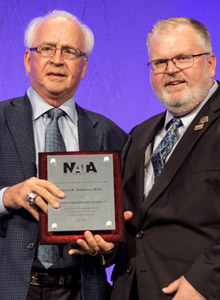
#jamesandrews
Under Andrews’ leadership and reputation, Baptist Health Care founded Andrews Institute in 2007.
The President’s Award recipient is chosen by the National Athletic Trainers’ Association (NATA) president for unwavering leadership and support of the athletic training profession. Andrews has always been a strong supporter of athletic trainers and the value they add to healthcare.
“Over his decades of serving athletes, both young and old, Dr. Andrews has become known as not only a caring and compassionate surgeon but, an innovator and trailblazer, constantly striving to improve the care he and his team are able to provide to their patients. He values athletic trainers but he also stands for what we as athletic trainers stand for—excellent care for our patients,” outgoing NATA President Scott Sailor, EdD, ATC said during the awards presentation.
The NATA President’s Award began in 2016. Previous recipients include Brian Hainline, M.D., NCAA chief medical officer (2016), and Rick Burkholder, MS, ATC, Kansas City Chiefs vice president of sports medicine and performance (2017).
Athletic trainers are health care professionals who specialize in the prevention, diagnosis, treatment and rehabilitation of injuries and sport-related illnesses. They prevent and treat chronic musculoskeletal injuries from sports, physical and occupational activity, and provide immediate care for acute injuries. NATA represents and supports 45,000 members of the athletic training profession.
Author
React:
Discussion
This is a fascinating development. In my practice we've seen similar outcomes with the revised protocol. The key differentiator seems to be patient selection criteria. Has anyone else noticed the correlation with BMI thresholds?
Great point. I'd push back slightly on the conclusion, the sample size in the cited study is too small to draw population-level inferences. That said, the directional signal is compelling and worth a larger RCT.
We implemented a similar approach last year. Early results are promising but we're still gathering 12-month follow-up data. Happy to share our protocol if anyone is interested.
Join the conversation
Orthopedic professionals are discussing this. Sign in and upgrade to read every comment and add your voice.