
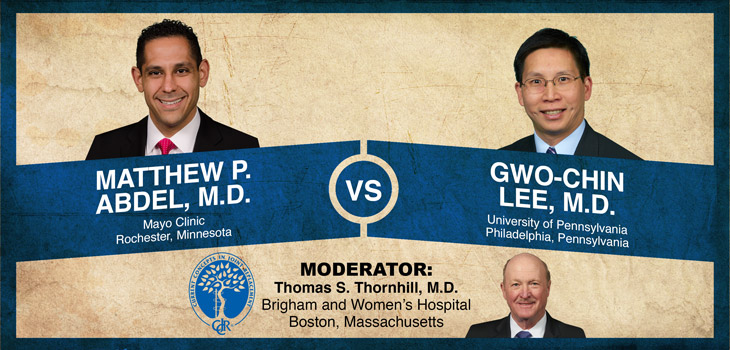
This week’s Orthopaedic Crossfire® debate was part of the 18th Annual Current Concepts in Joint Replacement® (CCJR®), Spring meeting, which took place in Las Vegas. This week’s topic is “The Cementless Knee: An Emergent Game Changer.” For is Matthew P. Abdel, M.D., Mayo Clinic, Rochester, Minnesota. Opposing is Gwo-Chin Lee, M.D., University of Pennsylvania, Philadelphia, Pennsylvania. Moderating is Thomas S. Thornhill, M.D., Brigham and Women’s Hospital, Boston, Massachusetts.
Abdel vs. Lee: The Cementless Knee: An Emergent Game Changer
8 min read Premium comments
#gwochinleeGreat Debates#matthewabdel#ccjr#cementlesstka
Dr. Abdel: We are all aware that there is good long-term survivorship with cemented primary total knee arthroplasty at approximately 90% at 15 years. However, there are multiple concerns with the contemporary patient, three of which I am going to articulate here today.
First and foremost, our patient profiles are changing; patients are younger, more active and living longer. In addition, the obesity epidemic is significant not only in the United States but across the world, and multiple studies have shown increased failure with cemented total knee arthroplasties in obese patients.
It is my contention that cementless total knee arthroplasty is an attractive option for three main reasons.
One, there is potential for improved longevity particularly in younger, more active patients.
Two, there is potential for improved longevity in obese patients which is a significant portion of our practice.
And three, there is potential for decreased operative time which is essential in the cost-conscious, bundled-care model.
So why now? There have been multiple modifications to implant design and surgical technique that make it possible. These include highly porous metals, 3D printing, and a fundamental understanding of the surgical technique required to execute cementless total knee replacements.
Let’s break it out into three main areas.
Longevity—we are targeting biologic fixation—very similar to an uncemented total hip replacement. Take for instance a review of 5 Level I randomized clinical trials with 300 patients (Nakama, et al., Cochrane Database Syst Rev. 2012). While the authors did find a greater displacement in tibias from a cementless design early on, they found that the risk of future aseptic loosening with cementless total knee arthroplasty was one half of that of cemented fixation – again, Level I data.
If you look at a summary of the cementless knee literature, particularly a study by Meneghini and Ritter (J Arthroplasty, 2010), you find 98% survivorship at 20 years.
Moreover, we have contemporary implant designs. At the Mayo Clinic we conducted a Level I, randomized clinical trial of three implant designs 2003 to 2006 (CORR 2015). We randomized 400 patients into one of three groups; cemented modular, uncemented monoblock trabecular metal, or cemented monoblock trabecular metal.
Looking at the survivorship, we found no significant difference at 5 years but I’d like to highlight: once you have biologic fixation early you can anticipate longevity whereas with cemented fixation you anticipate degradation over time.
What about obese patients? In a study we published in 2015 (J Arthroplasty) we showed that obese patients with cemented total knee arthroplasties had a greater rate of aseptic tibial loosening with a cutoff BMI being approximately 35. When we stratified it based on cumulative probability patients had a two-fold increased risk of failure with a BMI greater than 35 in a cemented construct.
On the other hand, if you review a recent publication with 300 primary total knee arthroplasties completed on morbidly obese patients (BMI greater than 40) (Bagsby, et al., J Arthroplasty 2016), they had 154 cemented knees and 144 cementless knees and the data are intriguing. When looking at any revision, the failure rate was 13% in the cemented group and less than 1% in the cementless group. However, what was most intriguing about this group of patients was revision for aseptic loosening. It was 6% in the cemented group as opposed to zero in the cementless group.
Finally, decreased operative time. An excellent study conducted by Denis Nam, et al. (J Arthroplasty 2017), looked at 62 cemented knees and 66 cementless knees. At a mean of approximately 2 years there are no revisions in either group but there was a significant decrease in operative time in the cementless total knee arthroplasty group.
In summary, multiple innovations with implant design and surgical technique including highly porous metals, and 3D printing do allow for reliable and reproducible cementless total knee arthroplasties. There is a particular cohort of patients that can benefit from this technology with improved longevity—including younger, more active patients, and obese patients.
In addition, you will hear some discussions from the next speaker about survivorship. I’ve shown you excellent long-term survivorship from multiple series of cementless total knee replacements and the contemporary data supports it as well.
Dr. Lee: Matt is part of this young generation of orthopedic surgeons who likes fast things, shiny things and new things. As expected, he has put on a good show, but unfortunately he’s wrong.
Remember Matt that primary total knee arthroplasty needs to be reliable, durable and reproducible, and particularly nowadays in this age of cost containment, new technologies or techniques must address existing shortcomings.
Cemented total knee arthroplasties remain the gold standard. They are reliable and reproducible, they can be used in all types of cases and bone and even if you believe that you want to use antibiotics, the only way to do it is with cement.
A study from your home institution Matt (Vessely, et al., CORR 2006) reported that cemented total knee arthroplasties in over 1000 patients showed excellent survivorship for loosening as an endpoint at 5 years, 10 years, and at 15 years; 98.8% survivorship—pretty good.
If you look at other published studies out there, if you have a good implant design, good materials, and good surgeons you have a greater chance of dying than of the implant loosening over the life of the implant (Ritter, et al., J Arthroplasty 2016). Now you can argue that that may not be true with younger patients but even with old designs and young patients a cemented design survived at 30 years, IB-I with 92.3% (Long, et al., JBJS-Am 2014).
So, cement may not be the only root cause of aseptic loosening and that may be a fallacy of your thinking. Cementless total knee arthroplasties in my mind are less forgiving, technically demanding, there are bone quality constraints, and most importantly, they are costly. By the way, they can fail as well in obese patients.
Another study out of your institution (Duffy, et al., CORR 1998), excellent surgeons, cemented total knee arthroplasties of one design—94% survivorship at 10 years and the same design but cementless, 72% survivorship at 10 years.
The Australian Registry Annual Report showed that the use of cement is actually increasing, not decreasing. Perhaps that is because cementless arthroplasty has higher rates of revision at 5 years, 10 years, and even 15 years. The Swedish Knee Arthroplasty Register reports the same findings.
What about in the UK? If you have a cementless total knee arthroplasty you are at increased risk of revision, increased risk of pain, and increased risk for aseptic loosening. Back around the Horn through the New Zealanders, cementless fixation has a higher rate of revision compared to hybrid or cemented fixations.
Undoubtedly, improved designs and reliability have led to publications of excellent clinical studies showing equivalent survivorship but not superior survivorship (Pulido, et al., CORR 2015; Harwin, et al., J Arthroplasty 2017).
Cementless total knee arthroplasties have a lower track record in obese. And Michael Meneghini’s study (J Arthroplasty 2013) looked at the potential failure of cementless total knee arthroplasty, a cautionary tale, particularly in the morbidly obese. Other stipulations such as osteopenia, osteoporosis, prior knee surgeries, post-traumatic conditions (bone sclerosis) may preclude the wide use of cementless knee designs.
We did have a successful transition in the United States from a cemented total hip arthroplasty to cementless total hip arthroplasty.
But a hip is not a knee.
In summary, cement fixation in total knee arthroplasty is and will remain the gold standard for the foreseeable future. Improvements in cementless total knee arthroplasties have improved reliability, but remain inferior at the registry level. The cementless TKA is not a game changer.
Moderator Thornhill: So Matt, I would like to congratulate you, you are really clever this was like a presidential press conference. You managed to evade some of the most important things that we talk about.
Dr. Abdel: Whenever we’re talking about anything, we’re looking at 10, 15, 20, 30, 40-year survivorship, and until we get to there and when the technology has already changed, there’s always the potential benefit. I think the novelty with cementless total knee arthroplasty is the innovation not only in the techniques, but the designs and the manufacturing. It’s a potential until we see the date at 20, 30 years.
Moderator Thornhill: We used to do cemented hips, now we almost always do uncemented hips. Are we going to do cementless knees in your career?
Dr. Lee: Well, I have done some uncemented total knee arthroplasties as part of a clinical study.
Moderator Thornhill: No, no I mean routine knee, day in and day out.
Dr. Lee: No, I don’t think so. There’s not enough evidence at this point to prove that that’s going to withstand the test of time.
Moderator Thornhill: Okay let me ask you it again. Do you think at some time in your career we will be doing routinely cementless knees?
Dr. Lee: No.
Dr. Abdel: I disagree. There are going to be learning curves. This is like an uncemented hip femoral component when initially there was patch coating and then we went to circumferential coating and then designs and geometries and fixation improved. It’s the same evolution that we are having with cementless total knee replacements.
Moderator Thornhill: It’s got the potential, right?
Dr. Abdel: No question.
Moderator Thornhill: So Gwo, what is going to be the tipping point, to use Malcolm Gladwell’s term, that would make you say, I’m going to maybe start doing cementless knees?
Dr. Lee: I mean everybody’s going to have their own tipping point, but in my mind, until you can show me that a cementless knee can work in all types of bone, in deformities and will surpass that of cemented fixation 20, 30 years down the road, it’s not going to happen and so by that time I’ll be long retired.
Moderator Thornhill: I’m going to ask the final question, 5 seconds each. Which is easier…doing a cemented knee or a cementless knee?
Dr. Abdel: Cemented.
Dr. Lee: Cementless.
Moderator Thornhill: Thanks very much both of you.
Please visit www.CCJR.com to register for the 2018 CCJR Winter Meeting, – December 12 – 15 in Orlando.
Senior Editor: Jay D. Mabrey, M.D., whose 35 year career in orthopedics included residency at Duke University Medical Center, service in the United States Army Medical Corps, Fellowship at the Hospital for Special Surgery and a long, distinguished career at Baylor University Medical Center where, in addition to his overall leadership at that institution, developed the Joint Wellness Program that helped patients get up after surgery more quickly, developed the first virtual reality surgical simulator for knee arthroscopy and chaired the FDA Orthopaedic Device Panel, is Orthopedics This Week’s newest contributing writer and editor.
Author
React:
Discussion
This is a fascinating development. In my practice we've seen similar outcomes with the revised protocol. The key differentiator seems to be patient selection criteria. Has anyone else noticed the correlation with BMI thresholds?
Great point. I'd push back slightly on the conclusion, the sample size in the cited study is too small to draw population-level inferences. That said, the directional signal is compelling and worth a larger RCT.
We implemented a similar approach last year. Early results are promising but we're still gathering 12-month follow-up data. Happy to share our protocol if anyone is interested.
Join the conversation
Orthopedic professionals are discussing this. Sign in and upgrade to read every comment and add your voice.