
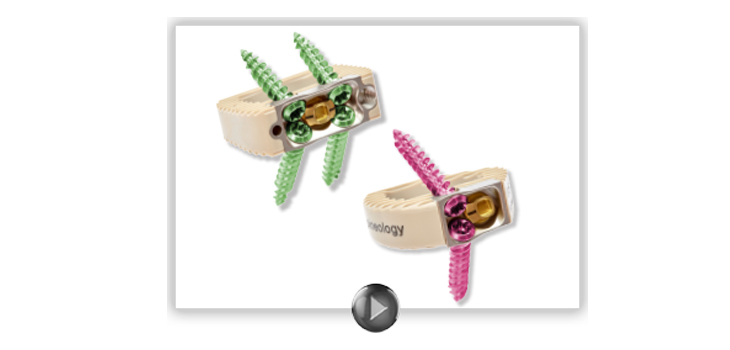
Spineology Inc. has received permission from the FDA to market its Rampart One Standard ALIF (anterior lumbar interbody fusion) device for use with or without supplemental fixation.
Spineology’s ALIF Receives “Stand-Alone” FDA Clearance
1 min read Premium comments
Secondary#anteriorlumbarinterbodyfusion#fusion#spinelogy
Company CEO John Booth announced the FDA 510(k) clearance on June 4, 2018, stating, “Following the success of our beta launch, this stand-alone clearance will provide additional momentum as we prepare for the full market release of the Rampart One ALIF Interbody Fusion System.”
Intervertebral body fusion devices are intended to stabilize lumbar spinal segment to promote fusion to restrict motion and decrease pain using bone graft with or without supplemental fixation.
The system, according to a company statement, includes both standard and oblique interbody devices, each with integrated fixation screws and is designed to minimize vascular retraction and exposure to maximize safety.
Additionally, the company notes the Rampart One is manufactured from Invibio PEEK-OPTIMA HA Enhanced material to support bone on-growth.
Boston-based Jeremy Shore, M.D., said minimal retraction and minimal exposure are very important for the anterior approach. “The Rampart One instruments work collinear with the access, providing surgeons the ability to keep the incision to a minimum. Additionally, divergent fixation screw angles and midline screw placement keep vascular retraction to a minimum.”
Clifford Tribus, M.D., of Madison, Wisconsin, said, “Advanced biomaterials are showing great promise in enhancing patient outcomes. It’s very exciting to have access to an implant like Rampart One.
The company adds that PEEK-OPTIMA HA Enhanced “provides improved osteoconductive surfaces for bone on-growth while preserving the traditional benefits of PEEK-OPTIMA Natural including a modulus of elasticity similar to that of human bone, reduced stress shielding and artifact-free imaging.”
The 510(k)-clearance notification was filed on January 2, 2018. The FDA reached the clearance decision at the end of April.
Author
React:
Discussion
This is a fascinating development. In my practice we've seen similar outcomes with the revised protocol. The key differentiator seems to be patient selection criteria. Has anyone else noticed the correlation with BMI thresholds?
Great point. I'd push back slightly on the conclusion, the sample size in the cited study is too small to draw population-level inferences. That said, the directional signal is compelling and worth a larger RCT.
We implemented a similar approach last year. Early results are promising but we're still gathering 12-month follow-up data. Happy to share our protocol if anyone is interested.
Join the conversation
Orthopedic professionals are discussing this. Sign in and upgrade to read every comment and add your voice.