
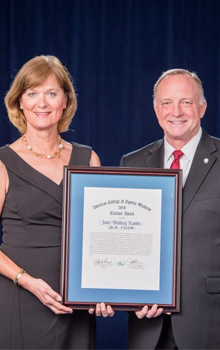
Janet Walberg Rankin, Ph.D., FACSM, professor and associate chair in the department of Human Nutrition, Foods and Exercise at Virginia Tech, recently received a 2018 Citation Award from the American College of Sports Medicine (ACSM) for her work in sports medicine and the exercise sciences.
Rankin Receives ACSM Citation Award
1 min read Premium comments
#acsm#janetrankin
“Citation award winners are selected for their outstanding performance in the areas of research and scholarship, clinical care, administrative services or educational services,” said ACSM President Kathryn Schmitz, Ph.D., MPH, FACSM. “We are happy to recognize Dr. Rankin’s outstanding accomplishments.”
Rankin’s work includes a focus on examining the use of active transport for health. She has served as president of the Southeast Regional Chapter of ASCM and has served on the ACSM Board of Trustees. In addition, she was elected president of ACSM in 2012. While president, she started the ActivEarth initiative which works to improve public health, the environment and the economy through greater levels of physical activity and active transportation.
Rankin was one of seven people to receive the Citation Award this year. Other recipients include Mary Jane De Souza, Ph.D. of Pennsylvania State University, Sandra Hoffman, M.D., FACSM of Idaho State University, William W. Dexter M.D., FACSM of Tufts University School of Medicine, David R. Bassett, Jr. Ph.D., FACSM of University of Tennessee, Lawrence E. Armstrong, Ph.D. FACSM of the University of Connecticut and Timothy Lightfoot, Ph.D., FACSM of Texas A&M University.
Rankin was recognized at an awards banquet during the association’s recent annual meeting, which was held from May 29 to June 2, 2018 in Minneapolis, Minnesota.
Author
React:
Discussion
This is a fascinating development. In my practice we've seen similar outcomes with the revised protocol. The key differentiator seems to be patient selection criteria. Has anyone else noticed the correlation with BMI thresholds?
Great point. I'd push back slightly on the conclusion, the sample size in the cited study is too small to draw population-level inferences. That said, the directional signal is compelling and worth a larger RCT.
We implemented a similar approach last year. Early results are promising but we're still gathering 12-month follow-up data. Happy to share our protocol if anyone is interested.
Join the conversation
Orthopedic professionals are discussing this. Sign in and upgrade to read every comment and add your voice.