
San Diego, California-based NuVasive, Inc. has announced the first use of the new PRECICE STRYDE system from NuVasive Specialized Orthopedics (NSO).
PRECICE STRYDE: First in Man Limb Lengthening
1 min read Premium comments
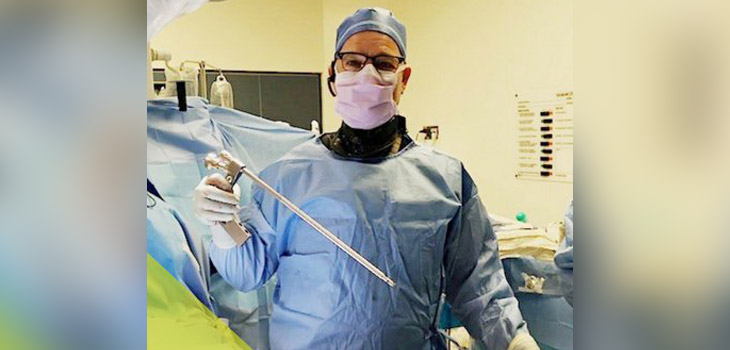
Secondary#limbreconstruction#precicestryde
The system was used by Dror Paley, M.D., a limb lengthening and reconstruction expert with the Paley Orthopedic and Spine Institute in West Palm Beach, Florida.
According to the company, PRECICE STRYDE is NSO’s third-generation limb lengthening system and includes an implantable intramedullary nail, locking screws, reusable instruments and a hand-held External Remote Controller (ERC).
“STRYDE was recently cleared by the U.S. Food and Drug Administration in April for use in both the tibia and femur. Patients are now able to non-invasively lengthen or shorten the implant to a prescribed length utilizing the ERC post-surgery from their own home versus lengthy hospital stays. When used for stature lengthening for cosmetic purposes, STRYDE can increase a patient’s height by more than three inches.”
“This new system aims to provide better and more tolerable post-operative outcomes for patients undergoing limb lengthening. Prior to this technology, a patient was only permitted to apply 30-50 pounds of weight on each leg, leading to a slow and lengthy return to daily life and activities. With STRYDE’s unique stainless-steel composition, patients are now able to apply 150-250 pounds of weight on each leg depending on the device chosen and post-operative care recommended by their physician…”
“The PRECICE STRYDE technology advances how I am able to treat patients requiring limb reconstruction or those seeking to increase their height, and I am excited to incorporate this into my practice,” said Dr. Paley, a board-certified orthopedic surgeon specializing in limb lengthening and deformity correction. “I continually seek to offer better clinical solutions to my patients, and I am proud to have collaborated with NuVasive in the development of this latest orthopedic advancement.”
Massimo Calafiore, president of NSO, told OTW, “The implant testing milestone was significant for us. The STRYDE device greatly outperformed what our engineering team expected. The results of this testing milestone really gave us confidence in the design and enabled my team to release the product to the U.S. market earlier than initially planned.”
Author
React:
Discussion
This is a fascinating development. In my practice we've seen similar outcomes with the revised protocol. The key differentiator seems to be patient selection criteria. Has anyone else noticed the correlation with BMI thresholds?
Great point. I'd push back slightly on the conclusion, the sample size in the cited study is too small to draw population-level inferences. That said, the directional signal is compelling and worth a larger RCT.
We implemented a similar approach last year. Early results are promising but we're still gathering 12-month follow-up data. Happy to share our protocol if anyone is interested.
Join the conversation
Orthopedic professionals are discussing this. Sign in and upgrade to read every comment and add your voice.