
OrthoSensor, Inc.’s Verasense sensor-assisted technology knee device is now cleared to be used with Zimmer Biomet’s Persona Knee System for total knee replacement.
OrthoSensor Device Cleared for Persona Knee System
2 min read Premium comments
#kneereplacementSecondary#orthosensor#personakneesystem
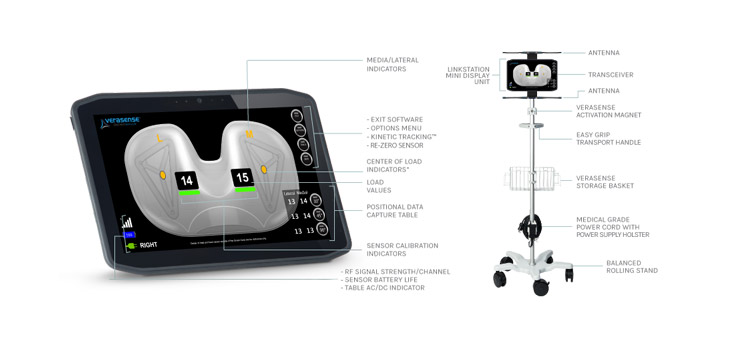
The technology provides a means to dynamically balance the knee during primary or revision total knee arthroplasty (TKA) intra-operatively.
The device was originally 510(k) cleared in 2014, with an updated use statement in April 2016 clearing the device to be used with Biomet’s Vanguard, Stryker’s Triathalon, Zimmer’s NexGen and Smith & Nephew’s Journey II and Legion knee systems.
It took the FDA a little under four months to grant clearance for use of the device with the Persona system.
According to FDA filings, the system is indicated for “any medical condition in which primary or revision Total Knee Arthroplasty (TKA) would be indicated.” Its use is “as a tool for adjustment of the femoral knee implant to reduce instability from flexion gap asymmetry.”
The system is sterile and for single patient use.
Included in the system is an instrumented trial tibial insert comprising an array of load sensors that measure the forces applied on its surface and angular positional information (such as alignment, varus/valgus, posterior, and anterior slope positioning, etc.) after insertion into the space between the tibia and femur.
First Use
The company received clearance to use the device with the Persona Knee System earlier in the year in Australia. According to the company, Lachlan Host, M.D., from Bathurst Private Hospital in New South Wales, successfully used Verasense for the Persona knee system for the first time. He said, “Using Verasense has completely changed my joint arthroplasty practice.” Since using the device, he added that he has found patients have “consistently improved range of motion and have had less focal pain. I now know, irrefutably, that I am achieving improved patient outcomes.”
Study Results
A June 11, 2018 press release cited a prospective multi-center study, where use of the device, “was proven to reduce post-operative pain, accelerate patient activity levels, improve functional outcomes, and increase patient satisfaction scores with high statistical significance.” In fact, added the company, 98% of patients whose knees were balanced using the system, “reported they were satisfied to very satisfied at three years post-op. These proven results point to improved joint balance being the key to higher TKR satisfaction.”
Ivan Delevic, president and CEO of OrthoSensor, said receiving this FDA clearance, “augments this outstanding implant and instrumentation, securing a better balanced knee after surgery.” He added that the device “brings real-time, quantified soft tissue balance data to our surgeons. This evidenced-based data regarding soft tissue balance works with systems such as Persona so that surgeons can make objective assessments intraoperatively, resulting in better clinical outcomes for patients.”
Author
React:
Discussion
This is a fascinating development. In my practice we've seen similar outcomes with the revised protocol. The key differentiator seems to be patient selection criteria. Has anyone else noticed the correlation with BMI thresholds?
Great point. I'd push back slightly on the conclusion, the sample size in the cited study is too small to draw population-level inferences. That said, the directional signal is compelling and worth a larger RCT.
We implemented a similar approach last year. Early results are promising but we're still gathering 12-month follow-up data. Happy to share our protocol if anyone is interested.
Join the conversation
Orthopedic professionals are discussing this. Sign in and upgrade to read every comment and add your voice.