
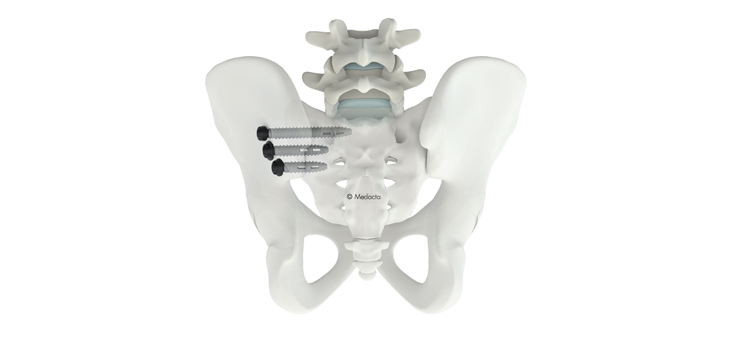
Castel San Pietro, Switzerland-based Medacta International has announced the first surgery utilizing its Medacta Unconstrained Screw Technology Sacro-Iliac Joint Screw System (M.U.S.T. SI) for sacroiliac (SI) joint fusion surgery.
Medacta: First-in-Man With New SI Joint Screw
1 min read Premium comments
#medactaSecondary#jointfusion#jointscrew
According to the company, “The M.U.S.T. Sacro-Iliac Joint Screw System is designed for sacroiliac joint fusion for patients suffering from degenerative sacroiliitis, sacroiliac joint disruptions and degenerative sacroiliac arthritis to ease chronic back pain.”
“The system’s corresponding procedure is minimally invasive and can be optimized for the outpatient surgical setting. The first surgery employing M.U.S.T. SI in the U.S. was performed by Ashish Sahai, M.D., at West Boca Medical Center, in Boca Raton, Florida in mid-May.”
Regarding details on the interface between the system and its instrumentation, Ashish Sahai, M.D., told OTW, “The interface between the screw system and its instrumentation was perhaps the portion of the product I was most impressed with.”
“The head of the M.U.S.T. SI screw has a deep recess allowing the corresponding screwdriver to achieve an extremely secure fit and the resulting screw trajectory to remain accurate. I used a percutaneous approach for this procedure, which made the secure connection a particularly important component.”
“I was able to remain confident throughout the surgery that my instruments would maintain a stable connection with the system, something I haven’t experienced with many other products.”
Francesco Siccardi, executive vice president, Medacta International, told OTW, “Orthopedic surgeons should primarily recognize that this system provides a set of streamlined instrumentation that features a stable interface between the implants and instrumentation.”
“The range of features that the screw itself offers is also notable, encompassing the most effective technologies and design elements that the sacroiliac fusion market has to offer. M.U.S.T. SI offers porous and rough hydroxyapatite rough plasma spray coating for biological fixation and increased arthrodesis and radial windowed slots for surrounding bone access, along with self-tapping screws, a long pitch with a dual lead and a tapered tip, all promoting a seamless insertion process.”
Author
React:
Discussion
This is a fascinating development. In my practice we've seen similar outcomes with the revised protocol. The key differentiator seems to be patient selection criteria. Has anyone else noticed the correlation with BMI thresholds?
Great point. I'd push back slightly on the conclusion, the sample size in the cited study is too small to draw population-level inferences. That said, the directional signal is compelling and worth a larger RCT.
We implemented a similar approach last year. Early results are promising but we're still gathering 12-month follow-up data. Happy to share our protocol if anyone is interested.
Join the conversation
Orthopedic professionals are discussing this. Sign in and upgrade to read every comment and add your voice.