
Camber Spine Technologies has won FDA 510(k) clearance for its second device in the company’s ENZA-line of implants.
FDA Clearance for Camber Spine’s ALIF System
2 min read Premium comments
Secondary#anteriorlumbarinterbodyfusion#fdaclearance
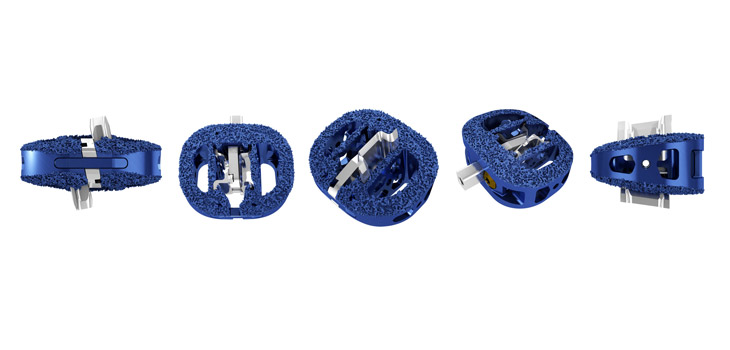
On June 4, 2018, the Wayne, Pennsylvania, spine company announced the clearance of its ENZA-A Titanium Anterior Lumbar Interbody Fusion (ALIF) system, “a unique, minimally invasive interbody fusion device providing integrated fixation.”
Company CEO Daniel Pontecorvo said the newly cleared system leverages two of the company’s “highly innovative platform technologies. The vast interest and success of our first generation ENZA (PEEK) with Duo Presa (Two Grips) anchor technology and our line of SPIRA products with Surface By Design, inspired us to combine their defining attributes to create this next generation ENZA-A Titanium ALIF.”
Indications
The system “…is indicated for use with autogenous bone graft in patients with degenerative disc disease at one or two contiguous levels from L2 to S1”…and “is intended to be used with additional FDA-cleared supplementary fixation systems implanted via a laparoscopic or an open anterior approach.”
According to the FDA document description, the device’s superior and inferior surfaces, “have a rough surface to help prevent movement of the device while fusion takes place.”
The system consists of a 3D printed titanium body with a roughened surface “that encourages bone growth onto the cranial and caudal surfaces of the device. The upper and lower faces are deliberately designed with pores that average 500 microns in diameter, the optimal environment for bone to grow and fully incorporate the implant with the vertebral bodies.”
“It has multiple openings to allow a large volume of autogenous bone graft to be packed into the implant to further facilitate fusion. Similar to the original ENZA, it has two sharpened anchor plates housed within the 3D-printed body until they are deployed into the adjacent vertebrae to provide fixation.”
The system is intended to be used with additional FDA-cleared supplementary fixation systems and must be used with autogenous graft material.
Substantial Equivalence
The FDA determined the device was substantially equivalent to the company’s ENZA Zero-Profile Anterior interbody fusion device and its SPIRA Open Matrix ALIF Device with respect to indications, design, materials, function, manufacturing, and/or performance.
The agency received the company’s clearance notification in early November 2017 and granted clearance on April 18, 2018.
The company said it expects to launch additional products later this year. “This interbody, coupled with additional product launches expected later this year in the cervical and lateral markets, will continue to grow Camber Spine’s presence as a market leader and innovator in minimally invasive spine surgery technology advancements.”
Author
React:
Discussion
This is a fascinating development. In my practice we've seen similar outcomes with the revised protocol. The key differentiator seems to be patient selection criteria. Has anyone else noticed the correlation with BMI thresholds?
Great point. I'd push back slightly on the conclusion, the sample size in the cited study is too small to draw population-level inferences. That said, the directional signal is compelling and worth a larger RCT.
We implemented a similar approach last year. Early results are promising but we're still gathering 12-month follow-up data. Happy to share our protocol if anyone is interested.
Join the conversation
Orthopedic professionals are discussing this. Sign in and upgrade to read every comment and add your voice.