
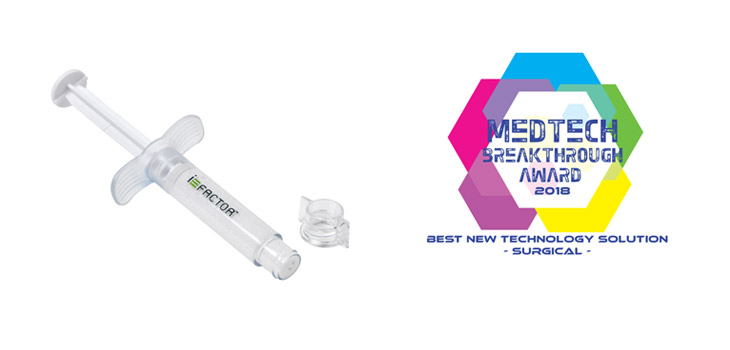
Orthobiologics company Cerapedics, Inc. recently announced that it has received the 2018 MedTech Breakthrough Award for Best New Surgical Technology Solution for its i-FACTOR Peptide Enhanced Bone Graft.
Cerapedics Receives 2018 MedTech Breakthrough Award
1 min read Premium comments
Secondary#cerapedics#ifactor#medtechbreakthrough
“We are pleased to be recognized as one of the top companies, technologies, and products in the global health and medical technology market,” said Cerapedics CEO Glen Kashuba.
“i-FACTOR Peptide Enhanced Bone Graft is an innovative solution for orthopedic surgeons who are looking for a safe, clinically proven and cost-effective bone graft that is supported by Level 1 human data and we are focused on gathering additional clinical evidence supporting its use and addressing the evidence gap around commercial bone grafts often used in spinal procedures.”
i-FACTOR Peptide Enhanced Bone Graft, according to the company, “is based on proprietary biomimetic small peptide (P-15) technology that has a novel mechanism of action (attract, attach, and activate) that induces osteoblast cell proliferation and differentiation to accelerate new bone formation in patients with degenerative disc disease.”
“For the hundreds of thousands of people suffering from severe back pain, degenerative disc disease and need a spinal fusion, Cerapedics has developed an innovative therapy to enhance bone healing with i-FACTOR Peptide Enhanced Bone Graft, a novel PMA-approved small peptide bone graft,” said James Johnson, managing director at MedTech Breakthrough.
“We congratulate Cerapedics on developing an innovative, evidence-based technology that has the opportunity to become an industry standard of care, and we are thrilled to recognize them as a 2018 MedTech Breakthrough Award – Surgery winner.”
Cerapedics is headquartered in Westminster, Colorado. For more information about i-Factor, visit their website.
Author
React:
Discussion
This is a fascinating development. In my practice we've seen similar outcomes with the revised protocol. The key differentiator seems to be patient selection criteria. Has anyone else noticed the correlation with BMI thresholds?
Great point. I'd push back slightly on the conclusion, the sample size in the cited study is too small to draw population-level inferences. That said, the directional signal is compelling and worth a larger RCT.
We implemented a similar approach last year. Early results are promising but we're still gathering 12-month follow-up data. Happy to share our protocol if anyone is interested.
Join the conversation
Orthopedic professionals are discussing this. Sign in and upgrade to read every comment and add your voice.