
If researchers at University of Wollongong (UOW) and St Vincent’s Hospital in Melbourne, Australia, have their way, doctors will soon mend damaged bone and cartilage with the stroke of a BioPen and eliminate or greatly reduce the need for joint replacements.
BioPen: Site Specific Stem Cell Delivery
1 min read Premium comments
Secondary#stemcells#biopen#gordonwallace#stemcellink
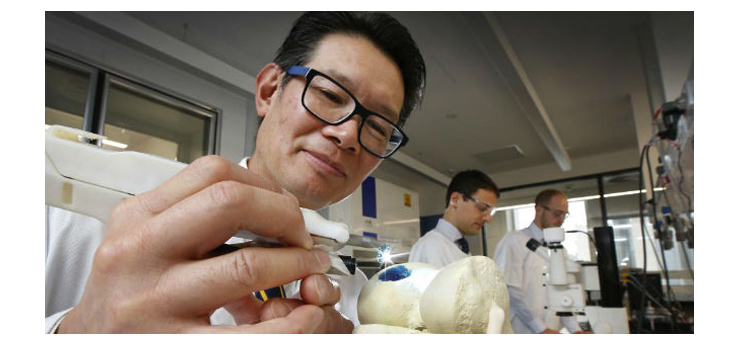
The BioPen is a handheld 3D printer designed to allow surgeons to “draw” new cells onto injuries with stem cell ink. The research team was recently awarded a $1 million grant that will enable the project to make progress on a prototype device, that will bring the technology closer to commercialization.
Professor Gordon Wallace, director of UOW’s ARC Centre of Excellence for Electromaterials Science, said the BioPen represents the convergence of engineering, science and medicine.
“The BioMedTech Horizons grant will enable the partnership between Australian academia, healthcare and industry to lead and translate our research discoveries at the coal face of care,” he said.
The BioPen uses live stem cells (previously extracted from the patient’s body) to accelerate the healing and regeneration of new bone and cartilage. The cells are protected by a biopolymer, with an additional gel layer. The BioPen head combines these two layers to allow the surgeon to draw a 3D scaffold on the injured bone.
The BioPen incorporates a low-powered ultraviolet light source that, the developers claim, solidifies the ink to keep the embedded cells safe. Once implanted, the cells multiply and transform into bone, muscle and nerve cells to repair the injury.
Author
React:
Discussion
This is a fascinating development. In my practice we've seen similar outcomes with the revised protocol. The key differentiator seems to be patient selection criteria. Has anyone else noticed the correlation with BMI thresholds?
Great point. I'd push back slightly on the conclusion, the sample size in the cited study is too small to draw population-level inferences. That said, the directional signal is compelling and worth a larger RCT.
We implemented a similar approach last year. Early results are promising but we're still gathering 12-month follow-up data. Happy to share our protocol if anyone is interested.
Join the conversation
Orthopedic professionals are discussing this. Sign in and upgrade to read every comment and add your voice.