
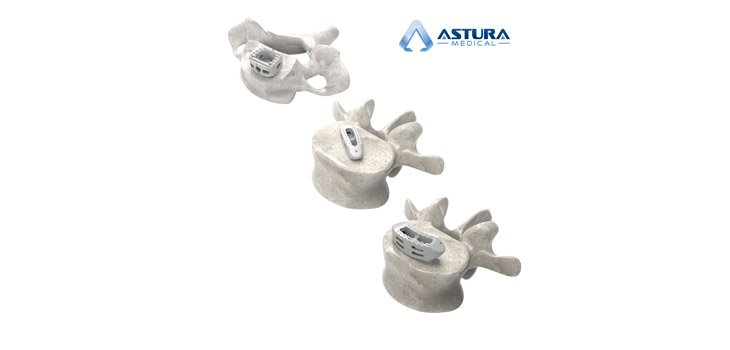
On June 4, 2018, Astura Medical of Carlsbad, California, announced the FDA 510(k) clearances of the company’s cervical and lumbar interbody spacers.
Astura Medical’s Cervical and Lumbar Spacers Cleared
2 min read Premium comments
Secondary#spinefusion#asturamedical#fdaclearance
ALTA Cervical Spacer
The first, the ALTA ACDF (anterior cervical discectomy and fusion) spacer is, according to FDA documents, “…intended for use for anterior cervical interbody fusion in patients with cervical disc degeneration and/or cervical spinal instability, as confirmed by imaging studies (radiographs, CT, MRI), that results in radiculopathy, myelopathy, and/or pain at multiple contiguous levels from C2 – T1.”
The ALTA system is “intended to be used with supplemental fixation and is designed for use with autogenous and/or allogeneic bone graft comprised of cancellous and/or corticocancellous bone graft to facilitate fusion.”
The devices have trapezoidal footprints and multiple sizes to accommodate patient anatomy. “This device is offered in PEEK OPTIMA LT120HA. The PEEK OPTIMA LT120HA implants have unidirectional teeth on both of their inferior and superior surfaces to prevent migration/expulsion, and graft windows which help facilitate bony integration. X-ray markers are integrated for visualization of the implants during and after surgery. The titanium implants have roughened superior and inferior surfaces to prevent migration of the spacer post implantation,” states the FDA document.
Predicate Devices
The primary predicate device for the ALTA system was Astura Medical’s ALTA Anterior Cervical Interbody Spacer. Other predicates included SpineFrontier Incorporated’s Arena-C HA PEEK Cervical Intervertebral Body Fusion Device and NuVasive, Inc.’s CoRoent Small Interbody System.
It took the FDA approximately four months to clear the device.
Half Dome Lumbar Spacer
The second cleared device is the Half Dome lumbar interbody spacer.
The system is indicated for intervertebral body fusion procedures in skeletally mature patients with degenerative disc disease (DDD) of the lumbar spine at one or two contiguous levels from L1-L2 to L5-S1. The DDD patients may also have Grade I spondylolisthesis or retrolisthesis at the involved levels. Half Dome implants are to be used with autogenous bone graft and supplemental fixation.
According to FDA documents, the devices are available in a range of footprints and heights to suit the individual pathology and anatomical conditions of the patient. The implants have a hollow center to allow placement of autogenous bone graft.
Predicate Devices
The primary predicate device was Astura Medical’s Half Dome Posterior Lumbar Interbody System. The other predicate was Cutting Edge Spine, LLC’s EVOS Lumbar Interbody System.
The FDA took a little over six months to clear the device.
PEEK-OPTIMA
The company says both spacers combine “the clinically proven strength and versatility of PEEK-OPTIMA with Hydroxyapatite (HA), a well-known osteoconductive material that enhances bone apposition, PEEK-OPTIMA HA Enhanced provides an innovative biomaterial for interbody fusion devices. HA is fully integrated, not coated, into the PEEK-OPTIMA matrix, ensuring it is present on all surfaces and throughout the implant.”
In addition to the launch of their HA PEEK lineup, the company says it will be introducing its MIS Percutaneous Screw System and Expandable Posterior Lumbar Interbody Cages later this year.
Author
React:
Discussion
This is a fascinating development. In my practice we've seen similar outcomes with the revised protocol. The key differentiator seems to be patient selection criteria. Has anyone else noticed the correlation with BMI thresholds?
Great point. I'd push back slightly on the conclusion, the sample size in the cited study is too small to draw population-level inferences. That said, the directional signal is compelling and worth a larger RCT.
We implemented a similar approach last year. Early results are promising but we're still gathering 12-month follow-up data. Happy to share our protocol if anyone is interested.
Join the conversation
Orthopedic professionals are discussing this. Sign in and upgrade to read every comment and add your voice.