
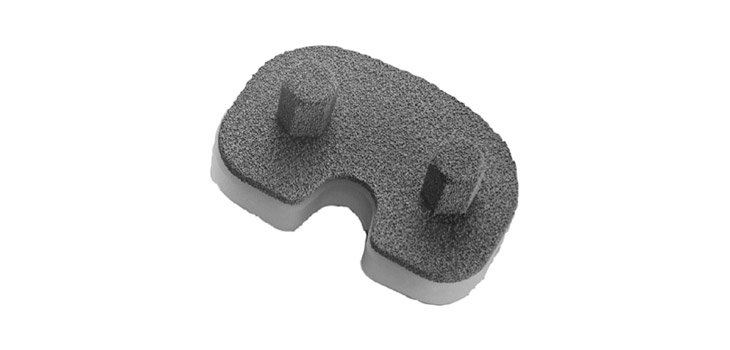
New research from the University of Pennsylvania has found that younger total knee arthroplasty (TKA) patients can do well with a biologic fixation using an uncemented design.
10-Year Follow Up Data for Tantalum in TKA
2 min read Premium comments
#totalkneearthroplastySecondary#tka#tibialfixation
The study, “Uncemented Tantalum Monoblock Tibial Fixation for Total Knee Arthroplasty in Patients Less Than 60 Years of Age: Mean 10-Year Follow-up,” appears in the May 16, 2018 edition of The Journal of Bone and Journal Surgery.
Atul Kamath, M.D. is with the Department of Orthopedic Surgery at the University of Pennsylvania Health System in Philadelphia, Pennsylvania. A co-author on the paper, Dr. Kamath told OTW, “Cemented tibial fixation may be considered the gold standard historically, but we sought to examine the potential for biologic fixation through an uncemented design. This may offer more durable long-term fixation which is important in younger patient populations.”
The authors wrote, “The original cohort included 79 patients (96 knees) who were <60 years old at the time of surgery. All procedures were performed with an uncemented, posterior-stabilized femoral component and a porous tantalum monoblock tibial component by 1 high-volume arthroplasty surgeon at a single institution. Patients were followed prospectively. The Knee Society Score (KSS), radiographic findings, and any complications or revisions were recorded.”
“At the latest follow-up, 76% (60) of the 79 patients (74% [71] of the 96 knees) were available for evaluation or had undergone revision (n = 6); 7 patients had died with the implants in place, and 12 patients were lost to follow-up. The average follow-up for the available implants was 10 years (range, 8 to 12 years). There were no progressive radiolucencies on radiographic review. The mean functional KSS was 68 points (range, 0 to 100 points). All revisions were for reasons unrelated to tibial fixation: femoral component loosening (1), stiffness (1), pain and swelling (2), and instability (2). The all-cause revision rate was 6% (6 of 96 knees).”
Dr. Kamath told OTW, “One of the fastest growing joint replacement populations is the young and active. This study demonstrates the durability of a particular uncemented tibial component prosthesis in a younger group of patients at midterm follow up. From this study, orthopedic surgeons can consider uncemented tibial fixation in the young and active patient with expected excellent results.”
Author
React:
Discussion
This is a fascinating development. In my practice we've seen similar outcomes with the revised protocol. The key differentiator seems to be patient selection criteria. Has anyone else noticed the correlation with BMI thresholds?
Great point. I'd push back slightly on the conclusion, the sample size in the cited study is too small to draw population-level inferences. That said, the directional signal is compelling and worth a larger RCT.
We implemented a similar approach last year. Early results are promising but we're still gathering 12-month follow-up data. Happy to share our protocol if anyone is interested.
Join the conversation
Orthopedic professionals are discussing this. Sign in and upgrade to read every comment and add your voice.