
Mayo Clinic researchers have learned that using a gastrocnemius flap in total knee arthroplasty (TKA) can provide reliable coverage.
10-Year Data for Using Gastrocnemius Flap in TKA
1 min read Premium comments
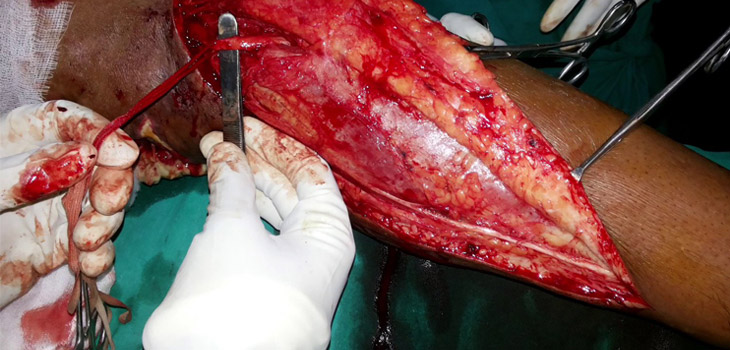
#totalkneearthroplastySecondary#mayoclinic
Their work, “Long-Term Outcomes of Pedicled Gastrocnemius Flaps in Total Knee Arthroplasty,” appears in the May 16, 2018 edition of The Journal of Bone and Joint Surgery.
The authors wrote, “Deficient soft tissue following total knee arthroplasty (TKA) can jeopardize outcome. The gastrocnemius flap is an important means of providing coverage of a knee with deficient soft tissue. There is a paucity of long-term studies on the use of the gastrocnemius flap in the setting of TKA. The purpose of this study was to review the outcomes after the use of pedicled gastrocnemius flaps for coverage of a soft-tissue defect at the time of TKA.”
“Eighty-three patients in whom a gastrocnemius flap had been used to cover the site of a primary (n=18) or revision (n=65) TKA over a 25-year period were identified…. The mean wound size was 49 cm2, and the wound was most commonly located over the anterior aspect of the knee/patellar tendon (n=33)…”
“The 10-year revision and amputation-free survival rates following gastrocnemius flap coverage were 68% and 79%, respectively…. Preoperatively the mean KSSs [Knee Society Scores] for pain and function were 46 and 28, and these scores significantly improved to 78 and 43, respectively, at the time of follow-up.”
Co-author Matthew T. Houdek, M.D. is an orthopedic oncologist with Mayo Clinic in Rochester, Minnesota. Dr. Houdek told OTW, “This was of interest to us because there really weren’t that many studies looking at the use of a gastrocnemius flap to cover total knee wounds, or if there were the series were small.”
“The take home point is that when needed, a gastrocnemius flap provides an excellent means of wound and component coverage, with a limited morbidity to the patient. Likewise, it provides clinicians evidence that once patients have greater than five surgeries on the limb, and the patient has a large wound there is an increased risk of amputation. This should be part of the preoperative conversation with the patient.”
Author
React:
Discussion
This is a fascinating development. In my practice we've seen similar outcomes with the revised protocol. The key differentiator seems to be patient selection criteria. Has anyone else noticed the correlation with BMI thresholds?
Great point. I'd push back slightly on the conclusion, the sample size in the cited study is too small to draw population-level inferences. That said, the directional signal is compelling and worth a larger RCT.
We implemented a similar approach last year. Early results are promising but we're still gathering 12-month follow-up data. Happy to share our protocol if anyone is interested.
Join the conversation
Orthopedic professionals are discussing this. Sign in and upgrade to read every comment and add your voice.