
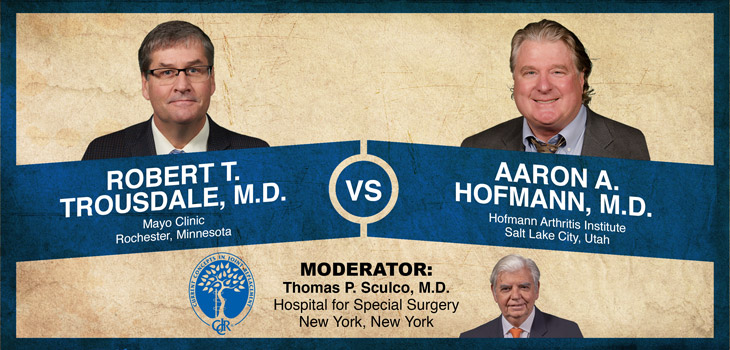
This week’s Orthopaedic Crossfire® debate was part of the 33rd Annual Current Concepts in Joint Replacement® (CCJR®), Winter meeting, which took place in Orlando. This week’s topic is “The Cemented All Poly Tibia in the Active <60 Patient.” For is Robert T. Trousdale, M.D., Mayo Clinic, Rochester, Minnesota. Opposing is Aaron A. Hofmann, M.D., Hofmann Arthritis Institute, Salt Lake City, Utah. Moderating is Thomas P. Sculco, M.D., Hospital for Special Surgery, New York, New York.
Trousdale v. Hofmann: The Cemented All Poly Tibia in the Active < 60 Patient
11 min read Premium comments
Great Debates#cementedallpolytibia
Dr. Trousdale: I’m going to advocate for the use of all polyethylene tibias in young active patients.
Fact #1 with our total knee replacements—at least to date—the best long-term results with fixed bearing knees are with monoblock tibial components…and I’ll share with you a little bit later some data that supports that fact.
And Fact #2, the results of many modular fixed bearing designs have been relatively disastrous and one of the reasons we spend a lot of time talking about osteolysis about total knees. In defense of Aaron, and what I think he’s going to tell you, is that the designs that we’ve got now are probably better than the designs we used in the ‘80s, ‘90s, and maybe early 2000s.
So, what are pros of an all polyethylene tibial component? There are a lot of them I think. You can resect less tibia for the same polyethylene thickness. I think in young, active patients there may be an advantage to that. There’s good data that suggests there’s less osteolysis than with some modular designs. There’s better long-term survivorship than in some modular designs that were used in the ’80s, ‘90s, and early 2000s. There is questionable better loading in the proximal tibia, whether it makes a clinical difference I think is unknown. And there’s no doubt they’re less expensive. That’s important, at least in the United States, and I’m sure where you practice, and the future cost of our total knees is going to be an important issue. So, if you use something cheaper with the same outcome, it may be worthwhile pursuing.
The major negative of an all polyethylene tibial component is you can’t do a poly exchange revision total knee surgery. I would argue that late poly exchanges only apply to a relatively small number of our patients. The outcome of that operation, I think, is a little unpredictable and I would ask you if it’s worth it, given all the negatives of modularity.
Here’s a little bit of data from Chit Ranawat and Jose Rodriguez. Two hundred forty-three (243) Press Fit Condylar cruciate-substituting total knee replacements: One hundred thirteen with titanium baseplates with a modular liner and 130 with all poly tibias in the monoblock design. The seven-year survivorship data with the endpoint of revision and/or osteolysis demonstrates 96% for the all poly monoblock versus 75% for the metal-backed tibias. So, early mid-term follow-up, the all poly clearly wins in this design.
Weber published a study looking at modular and monoblock tibial components, and at intermediate follow-up, the revision rates were lower in the monoblock. The radiolucencies about the tibial component were lower in the monoblock. And the osteolysis rate was 17 times lower in the monoblock tibial component at only 5- to 11-year follow-up.
We recently looked up our experience with a large number of knees, and the all poly tibias had significantly lower risk of revision versus the modular components. And the risk reduction with the all poly was not affected by age, sex or BMI [body mass index].
Across all age groups, even in those patients less than 60 or 65, monoblock had better survivorships than modular total knees except in the very elderly. In the very elderly, the results were the same with the monoblock tibial component or the modular tibial component. The argument to use only an all poly in the elderly is, I think, flawed. Across all BMI groups, except the very heavy patients, the all poly tibia has won. It has better survivorship and in the heaviest patients there was no significant difference.
Additionally, we found that the infection rate was also lower in the all poly design—so, 2.7% of the people developed postop infection. There’s a significantly increased risk for reoperation in the metal-backed group compared to the all poly group with the endpoint of infection. There may be some selection bias here, but there may also be some polyethylene synovitis issues and hyperemia issues that make the all poly a little protective against infection.
So, based on this data, we felt that the all poly tibia had a significantly improved implant survival compared to metal-backed tibias in all age groups except the very old. There is a significantly reduced rate and risk of postoperative infection compared to metal-backed tibias. And there’s a significantly reduced incidence of loosening with all poly versus metal-backed tibias.
Do you need modularity? Sure we do. We need modularity in revision cases. We need modularity in complex primary cases in those patients that have a big deformity. The obese patients. And those patients that have marked ligament problems. You should use modularity. But in the routine total knee, the all poly tibia seems to be a very durable, reliable operation.
So well designed monoblock all poly tibial components are now entering their fifth or sixth decade of use. To date they’ve provided very durable fixation and I continue to use a monoblock, all poly tibia for the majority of my knee patients. And it’s my belief that the benefits of modularity for routine total knee replacement do not outweigh the negatives in the majority of our patients.
Dr. Hofmann: I don’t know if anybody was watching PBS last week, but they had the making of the movie “Frozen” that was actually shot in Rochester, Minnesota. So, things are a little slower there, hard to catch up with what’s going on with the rest of the orthopedic world. All poly tibias, no, modularity yes, versatility yes. That’s what we need.
So, I always have to listen to Dr. Ranawat because I know he’s like probably the smartest guy in the room and I know that he’s written a lot about all poly tibias, so I’m using some all poly tibias. I’ll have to admit that at the beginning here.
We started using metal-backed tibias in the first place to protect the underlying bone.
What about the monoblocks with a metal-back? They’re supposed to be quite good. And they are, at least in the short term, but you know a patient is going to come in with medial wear. Now we’re going to have to cut that thing out instead of just doing a poly change, which would be a 10- to 15-minute operation. That turns into a big deal. Certainly metal-backed tibias are great for bone defects; for poor quality bone. I just think it’s more convenient and it’s easy for insert exchange, which is happening more and more for old guys like me.
My patients are coming back at 20-25 years that have worn out their poly. Certainly modularity was introduced in the ‘80s for those very same reasons. Isolated polyethylene exchange isn’t very popular. Certainly not the right answer early on for a patient that’s having a problem, but long-term patients that have poor poly, especially that was irradiated and is breaking down, it’s easy to change that.
Not all locking mechanisms are the same. Three percent of my patients long-term lost their posterior cruciate and had to have their polyethylene exchanged. One patient, 22 years later, still had the markings on the back of the polyethylene insert so there’s no backside wear, but the top was pretty beat up. And just changing that from a congruent to an ultra-congruent was actually a pretty easy solution, 15-minute operation on a lady that’s 85 years old.
We need modularity if we have bone defects; we can add spacers. If we have old tibial fractures, we can add stems, or longer stems. So, you have the choice of old or new. The first tractor my dad ever bought was in 1952. I loved driving it. I loved driving it in parades, but I leave it parked most of the time and I drive my new Kubota that has a backhoe, it’s got a front-end loader; it’s all wheel drive, so I’d rather drive that tractor most of the time than my Dad’s 1952 Allis-Chalmers. I took a picture of a 1957 Chevy in Cuba last year, and it’s great to look at these old cars, just like it’s good to look at these old knee designs. But my wife would rather drive her 400 Mercedes and I’d rather drive my 550 Mercedes convertible. I like looking at these old things and I wouldn’t mind driving them once in a while, but not every day.
Moderator Sculco: Rob, let’s start with you. Aaron raises a couple of good questions here about all polys. One, how do you speak to the versatility and the modularity of revision?
Dr. Trousdale: I think that’s a valid point. There is a small percentage of our patients that would benefit from isolated poly exchange. And Aaron pointed out very nicely that the patient that fails late rather than early would, but I would argue that’s relatively rare. Most patients’ total knees will last them forever, if they’re over the age of 50 or 60, I think. Secondly, Aaron, we’ve got these things called a saw in Rochester, so if you need to revise an all poly tibia you take a saw to the interface at the cement and burr—it takes about 37 seconds or so. (laughter)
Dr. Hofmann: Can you use a wood chipper? (more laughter) We do that in Fargo.
Dr. Trousdale: The other point that wasn’t brought up is that all poly tibias are a little harder to do for a primary total knee. There are a few nuances of doing an all poly tibia. Once you cement the components, you can’t change them. I would argue that’s a relatively rare event, but it’s a little less versatile, so I couldn’t advocate that you jump in and do the monoblock tibias from the get-go. But once you have Aaron’s level in his career, even he could put in a monoblock tibia component.
Moderator Sculco: What about the weight restrictions? I can remember I did total condylars for years and in young active male patients—heavy—you would see, on occasion, bending of that polyethylene. Has that been an issue at all?
Dr. Trousdale: Dan Berry has a series on heavy set patients. All poly tibias. Survivorship is just fine. Our series looks like it’s pretty good. Having said that…if you look at the patient that’s really heavy set, that’s a patient I’ll probably put a metal-backed tibia with a short stem in. Concerned about? Sure, I go to a metal-backed tray. Having said that, there is good data for giving the heavy-set folks the all polys.
Moderator Sculco: What percent of tibias at Mayo currently are all poly? You’re doing them for primary knees, but is the whole knee group pretty much doing it?
Dr. Trousdale: No, most are modular total knees for sure. There’s a handful of surgeons that do it selectively. I’m probably the biggest user, but other surgeons are doing them okay in selective patients.
Moderator Sculco: The infection rate. Why do you think the infection rate is greater with metal-backed compared to the all polys? Is it debris?
Dr. Trousdale: It’s two reasons. One is patient selection. I think more complex, sicker patients, heavy-set diabetics, maybe; those patients getting the metal-backed. So it may be apples and oranges you’re comparing there. I also think these are designs that were done in the ‘80s and ‘90s and the sterilization method wasn’t that great. And the modularity issues with backside wear causing synovitis and increased infection. If you got a good locking mechanism, which I think we have now, that probably is going to fall off a cliff. That’s probably not going to be an issue.
Moderator Sculco: Aaron, let’s come to you. Cost is a real issue and you can put one of these all poly tibias in and it’s probably $1,000 less than a metal-backed. Rob is showing you outstanding results across the board with all poly tibias, so how can you justify metal-backed in the bulk of your patients?
Dr. Hofmann: A year ago I said I wouldn’t even listen to that argument, but having done 25 in a row in El Salvador last month, they are pretty easy to put in. This isn’t being recorded is it?
Moderator Sculco: You’re doing all polys in El Salvador?
Dr. Hofmann: Yes, in El Salvador, yes. We did a bunch when we were testing the water and they’re actually fun. They’re easy, they’re a little quicker. In that population, I think, in going back to cost, they can’t afford a $4,000-$5,000 total knee, so what are we going to provide to the rest of the world?
Dr. Trousdale: Aaron, is the Kubota tractor that you’ve got cheaper or better than your Dad’s tractor that’s sitting your backyard?
Dr. Hofmann: No, I think with appreciation, I think they are about the same. $5,000 versus $50,000.
Moderator Sculco: What do you think about Rob’s data about infection and failure with the metal-backed tibia? It’s a strong argument for doing all poly tibias.
Dr. Hofmann: Certainly when you get backside wear, you get particles, you get lysis, and there’s more things happening, more dead space, less vascularity, in those cases, that’s some really poor locking mechanisms that we’ve all seen over the years. I think they’re better, but that might explain a higher infection rate.
Moderator Sculco: I noticed also that the results in your older population weren’t as good. You think that a quality of the bone or…
Dr. Trousdale: Yeah, I think that the benefit of the backside wear issues is lost in the elderly patient. I’m different than most people in the very elderly osteopenic patients I’m using the metal-backed tibia and the 60-year-old patients, I’m using the all poly tibia.
Moderator Sculco: So how would you summarize then? I think there’s a real place for all poly tibias. I think we should be using more of them and I don’t know why we’re not. I think industry probably discourages us from using them because the margins are much greater with the metal-backed tibia than the all poly tibia. And I really think all those out there should rethink the use of it if you’re not using all poly tibias to a greater extent. Just as Aaron has. Aaron, comment?
Dr. Hofmann: I’m starting to use it…I think it’s great as a spacer, for example. I do an articulating spacer and I’ve just done a couple for that purpose. Before I would never think about doing that, but it does save the hospital a significant amount of money.
Moderator Sculco: Okay, so I think we have good arguments on both sides and certainly the all poly tibia is something to think about going forward. Aaron raises good questions about its versatility in the long-run and particularly in the revision situation. Thank our two debaters. I think they did a great job.
Please visit www.CCJR.com to register for the 2018 CCJR Spring Meeting, – May 20 – 23 in Las Vegas.
Senior Editor: Jay D. Mabrey, M.D., whose 35 year career in orthopedics included residency at Duke University Medical Center, service in the United States Army Medical Corps, Fellowship at the Hospital for Special Surgery and a long, distinguished career at Baylor University Medical Center where, in addition to his overall leadership at that institution, developed the Joint Wellness Program that helped patients get up after surgery more quickly, developed the first virtual reality surgical simulator for knee arthroscopy and chaired the FDA Orthopaedic Device Panel, is Orthopedics This Week’s newest contributing writer and editor.
Author
React:
Discussion
This is a fascinating development. In my practice we've seen similar outcomes with the revised protocol. The key differentiator seems to be patient selection criteria. Has anyone else noticed the correlation with BMI thresholds?
Great point. I'd push back slightly on the conclusion, the sample size in the cited study is too small to draw population-level inferences. That said, the directional signal is compelling and worth a larger RCT.
We implemented a similar approach last year. Early results are promising but we're still gathering 12-month follow-up data. Happy to share our protocol if anyone is interested.
Join the conversation
Orthopedic professionals are discussing this. Sign in and upgrade to read every comment and add your voice.