
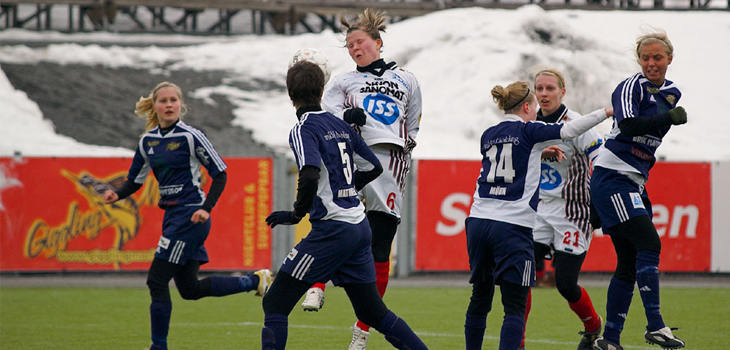
While most sports-related brain injury research has focused on head impact during collisions, a study published in Frontiers in Neurology, “Heading Frequency Is More Strongly Related to Cognitive Performance than Unintentional Head Impacts in Amateur Soccer Players,” from researchers at Albert Einstein College of Medicine located in Bronx, New York, suggest that it is not accidental head collisions, but intentional and frequent ball heading that cognitively impairs players.
Soccer Headings Not Collisions Cognitively Impairs Players
2 min read Premium comments
Secondary#soccerheading#cognitivedamage#braininjury
“Unintentional head impacts are generally considered the most common cause of diagnosed concussions in soccer, so it’s understandable that current prevention efforts aim at minimizing those collisions,” Michael Lipton, M.D., Ph.D., F.A.C.R., professor of radiology and of psychiatry and behavioral sciences at Einstein and medical director of MRI Services at Montefiore said in a press release.
“But intentional head impacts—that is, soccer ball heading—are not benign. We showed in a previous study (“Symptoms from repeated intentional and unintentional head impact in soccer players” published in Neurology) that frequent heading is an underappreciated cause of concussion symptoms. And now we’ve found that heading appears to alter cognitive function as well, at least temporarily.”
According to the release, while heading has previously been associated with some cognitive problems, this study is the first to compare the cognitive effects of repetitive heading to the effects of head collisions.
For this study, Lipton and his colleagues recruited 308 amateur soccer players in New York City and asked them to fill out questionnaires on their soccer activity for the previous two weeks including headings and collisions. The soccer players were also asked to complete neuropsychological tests on verbal leaning, verbal memory, psychomotor speed, attention and working memory. The age range for players was between 18 and 55, and 78% of them were male.
According to the data collected, the players headed soccer balls around 45 times during the study period and during that time, approximately, one-third of the players also suffered at least one head collision, whether it was a kick to the head, a head to head collision or a head to ground collision.
Interestingly, the players who did the most headings had the weakest performance on psychomotor speed and attention tasks. They also had poorer performance on the working memory task, although the correlation was of borderline significance. The head collisions, on the other hand, were not associated with any aspect of cognitive performance.
While there seemed to be no obvious clinical impairment associated with the changes in cognitive function, Lipton said, “…we’re concerned that subtle, even transient reductions in neuropsychological function from heading could translate to microstructural changes in the brain that then lead to persistently impaired function. We need a much longer-term follow-up study of more soccer players to fully address this question.”
Lipton advises that soccer players need to be encouraged to limit heading during practice and games. He said, “Heading is a potential cause of brain injury and since it’s under control of the player, its consequences can be prevented.”
Author
React:
Discussion
This is a fascinating development. In my practice we've seen similar outcomes with the revised protocol. The key differentiator seems to be patient selection criteria. Has anyone else noticed the correlation with BMI thresholds?
Great point. I'd push back slightly on the conclusion, the sample size in the cited study is too small to draw population-level inferences. That said, the directional signal is compelling and worth a larger RCT.
We implemented a similar approach last year. Early results are promising but we're still gathering 12-month follow-up data. Happy to share our protocol if anyone is interested.
Join the conversation
Orthopedic professionals are discussing this. Sign in and upgrade to read every comment and add your voice.