
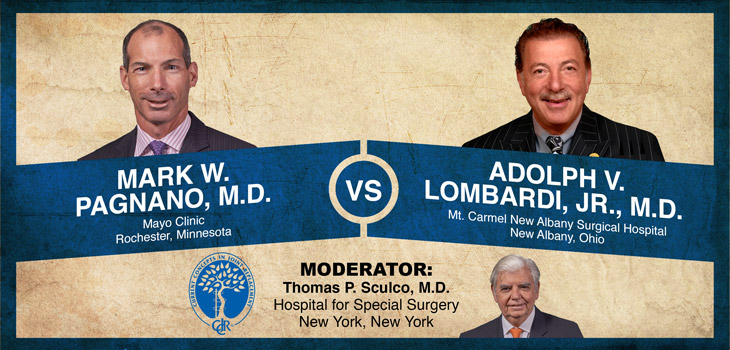
This week’s Orthopaedic Crossfire® debate was part of the 33rd Annual Current Concepts in Joint Replacement® (CCJR®), Winter meeting, which took place in Orlando. This week’s topic is “The Bi-Cruciate Retaining Knee: A Bridge Too Far.” For is Mark W. Pagnano, M.D., Mayo Clinic, Rochester, Minnesota. Opposing is Adolph V. Lombardi, Jr., M.D., Mt. Carmel New Albany Surgical Hospital, New Albany, Ohio. Moderating is Thomas P. Sculco, M.D., Hospital for Special Surgery, New York, New York.
Pagnano v. Lombardi: The Bi-Cruciate Retaining Knee: A Bridge Too Far
8 min read Premium comments
Great Debates#adolphlombardi#bicruciateretainingknee#markpagnanomd
Moderator Sculco: This debate is sort of a throw-back topic. We’re going to talk bi-cruciate total knee replacement. And, we have an all Italian panel here. Pagnano, Lombardi and Sculco—with Mark Pagnano taking the negative side of using the bi-cruciate.
Dr. Pagnano: Thanks very much Tom. It is a pleasure to discuss the bi-cruciate retaining total knee replacement—which remains a bridge too far.
You and I as surgeons certainly want to make knee replacement operations reliable, reproducible and durable as we alleviate pain and improve function for our patients whether we use total knee replacement or partial knee replacement.
Total knee replacement, thankfully, has proved quite durable over the last several decades. Some implants do a little bit better. Some surgeons and institutions do a little bit better. But overall knee replacement is a durable operation.
In the last five years, much of the focus in the academic circles has shifted to function after total knee replacements with an interest in eliminating the so-called satisfaction gap, recognizing that some percentage of total knee replacement patients are not quite satisfied with their knee.
Surgeons have many thoughts on how to improve that function. Some focus on alignment. Better alignment goals and whether enabling technology like navigation or robotics might help. Others focus on advanced ligament balancing concepts, like sensor/tensor devices. We’re here to discuss ACL [anterior cruciate ligament] and PCL [posterior cruciate ligament] preserving total knees. And at the other end of the design spectrum are implants that provide guided motion, like ACL/PCL substituting total knee replacements.
Bi-cruciate retaining total knee replacement is conceptually appealing. Its appeal typically comes from references to the uni-compartmental knee. With the uni-compartmental knee, we know you can see better motion, quicker recovery, and movement closer to normal kinematics. Many surgeons assume that is because you save the ACL and the PCL. There’s no doubt that is happening. But in a uni-compartmental knee, things are markedly different than an ACL/PCL preserving total knee.
I think it’s a logical fallacy to assume that an ACL/PCL retaining total knee replacement will approximate the results of a uni-compartmental knee. A uni is really much, much less than one-third of a total knee replacement.
Think about the complex three-dimensional architecture of a knee, the joint contour, the trochlea, the transition zones, the offset. In a uni-compartmental knee, the only thing you’re changing is the joint surface. All other factors stay the same.
As soon as we switch to a total knee replacement, every one of those complex three-dimensional architecture elements is going to change.
Some have already recognized this (Saxena et al, Knee 2016) and are working on 3-D MRI analysis that looks at the tibia and shows that due to the highly variable proximal tibial topography, a monoblock, bi-cruciate baseplate is not likely to reproduce normal anatomy.
I’m sure Dr. Lombardi will review some of the retrospective data. Cloutier has a long-term follow-up of his individual series and showed the survivorship about the same as a standard total knee. And Pritchett had some data on bi-cruciate versus posterior cruciate retaining knees. Again, similar survival and a little bit of a preference for a bi-cruciate in some of the patients.
The current data (Christensen & Peters, CORR 2016) show that there is a higher frequency of reoperation with the new design—300 cruciate retaining versus 80 bi-cruciate. There was not better range of motion, patient-reported outcomes, or physical function.
In the big series that included Dr. Lombardi’s initial experience (Della Valle et al., AAOS 2015)—383 patients—there were some clear problems in the first group of 120 cases, including 9% incidence of bone island fracture.
To summarize in one line—BCR has overpromised and underdelivered to date. I think bi-cruciate is a step too far and yet not far enough. It’s technically demanding enough to cause a substantial learning curve. And further, there is no demonstrable clinical benefit in regard to range of motion, patient-reported outcomes, or physical function.
If you want to do a reliable bi-cruciate, do a uni-compartmental knee replacement. And if you want to do a better total knee replacement in 2017, you’d be better off to pick one of these different technologies (sensor technology for balancing or robotics).
Moderator Sculco: Adolph, tell us why we should go back to using bi-cruciate retaining knees.
Dr. Lombardi: As Mark has outlined, a uni is sometimes a better operation than a total knee and the reason for that is maintenance of the cruciate mechanism which sort of feels a little better. As we look at the literature, we find the ACL present in many of the knees that we do—papers have reported 61%, 78%, up to 82%.
We looked at a series of our patients, 2,317, and found the ACL normal in 53% and present but abnormal in 28%. One of the interesting things is when we looked at our clinical results, the range of motion improvement was better when it was absent than when it was intact.
The Knee Society pain was better when it was absent than when it was intact. The clinical improvement was better when it was absent than when it was present and intact. And the function was better. This was the impetus for relooking at the old types of designs and seeing if we could actually do something a little different.
To-date 5,000 Vanguard XP bi-cruciate-retaining devices have been implanted globally. It has done what we intended it to do. But with mixed results.
One new complication that I haven’t seen with a PS [posterior stabilizing] or CR [cruciate retaining] knee is this cyclops lesion that some people frequently see when they do ACL reconstruction. There have been a couple of cases reported.
But our biggest problem has been some tibial loosening and quite frankly it comes from very poor cementing technique and I have been a victim of that myself.
To date, 5,020 have been implanted; 91 revisions for a 1.8% overall revision rate. And there have been some reoperations to take care of the cyclops lesion, resurface the patella and arthroscopic lysis lesions as well as some others. As far as ACL rupture, only one of those. There has been some arthrofibrosis though, 11 of those, and our biggest has been tibial loosening, 46.
Clinical studies…an RSA/RCT [radiostereometric analysis/random controlled trial] by Professor Anders Troelsen comparing this Vanguard XP to a CR knee—25 in each group—and he does the fixation in two stages. He has had one revision for fracture. Two operations for re-manipulation for a patient who apparently felt his range of motion was unacceptable. Overall, his clinical results are equal to the CR. His outcomes database shows that they’re similar, both the Oxford score and the Forgotten Knee Score…they’re doing as well.
Appropriate follow-up studies have been done by Professor Tibesku as well as looking at some other data. No differences between the medial uni and the bi-cruciate total knee, but the PS knees were actually worse than both.
The early clinical data reflects variations in outcomes. Implant stability is achievable based on RSA, but I think requires a meticulous cementation process.
I would say, in summary, my patients report that they do feel good, it does feel stable, and I’m proceeding with vigor, enthusiasm and a sense of optimism.
Moderator Sculco: Okay, so Mark…you’re a kinematic kind of guy. Does this then have some appeal to you that perhaps the kinematics—if the kinks are worked out—could make it a better knee?
Dr. Pagnano: Well I think that’s why I started with the presumption that it is conceptually appealing. There’s no mystery if you can save the ACL and PCL that’s at least one step closer potentially to getting better knee kinematics.
It’s just that the whole three-dimensional architecture of the knee becomes so distorted as soon as you switch to a total knee design.
Again, where you’re trying to make an incremental gain in function, you have to weigh that against the potential that you can have some short-term catastrophic problems. That’s my problem right now with bi-cruciate as it currently stands.
Moderator Sculco: So, Adolph, tell us a little bit more about the technique and your patient selection because balancing the cruciates—anterior or posterior—is involved in the deformity. So how technically difficult is it to do this well?
Dr. Lombardi: First of all, the indication is going to be the patient that, in my hands, I can’t do the uni on. These are minimal deformity and correctible usually. This is the type of patient that I’m approaching with a bi-cruciate.
As far as balancing these knees, it’s really a resurfacing technique. You’re removing that amount of bone and putting back with the metal and plastic. Another nice feature is you can put a different thickness medial versus lateral because they are separate components. We do that to catch up with a bit of that lateral laxity instead of releasing on the medial side.
You can take this one step further if you decide you haven’t taken enough bone and it’s too tight, the first thing that goes is the anterior cruciate ligament. At that point you can switch to a tibial tray that has a keel and you can use different bearings on either side and even a more stabilized bearing, let’s say, on the medial side if you want a not as stabilized bearing on the lateral side.
Moderator Sculco: Mark, as you look to the future where do you see us potentially moving to advance the state of what we’re doing in design and knee replacement? Do you see us in an area where we could be much better than we are?
Dr. Pagnano: We’re probably, from an implant design standpoint, fairly close to the asymptote of what we can do. Anything further runs the risk of introducing unforeseen problems.
We’re probably pretty close to the peak as far as implant design goes. And I think more of the potential impact on improving function and patient satisfaction is going to come from surgical technique and finding for groups of patients or for individual patients, what is a better target.
If hitting that target is very, very important, then using some type of enabling technology to hit that target whether that’s navigation or robotics or some other imaging modality.
That’s where I think the next step comes.
Moderator Sculco: Let’s get a big round of applause and Bon Natale.
Please visit www.CCJR.com to register for the 2018 CCJR Winter Meeting, – December 12 – 15 in Orlando.
Senior Editor: Jay D. Mabrey, M.D., whose 35 year career in orthopedics included residency at Duke University Medical Center, service in the United States Army Medical Corps, Fellowship at the Hospital for Special Surgery and a long, distinguished career at Baylor University Medical Center where, in addition to his overall leadership at that institution, developed the Joint Wellness Program that helped patients get up after surgery more quickly, developed the first virtual reality surgical simulator for knee arthroscopy and chaired the FDA Orthopaedic Device Panel, is Orthopedics This Week’s newest contributing writer and editor.
React:
Discussion
This is a fascinating development. In my practice we've seen similar outcomes with the revised protocol. The key differentiator seems to be patient selection criteria. Has anyone else noticed the correlation with BMI thresholds?
Great point. I'd push back slightly on the conclusion, the sample size in the cited study is too small to draw population-level inferences. That said, the directional signal is compelling and worth a larger RCT.
We implemented a similar approach last year. Early results are promising but we're still gathering 12-month follow-up data. Happy to share our protocol if anyone is interested.
Join the conversation
Orthopedic professionals are discussing this. Sign in and upgrade to read every comment and add your voice.