
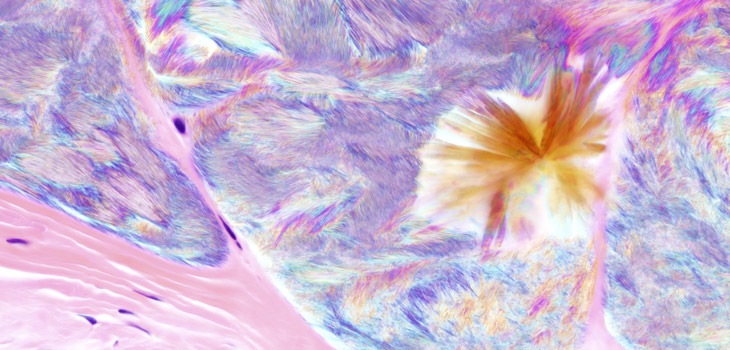
Using a large primary care database, Keele University researchers have determined that patients with the inflammatory arthritis condition that often occurs in the big toe—gout—were not at an increased risk of fracture.
New Study: Gout May Not Increase Fracture Risk
2 min read Premium comments
Secondary#fragilityfracture#knee#arthritis#gout
Their work, “Risk of fragility fracture among patients with gout and the effect of urate-lowering therapy,” was published in the May 14, 2018 edition of CMAJ. According to the researchers this is different from prior research which found a higher risk of fracture in people with gout.
The authors had looked at gout patients over a 14-year period of time (1990 to 2004) and then continued to track their progress until 2015. They then matched the patients to four controls based on age, sex and general practice.
According to the authors; “We calculated absolute rate of fracture and hazard ratios (HRs) using Cox regression models. Among patients with gout, we assessed the impact of urate-lowering therapy on fracture, and used landmark analysis and propensity score matching to account for immortal time bias and confounding by indication. We identified 31,781 patients with incident gout matched to 122,961 controls. The absolute rate of fracture was similar in both cases and controls (absolute rate=53 and 55 per 10,000 person-years, respectively…”
Zoe Paskins, Ph.D., with the Arthritis Research UK Primary Care Centre at Keele University in Staffordshire, UK, told OTW, “We know that rheumatoid arthritis, a common form of inflammatory arthritis, is associated with an increased risk of sustaining a fracture. This means patients with rheumatoid arthritis should have a ‘fracture risk assessment’ to assess their individual risk and see if they need treatment to reduce their risk of breaking a bone.”
“However, for many other common inflammatory conditions, the association with fracture is not established. This is important as we need to know if patients with other conditions should be having fracture risk assessments. Specifically, gout was of interest to us as it is the most common type of inflammatory arthritis. Several studies have examined the risk of fracture in patients with gout, but all concluded different things.”
“Our study uses information from a very large primary care database and finds there is no increased risk of fracture in patients with gout. This means researchers can now focus on other possible risk factors for fracture and that patients with gout can be reassured.”
Author
React:
Discussion
This is a fascinating development. In my practice we've seen similar outcomes with the revised protocol. The key differentiator seems to be patient selection criteria. Has anyone else noticed the correlation with BMI thresholds?
Great point. I'd push back slightly on the conclusion, the sample size in the cited study is too small to draw population-level inferences. That said, the directional signal is compelling and worth a larger RCT.
We implemented a similar approach last year. Early results are promising but we're still gathering 12-month follow-up data. Happy to share our protocol if anyone is interested.
Join the conversation
Orthopedic professionals are discussing this. Sign in and upgrade to read every comment and add your voice.