
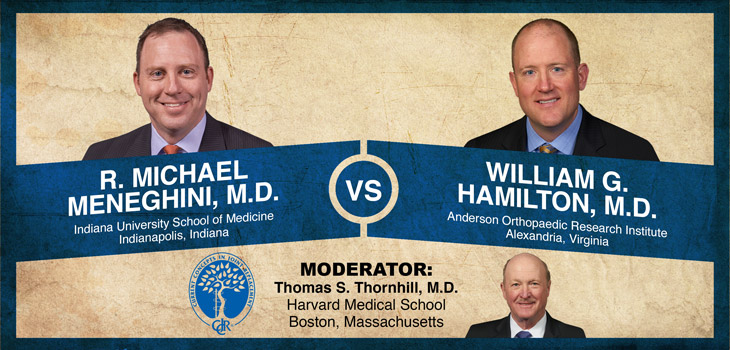
This week’s Orthopaedic Crossfire® debate was part of the 18th Annual Current Concepts in Joint Replacement® (CCJR®), Spring meeting, which took place in Las Vegas. This week’s topic is “Posterior Stabilized Knee Designs: Vestigial Organs.” For is R. Michael Meneghini, M.D., Indiana University School of Medicine, Indianapolis, Indiana. Opposing is William G. Hamilton, M.D., Anderson Orthopaedic Research Institute, Alexandria, Virginia. Moderating is Thomas S. Thornhill, M.D., Brigham and Women’s Hospital, Boston, Massachusetts.
Meneghini v. Hamilton: Posterior Stabilized Knee Designs: Vestigial Organs
9 min read Premium comments
Great Debates#posteriorstabilizedknee#vestigialorgans
Dr. Meneghini: So, my charge is defending the position that posterior stabilized designs are a vestigial organ.
This was a classic debate—as a medical student, resident, early in my practice—it was awesome to watch the greats fight back and forth over keeping the PCL [posterior cruciate ligament].
Why did that debate fade away?
Probably because there has been no clear advantage over cruciate-retaining or posterior-stabilized designs based on the literature; the pros and cons were largely theoretical. We focused on survivorship, and the metrics weren’t sensitive enough to determine a difference…so why are we bringing the debate back?
I would argue that newer tibial inserts with enhanced sagittal conformity (anterior-lipped) designed to substitute for the PCL, render the post-cam obsolete.
The definition of a vestigial organ is a structural organism that has lost all or most of its original function in the course of evolution. And we have evolved in total knee replacement.
There are two fundamental arguments: one is intuitive and one scientific/data-driven. The first argument comes from the observation that the native knee is elastic and fluid. Therefore, it makes little intuitive sense to put a cam and a post in a native knee. Nothing in the human body likes robust or articular constraining devices. So, I would argue that nothing external or internal in the knee really likes slamming into a post.
Why put that inside the knee?
The second argument is based on the post-cam mechanism. There is wear and impingement and fractures across all designs and that is all over the literature. Patella clunk is an issue; condylar fracture (depending on the size of the box, which we’ve seen in other designs) and so forth.
So now let’s look at the science. My debate partner takes out the cruciate ligament on every knee, so we decided to examine them. We found no difference in any functional outcomes between those patients without a PCL whether you replace it with a cam and post or a sagittally conforming polyethylene insert like an anterior lipped.
Brian Parsley, et al., reported the exact same finding over a decade ago, with over 200 knees, in all without the PCL with either an anterior lipped ultracongruent insert or a cam and a post.
In an elegant prospective randomized study presented at AAHKS a few years ago and subsequently published, David Scott of Washington looked at 56 knees with posts and 55 knees with an anterior-lipped insert, all without the PCL. There were no functional outcome differences at two years.
From the Australian registry, at 14 years there is a clear difference between survivorship and revision rates in cruciate-retaining versus posterior stabilized TKAs, with cruciate-retaining having a distinct advantage.
Well, you say, Australia has their patellar resurfacing so that might confound those results. If break that out, the lowest revision rate is a cruciate-retaining knee with a patella resurfaced. What is by far the worst: if you don’t resurface the patella you better not use a cam and post because that has significantly higher revision rates than the others.
Finally, patient satisfaction.
We looked at about 600 modern primary total knee replacements of the same design—one surgeon using cruciate-retaining, one surgeon using a cam and post mechanism. The only finding that we could determine in all of the metrics was the surgeon and implant.
The surgeon who used cruciate-retaining implants had 92% “satisfied” or “very satisfied” in that large group of patients; the surgeon who used a cam and a post had 81% “satisfied” or “very satisfied”—pretty much what we quote now at the norm of 20% being unsatisfied.
Let’s look at the technological advances. We now see that highly cross-linked polyethylene in the knee is showing improved survivorship, but why subject it to its Achilles heel, which is fatigue failure of the post.
In summary, the emergence of anterior-lipped cruciate-retaining implants provides a factor of safety and, I believe, obviates the need for any sort of cam-post mechanism in total knee replacement.
I do believe surgical technique remains critical; the knee must be balanced in flexion no matter what articulation you use.
Healthcare reform mandates that we control costs, which may be in the form of inventory reduction. Currently there is no scientific evidence to support a cam and post mechanism to replace PCL in a modern total knee replacement—either intuitively or scientifically.
Dr. Hamilton: My disclosures: I am biased towards PS [posterior-stabilized] knees. I was raised in New York and that’s the home of the PS total knee design. I subsequently did my training in Philadelphia where I had giants like Bob Booth and Paul Lotke who were strong PS influences on my implant use and I have used PS knees throughout my entire career.
Let me tell you why not to use a PCL-retaining TKA [total knee arthroplasty].
First, the PCL is not normal in an arthritic knee. A histologic study done over 20 years ago showed that once the knee becomes arthritic the PCL does not function normally.
Secondly, the PCL does not function normally in the absence of an ACL [anterior cruciate ligament]. The concept of the 4-bar linkage where one ligament works in concert with the other simply does not function appropriately, and this is now a 40-year-old concept.
PCL excision helps correct severe deformities in soft tissue balancing. It’s a portion of the procedure that actually helps me get to my end goal. The concept of femoral rollback is important, especially for improved range of motion (ROM). PCL retention does not allow to femoral rollback to reliably occur, which has been shown through fluoroscopic studies over a generation—primarily in the lab of Doug Dennis and Rick Komistek.
And there is the concept of anterior paradoxical motion where the femur rides anterior on the tibia, which is the opposite of what it’s supposed to do. Fluoroscopic studies have shown us this…that as the knee comes into flexion instead of rolling back, the femur will run anterior…and in deep flexion you get impingement of the polyethylene and subsequent loss of ROM.
PCL designs over time have evolved to increase conformity in response to the round-on-flat design. More curved implants, unfortunately, lead to this kinematic conflict where in deep flexion as the femoral bearing rides up on the posterior lip it tightens the PCL (maybe another reason why PCL-retaining knees don’t seem to flex quite as well).
The result there, and the solution for these surgeons, is to just go ahead and cut the PCL. But that is counterintuitive to the argument that it is seemingly important. But if you over-release the PCL it can lead to unfavorable AP laxity. Maybe by giving us an insert with increased conformity it can help to combat that…basically returning to the days of the total condylar where you resect both ligaments and put in a conforming insert. Not that the total condylar knee didn’t work; it did quite well. But there were many things in the 1970’s that I’ve aborted that simply work better today.
What are the most common reasons for revision? We’ve seen this time and time again in multiple publications: instability of the knee. There are multiple ways the knee can become unstable (varus/valgus), but I believe that AP instability in the PCL retaining knee is one of the more common reasons that these are revised.
As Mike mentioned, the PS knee does have its issues historically. I would argue, however, that improved designs and technique are minimizing those. Patellar clunk and crepitus have been the Achilles heels of PS knees for a generation. However, with improved designs, such as a blended PS box transition extending the trochlear groove, I think we’re seeing a significant reduction in complications.
As for clinical outcomes, a Cochrane database review that was not biased (like some of the studies Mike quoted from his partners), a 2013 study of 17 randomized studies showed very similar results across the board. The only difference was that PS knees had better flexion and higher functional Knee Society Scores by small margins. But if I am choosing between two implants, I think as a tiebreaker, I’ll take the one that moves better and has better function.
In summary, I agree that clinical performance is good with both PS and cruciate-retaining knees. I believe the PS knee leads to more reproducible femoral rollback and knee kinematics, and better range of motion. Complications such as fracture, clunk and crepitus, and post failure can be minimized with improved technique, materials, and design.
Moderator Thornhill: Mike, do you use flat-on-flat knees?
Dr. Meneghini: No, I do not.
Moderator Thornhill: I don’t either. Do you remove the PCL with a CR knee?
Dr. Meneghini: I do not.
Moderator Thornhill: OK, good. John Insall said he thinks that the post in a PS knee—and Bill I’d like you to comment on this—is there for a period of time during the first healing of the soft tissues. You don’t continue to have function from the post after a period of time. Do you think the post always functions after the soft tissues? Or does it teach the soft tissues to get the memory of the PS motion?
Dr. Hamilton: Good question. I’m not sure I know the definitive answer, but I think that based on the studies from Doug and Rick Komistek’s lab, that the post does provide consistent kinematics, allowing rollback not just in the early going, but even beyond. So, I do believe it retains some form of function.
Moderator Thornhill: Mike, do you balance the PCL? How?
Dr. Meneghini: Release it off the femur or the tibia, either way. The key is to leave the OR with a well-balanced knee. The second thing is that we spent a lot of time years ago and as a med student, resident, and early faculty listening to the debates of rollback and anterior paradoxical translation. None of that was ever correlated to clinical outcomes. I don’t want to discredit the work that Rick and Doug did, but the gap is that it was never correlated to clinical outcomes and I think that’s a step we have to take. The registry data provides a powerful testament to adding more mechanical congruity into our body and I’m not sure that’s the right answer. I think we do need to evolve for the reasons I outlined.
Moderator Thornhill: Bill, could you live with not using a cam-post but sacrificing the PCL and using a more conforming insert like a deep dish?
Dr. Hamilton: I think so. There are certainly people who are moving towards that direction. I have a junior partner from Philadelphia and what they have taken to doing is cutting the PCL in all patients and using one of these highly congruent inserts and it seems that clinical outcomes are quite similar. That doesn’t make a ton of sense to me because that’s probably giving you the least rollback of all situations, and I think rollback is what God designed and what helps to facilitate deep flexion. While the clinical outcomes seem similar it’s probably because our measurement tools are not sensitive enough to figure those differences out. As long as you put the knee in well and balance it well you can probably get good outcomes with that approach.
Moderator Thornhill: Great debate. I appreciate both of you.
Please visit www.CCJR.com to register for the 2018 CCJR Winter Meeting, – December 12 – 15 in Orlando.
Senior Editor: Jay D. Mabrey, M.D., whose 35 year career in orthopedics included residency at Duke University Medical Center, service in the United States Army Medical Corps, Fellowship at the Hospital for Special Surgery and a long, distinguished career at Baylor University Medical Center where, in addition to his overall leadership at that institution, developed the Joint Wellness Program that helped patients get up after surgery more quickly, developed the first virtual reality surgical simulator for knee arthroscopy and chaired the FDA Orthopaedic Device Panel, is Orthopedics This Week’s newest contributing writer and editor.
Author
React:
Discussion
This is a fascinating development. In my practice we've seen similar outcomes with the revised protocol. The key differentiator seems to be patient selection criteria. Has anyone else noticed the correlation with BMI thresholds?
Great point. I'd push back slightly on the conclusion, the sample size in the cited study is too small to draw population-level inferences. That said, the directional signal is compelling and worth a larger RCT.
We implemented a similar approach last year. Early results are promising but we're still gathering 12-month follow-up data. Happy to share our protocol if anyone is interested.
Join the conversation
Orthopedic professionals are discussing this. Sign in and upgrade to read every comment and add your voice.