
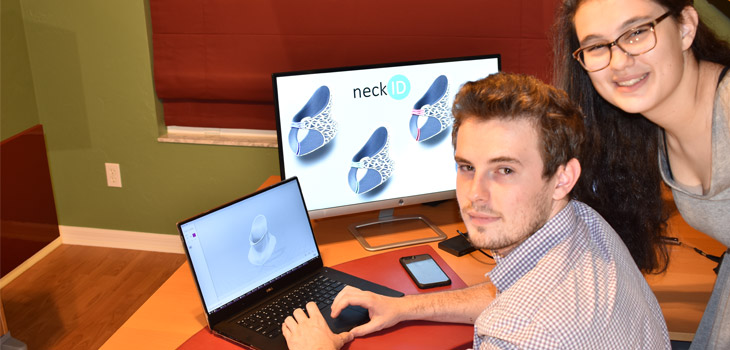
Mailys and Pierre Angibaud know how frustrating treatment for a neck injury can be. That was what inspired them to team up to create neckID, a personalizable neck brace.
Brother and Sister Team Up to Create neckID
2 min read Premium comments
Secondary#neckbrace#neckid#neckinjury
Their invention was born out of personal experiences with the frustrating limitations of current neck braces. When they were in a car accident together in 2016, they noticed that they were both given the same exact neck brace despite their different body types.
“Since we were in the car together we just assumed we had similar injuries and that is why we were give identical neck braces,” Pierre Angibaud told OTW.
“But then a year later, our mom was in a car accident where her car was t-boned. And despite her more serious injuries and the fact that she is of shorter stature, she was given the exact same brace that we had.”
He added, “All of us found the neck brace uncomfortable and had to make different modifications to it. And our mom never got better from her injuries. In fact, the pain she felt from wearing an ill-fitted neck brace ended up being worse than the pain from her actual injuries.”
Unfortunately, the size and structural options available for common cervical collars is very limited and are not tailored to specific patients’ needs. So one day at lunch Mailys, 16, and Pierre, 19, and their mom were talking about 3D printing casts for broken arms and they came with the idea to do something similar with neck braces.
To get a better feel for what physicians and physical therapists need for their patients, they talked to the medical staff who had treated them after their accidents. And they came up with neckID, a personalizable neck brace that not only fits each patient more comfortably, but also has an individualized structure to better treat specific injuries. Pierre has been using a CAD (computer-aided design) model to create their neck brace. The way their technology works is that first a 3D scan is done on the patient and then the scan and information provided on a personalization form are used to create a neck brace that fits the exact measurements and needs of the patient.
Right now they are working on getting a manufacturer to help them print out examples of the neck brace and hope to have a prototype ready soon.
The Angibaud’s live in Gainesville, Florida. Pierre works on the technical side of things including the neckID design and development, while Mailys is responsible for the patent process and the writing for their website.
For more information, visit their website: https://pierreangibaud64.wixsite.com/neckid
Author
React:
Discussion
This is a fascinating development. In my practice we've seen similar outcomes with the revised protocol. The key differentiator seems to be patient selection criteria. Has anyone else noticed the correlation with BMI thresholds?
Great point. I'd push back slightly on the conclusion, the sample size in the cited study is too small to draw population-level inferences. That said, the directional signal is compelling and worth a larger RCT.
We implemented a similar approach last year. Early results are promising but we're still gathering 12-month follow-up data. Happy to share our protocol if anyone is interested.
Join the conversation
Orthopedic professionals are discussing this. Sign in and upgrade to read every comment and add your voice.