
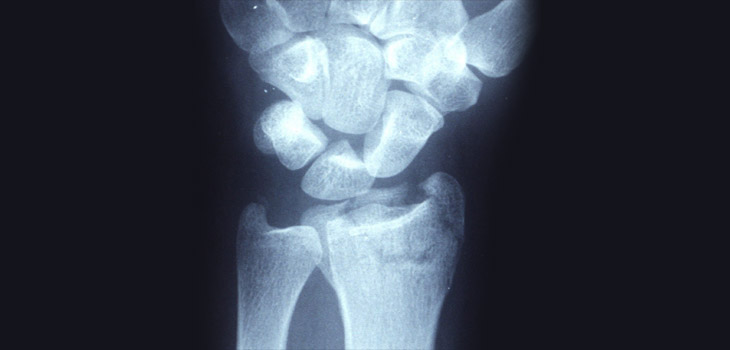
New work from Sweden collected 12-14 year follow up data on distal radial fracture malunions and their impact on quality of life.
12-14 Year Follow-Up Data for Distal Radial Malunions
2 min read Premium comments
Secondary#distalradialfracture#wrist#malunion
The study, “Association Between Distal Radial Fracture Malunion and Patient-Reported Activity Limitations: A Long-Term Follow-up,” appears in the April 18, 2018 edition of The Journal of Bone & Joint Surgery.
Co-author Muhanned Ali, M.D. with the Department of Orthopedics, Kristianstad and Hässleholm Hospitals in Sweden told OTW, “Fracture of the distal radius is the most common arm fracture. The incidence increases continuously with age in both women and men. However, because of the strong association with osteoporosis, the fracture is more frequent among women. The socioeconomic burden for the individual and society is substantial.”
“Surprisingly, there is still no practice conformity for treating such a common injury. Although almost all fractures heal irrespective of how they are treated, the type of treatment is often important with regard to whether the fracture heals in a good position or with deformity. Before our study there was little knowledge about the long-term consequences of fracture healing without or with deformity. Many clinicians believed that even if the fracture heals with deformity, especially among the elderly, it would not matter in the long term, that is to say it does not matter how you treat the fracture.”
“We therefore decided to study whether people who had a fracture that healed with deformity have, in the long term, more pain and difficulties in using their hand in daily activities compared to people whose fractures healed without deformity.”
“At 12 to 14 years after a distal radius fracture, people whose fractures had healed with deformity were more limited in their daily activities, had more pain and were less satisfied with how their arm functioned compared to people whose fractures had healed in a good position without deformity.”
“The goal of treatment should be to achieve fracture healing in a good position without deformity. Treatment methods that have a higher likelihood of achieving this goal should be used, provided that the treatment method does not cause complications that outweigh the benefit.”
“Patients 18 to 65 years of age who sustain a distal radial fracture that heals with deformity (malunion) are more likely to have worse long-term outcomes including activity limitations and pain.”
Author
React:
Discussion
This is a fascinating development. In my practice we've seen similar outcomes with the revised protocol. The key differentiator seems to be patient selection criteria. Has anyone else noticed the correlation with BMI thresholds?
Great point. I'd push back slightly on the conclusion, the sample size in the cited study is too small to draw population-level inferences. That said, the directional signal is compelling and worth a larger RCT.
We implemented a similar approach last year. Early results are promising but we're still gathering 12-month follow-up data. Happy to share our protocol if anyone is interested.
Join the conversation
Orthopedic professionals are discussing this. Sign in and upgrade to read every comment and add your voice.