
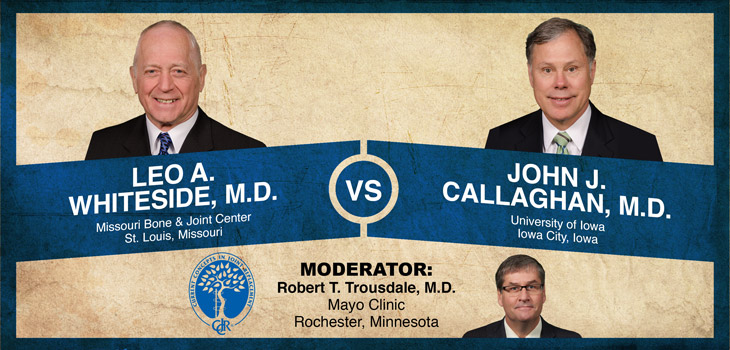
This week’s Orthopaedic Crossfire® debate was part of the 33rd Annual Current Concepts in Joint Replacement® (CCJR®), Winter meeting, which took place in Orlando. This week’s topic is “The Cementless TKA: It’s About Time” For is Leo A. Whiteside, M.D., Missouri Bone & Joint Center, St. Louis, Missouri. Opposing is John J. Callaghan, M.D., University of Iowa, Iowa City, Iowa. Moderating is Robert T. Trousdale, M.D., Mayo Clinic, Rochester, Minnesota.
Whiteside v. Callaghan: The Cementless TKA: It’s About Time
8 min read Premium comments
Great Debates#ccjr#cementlesstka
Dr. Whiteside: Seth. As a young man in wrestling I learned to thank God for my opponent and so thank you, Seth. John is professor at Iowa, president of the American Academy of Orthopaedic Surgeons (AAOS) and a very distinguished gentleman, but he’s wrong and it’s always much more fun to kick somebody’s butt if he’s really wrong and he’s really tough. So, thanks again Seth.
If cemented TKA works so well, why are we even talking?
A well-known study from Nelissen in the early ‘90s suggests that it does well forever. But if you look at the scores, not just survivorship, the results deteriorate down to the point that maybe 50% of them are good or excellent at 10 years after surgery.
Chit Ranawat has a nicely done study too that looked at weight and activity level and age and found that the tougher cases, the heavier ones, the ones that we’re doing now all the time, deteriorate beginning at 5 years and at 15 years, about 70% of them are doing pretty well.
I think there’s something wrong here and what’s wrong is the interface. Nielsen, looked at this with micro-analysis of the interface and he found that cemented implants, even though they’re stable to begin with, migrate and continue to migrate, whereas cementless implants when done well do not migrate.
Miller, et al. looked at this with cadaver specimens and found that when you get deep interdigitation of cement in the bone initially you find that this cement has been eroded and degraded. After 5 years in-vivo, it’s often 2mm thick and its adherence strength to the bone is about 0.2 megapascals.
If you don’t know much about megapascals, 0.2 megapascals is about what it takes to pick a scab off. We’re not talking about a lot of strength in that bone cement interface.
Now, John this may not occur to you, but things happen to the bone cement and the cement-metal interface. In fact, cement fails at the interface between the cement and the metal itself.
Also, cement bonding to the bone is weak. Stuck to metal, or stuck to bone, chunks of cement surrounded by fibrous tissue, don’t look comfortable to me. I think that’s why these are still hurting after a period of time.
Bartel, Burstein and Insall, nice paper that showed what you need is an effective stem, cement mantle that is deeply interdigitated in the bone and then peripheral contact. And even then the cement erodes.
With 9 to 11 years follow-up in 256 cementless knees, what we found was that one loosened and when we continued to follow these out past 18 years, we still found a survivorship rate greater than 99% and no deterioration in pain. Big difference.
What works? Current practice and techniques, better porous coating, stronger implants well-designed for fixation, a surgeon that will ensure a flat tibial cut surface, and then use a stem. Screw the tibial tray down, after you have driven it down as effectively as you possibly can.
The surgeon needs to know a few techniques and to perform these techniques.
Rigid fixation…it takes a little bit of work and then watch these interfaces mature.
Beware of new technology. Weak materials tend to break. Flexible materials do not work and if you try flexible and weak together, you’re going to lose.
Dr. Callaghan: Leo and I have been friends for a long time. Just like he said, I was president of the AAOS and when someone wrote me an irate letter, I just said, “I appreciate your perspective.” And I’ve always appreciated Leo’s perspective and even more so today.
So, my disclosures are that I have designed both knee and hip implants. And believe it or not both cementless and cemented knee implants.
One might say that long-term data is irrelevant to today—and I would agree with that. Why? Because the demographics of patients today are totally different. They’re younger and heavier.
The devices are improved. The capture mechanisms are improved. Polyethylene is markedly improved. Kinematics improved. Patellofemoral joints and fixation are improved.
And the one thing with 20-year follow-up is that most of those patients were over 65, and very few of them are living out to 20 years.
So, when you look at some meta-analysis—this happens to be by Michael Mont—cemented versus cementless looks pretty close. Ten years, same survivorship. Twenty years—Leo would probably say that 5% is a little different. The good thing is as he pointed out, they do better with screws.
And that brings me to Leo’s scab theory.
A scab, if you pick on it, it is not going to last. So, since I heard this for the first time this fall in Paris, I started looking for the scab theory. So, in a 22-year follow-up X-ray, I still can’t see the scab.
Why should one consider using cement to fix the total knee?
It works, it’s durable, it provides predictable clinical results.
The prosthesis I use today is really a variant of the prosthesis that was used over 20 years ago. We had the opportunity to review mobile bearing LCS knees and I still believe in a mobile bearing and maybe that’s why the scab doesn’t quite come as frequently.
Our 20-year results show no loosening. Our results have been corroborated by many other investigators using many other cemented designs. Sculco with 8.3% revision at 20 years with the Total Condylar knee. Kinematic I knees out to 15 years. CR knees working just as well.
Ritter, as he said, with cementless they did well, but his cemented results were just as well as his cementless results. And the IB results at 10 years, and in younger patients, had 92% success.
So, Leo’s scab theory of cement does not hold out at least at 20 years as far as I can see.
We should always go to registries to find the real data. In the Australian Registry—the cement curve always outdoes the cementless design out to 15 years.
I don’t think there’s really a need to change. I haven’t seen it yet, or I didn’t think I did. But we are starting to see some failures in patients with poor bone, large patients who are caving in medially. And today, in big, huge people I’m actually using a long cemented stem, and I’m a little bit uncomfortable with that, but that’s what I’m doing to try to prevent that caving effect.
So, for this reason and for all the success that Leo’s reported with cementless TKAs, after the New Year I’m going to embark on a prospective study evaluating a contemporary, cementless total knee design. And the best part about that is Seth will never be able to make me debate Leo anymore because I’m going to be in his camp.
Zebra’s do change occasionally. I thank you for your attention.
Moderator Trousdale: In hip surgery we’ve certainly migrated away from cement for the most part. Do you think 10-15 years from now the same will be true about our total knees or is it going to take longer than that?
Dr. Callaghan: Leo’s been working on it for 20 years, but I think he’s getting close to the halfway point. So in 15 years I think we’ll be there.
Moderator Trousdale: So, Leo how would you argue…John showed some really compelling registry data. So, certainly in your hands you show 99% 18-year survivorship with one design that you use that was pretty impressive. How would you argue in the masses, certainly in large registries whether it’s the Norwegian, Scandinavian registries, the Australian registry or the other registries in the UK, that cementless fixation seems to lose in a large group versus cemented fixation. How do you address that?
Dr. Whiteside: When you look at some of the recent registry data, segmented, stratified data, what you find was the Profix knee in the UK done cementless had the highest survivorship. Likewise, in the Australian registry when you stratify and look at different implants, the Profix knee done cementless had the highest survivorship. Now the registries are like the Bible, you can use ‘em to prove anything, but you certainly can’t use registries to show that cementless does not work in total knees, at least with modern day registries.
Moderator Trousdale: John, you said you’re going to migrate towards cementless fixation. So, what are the optimal design characteristics of a cementless total knee?
Dr. Callaghan: I think you have to have something that absolutely fixes to the bone. So, in that regard you have to make sure that you have a porous surface that has a track record to be able to do that. But I also think that you have to have more than that to prevent lifting up of the front of the device. He’s using screws to do that. I think you can do some of that with pegs. I think maybe you can do some of that by taking the load off of that surface. I use a mobile bearing to do that. I think you have to abide by the principles that Leo showed, if you’re going to have a chance.
Moderator Trousdale: Yeah, if you have live bone, good ingrowth surface and you make it stable, it will probably work. So, Leo what are your tricks?
Dr. Whiteside: You need a stem that actually presses bone and gives you an elastic grip on the stems to begin with. And you need a stem that has gross contour to it as well to accept that grip…that press fit that you get. You need a surface at the top that is very well done. I mean done so it’s not a round surface. Remember it’s soft on one side and hard on the other. Always going to be like that, so it’s always going to try to sink into the soft bone. That’s why the screws are necessary to hold it down. One thing that John said that I think is very true, destressing the interface is very important.
Moderator Trousdale: To elaborate on that. Do you do cementless in everybody? So, 350-pound male?
Dr. Whiteside: 350 pound male.
Moderator Trousdale: 90-year-old woman with osteopenic bone?
Dr. Whiteside: Yes. But I do have a Morse taper on that tibial component and I can add a stem that goes clear down to the diaphysis if I want to.
Moderator Trousdale: You ever sneak a little cement on that stem, Leo, to hold it in?
Dr. Whiteside: Jesus, no, no.
Moderator Trousdale: Fair enough. Last question to the audience. How many are routinely using uncemented total knee replacements? There’s three of them out there Leo. I agree with you that’s going to change. Thank you, gentlemen.
Please visit www.CCJR.com to register for the 2018 CCJR Spring Meeting, – May 20 – 23 in Las Vegas.
Senior Editor: Jay D. Mabrey, M.D., whose 35 year career in orthopedics included residency at Duke University Medical Center, service in the United States Army Medical Corps, Fellowship at the Hospital for Special Surgery and a long, distinguished career at Baylor University Medical Center where, in addition to his overall leadership at that institution, developed the Joint Wellness Program that helped patients get up after surgery more quickly, developed the first virtual reality surgical simulator for knee arthroscopy and chaired the FDA Orthopaedic Device Panel, is Orthopedics This Week’s newest contributing writer and editor.
Author
React:
Discussion
This is a fascinating development. In my practice we've seen similar outcomes with the revised protocol. The key differentiator seems to be patient selection criteria. Has anyone else noticed the correlation with BMI thresholds?
Great point. I'd push back slightly on the conclusion, the sample size in the cited study is too small to draw population-level inferences. That said, the directional signal is compelling and worth a larger RCT.
We implemented a similar approach last year. Early results are promising but we're still gathering 12-month follow-up data. Happy to share our protocol if anyone is interested.
Join the conversation
Orthopedic professionals are discussing this. Sign in and upgrade to read every comment and add your voice.