
How to ensure patients are surgery-ready? Text them the night before! “Please do not eat or drink anything after 8PM” is a text that healthcare providers can now easily send to their patients.
Texting “Bot” Company: Innovator of the Year
2 min read Premium comments
Secondary#knee#streamd
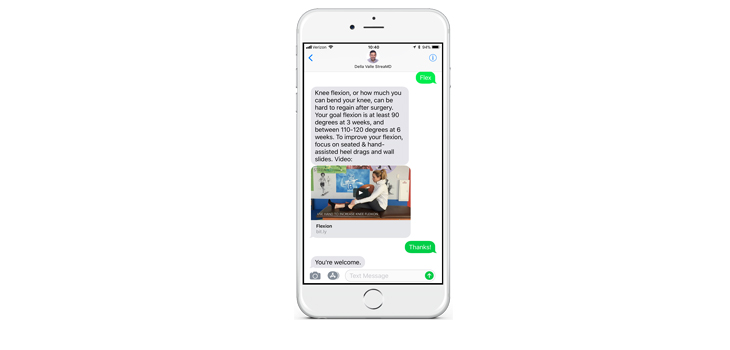
StreaMD, a Chicago-based health tech company, creates physician chatbots that send personalized messages to maximize patient engagement and care.
StreaMD was founded in part by Kevin Campbell, M.D. and Philip Louie, M.D, residents at Midwest Orthopaedics at Rush (MOR), and was awarded 2017 Innovator of the Year by the American Academy of Orthopaedic Surgeons (AAOS).
They presented the results of a recent randomized clinical trial at the 2018 AAOS Annual Meeting in New Orleans.
Their chatbot, which has been shown to increase rehabilitation activity, also decreases narcotic use, improves satisfaction, and decreases phone calls. It has been used in the practices of Drs. Tad Gerlinger and Brett Levine, both surgeons at MOR, for over two years now.
Dr. Campbell told OTW, “Several years ago, my mom was dealing with an orthopedic condition that kept her from enjoying her active lifestyle. I sent her a series of daily text messages and exercise videos to coach her through it. When I saw how helpful it was and how much she appreciated it, I thought, ‘What if all patients could feel this level of support and motivation from their physician?’ so we started StreaMD.”
“One of the biggest challenges we faced was creating something practical that would be enjoyed by patients and physicians alike. Our solution was to keep it simple.”
“Unlike a traditional mobile app that requires downloads, passwords, and a steep learning curve, patients interact with our SMS-based chatbots through conversation which makes them inherently easy to use. We found that our simplicity is the strongest attribute of our product and has resulted in high adoption rates by both patients and physicians.”
Among patients in the first six weeks after undergoing primary total knee arthroplasty (TKA) and total hip arthroplasty (THA), study results showed increased patient satisfaction scores, visual analog scale (VAS) mood score, and minutes spent on home therapy exercises, plus decreased narcotic pain medication use, and calls to the surgeon’s office.
Dr. Gerlinger commented to OTW, “I primarily use this in my practice to encourage a strong connection with the patients during their postop period. The patients that I’ve had enroll in the text messaging service are those who preferred to have more guidance and feedback during the recovery period.”
“For those patients it seems to be exceptionally valuable and as the study suggests decreased phone calls to the office, refills of medications and other interventions that appear to have been a substitute for increased contact with their surgical team. We continue to offer this service to our patients and it continues to be used quite a bit in my practice.”
Author
React:
Discussion
This is a fascinating development. In my practice we've seen similar outcomes with the revised protocol. The key differentiator seems to be patient selection criteria. Has anyone else noticed the correlation with BMI thresholds?
Great point. I'd push back slightly on the conclusion, the sample size in the cited study is too small to draw population-level inferences. That said, the directional signal is compelling and worth a larger RCT.
We implemented a similar approach last year. Early results are promising but we're still gathering 12-month follow-up data. Happy to share our protocol if anyone is interested.
Join the conversation
Orthopedic professionals are discussing this. Sign in and upgrade to read every comment and add your voice.