
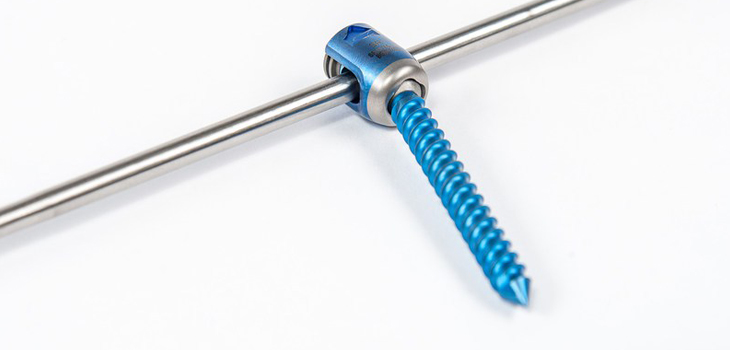
Spinal Resources, Inc. (SRI), based in Fort Lauderdale, Florida, has announced that its Swedge Pedicle Screw System was implanted for the first time.
Spinal Resources: First Implantation With Swedge System
1 min read Premium comments
Secondary#spinalresources#swedge
According to the company, “The Swedge is the first of four landmark products in SRI’s implant development pipeline. It features three different rod diameters which can be conveniently and easily interchanged for use in one effective tulip, and fastened with a simple, one-step locking cap. The recent clinical implantation was performed by Parker Babington, M.D., a neurosurgeon in Virginia Beach, Virginia.”
“My first surgery with the Swedge exceeded my expectations,” said Dr. Babington. “The system’s interoperative flexibility shows that it was well thought out with the surgeon in mind, providing me with many surgical options so I can do what is best for the patient.”
“The design lets me lock the one-size-fits-all tulip in a convenient orientation without the presence of a rod, which is especially valuable with rod placement in longer constructs, because the tulip stays in an optimal position. The unique threaded cap allows for easy and efficient final tightening.”
“I like that the solid and cannulated screws are available in a wide variety of diameters and lengths to suit any anatomy, and deliver an aggressive bite for quicker insertion. The low-profile design of the cross-link, which is available in three lengths, adds extra stabilization to any anatomy. All of these factors make the Swedge a good choice for me.”
SRI Founder and CEO Bernie Bedor told OTW, “It was a milestone to get all the tolerances and parts to function as a unit in order to accommodate the fixation of three different diameter rods in one tulip and one locking cap. It came down to thousands of an inch on several different parts to make this work, so technologically it was a challenge.”
“There are biomechanical advantages in being able to use different rod sizes in different segments of the spine, and not all screw systems are the same. There are advancements in pedicle screws that can and are being made ‘pedicle screws are not tapped out.’”
Author
React:
Discussion
This is a fascinating development. In my practice we've seen similar outcomes with the revised protocol. The key differentiator seems to be patient selection criteria. Has anyone else noticed the correlation with BMI thresholds?
Great point. I'd push back slightly on the conclusion, the sample size in the cited study is too small to draw population-level inferences. That said, the directional signal is compelling and worth a larger RCT.
We implemented a similar approach last year. Early results are promising but we're still gathering 12-month follow-up data. Happy to share our protocol if anyone is interested.
Join the conversation
Orthopedic professionals are discussing this. Sign in and upgrade to read every comment and add your voice.