
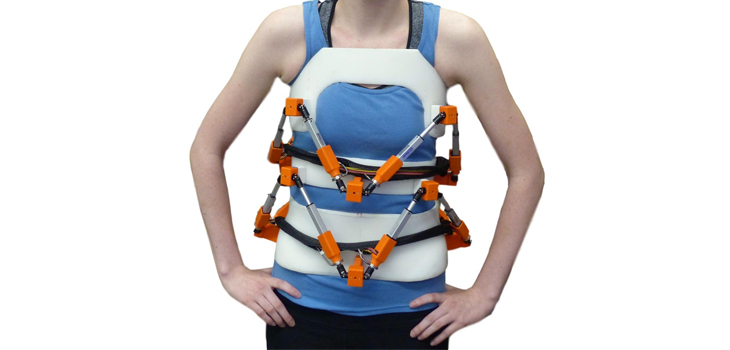
Columbia Engineers have crafted the first device that measures 3D stiffness of the human torso, providing hope for children with spine deformities such as idiopathic scoliosis and kyphosis.
Robotic Exoskeleton to Revolutionize Bracing
2 min read Premium comments
Secondary#scoliosis#rosebrace#spinebrace
The related study, “Robotic Spine Exoskeleton (RoSE): Characterizing the Three-dimensional Stiffness of the Human Torso in the Treatment of Spine Deformity,” appears in the March 30, 2018 edition of IEEE Transactions on Neural Systems and Rehabilitation Engineering.
Co-author Sunil K. Agrawal, Ph.D., professor in the Department of Rehabilitative and Regenerative Medicine and director of The Robotics and Rehabilitation (RoAR) Lab at Columbia University, told OTW, “Many children with idiopathic scoliosis undergo bracing.”
“However, all braces are designed to be static, i.e., do not modulate the external forces over time. Also, it is also not known how modulating these forces applied externally by the brace affects the posture of the upper body.”
“These were the motivations for the design of our robotic spine brace which allows us to study displacements of the upper body in response to applied forces.”
“The design of the brace was based on the scan of the human body. Many of the brace components were 3D printed and were adjusted to the users. The RoSE brace is fully wearable and can record forces and movements over time when worn by the user.”
“The brace allowed us to collect in-vivo data of stiffness of the human spine. Effectively, the upper body behaves as a six-dimensional spring. Force applied in one direction results in displacements and rotations in all three directions in space. We have found that patients with abnormal spine curvatures have stiffness characteristics that are different from those with normal spine.”
“One can create braces that control forces on the upper body as opposed to displacements of the upper body. One can design braces which apply corrective forces on the human torso while still allowing the subject to bend down and tie the shoe laces.”
“The RoSE brace can be used as a tool for both characterization of the forces and the resulting changes in curvature of the spine. Additionally, it can be used to develop new intervention techniques for correction, loading, decompression by regulating forces in real-time using the robotic spine brace.”
Author
React:
Discussion
This is a fascinating development. In my practice we've seen similar outcomes with the revised protocol. The key differentiator seems to be patient selection criteria. Has anyone else noticed the correlation with BMI thresholds?
Great point. I'd push back slightly on the conclusion, the sample size in the cited study is too small to draw population-level inferences. That said, the directional signal is compelling and worth a larger RCT.
We implemented a similar approach last year. Early results are promising but we're still gathering 12-month follow-up data. Happy to share our protocol if anyone is interested.
Join the conversation
Orthopedic professionals are discussing this. Sign in and upgrade to read every comment and add your voice.