
Rick D. Wilkerson, D.O., a West Point graduate and private practice orthopedic surgeon in Spencer, Iowa, has been honored with the Humanitarian Award from the American Academy of Orthopaedic Surgeons (AAOS).
Rick D. Wilkerson: AAOS’ 2018 Humanitarian Award Winner
7 min read Premium comments
#humanitarianaward#lovetakesroot#rickwilkerson
A Middles Eastern studies major at West Point, Rick Wilkerson always had a leaning towards all things international. And while the U.S. Military Academy provided the discipline for a life of service, Rick Wilkerson brought the heart.
Dr. Wilkerson told OTW, “At my first AAOS meeting I stopped by the Orthopaedics Overseas (OO) booth, where they were looking for someone to go to Afghanistan. I accepted and three years later I was teaching at the Afghan Trauma Center in Peshawar, Pakistan, where many of the Afghan refugees were being cared for by a program started by OO providing orthopedic residency training to Afghan residents.”
“This led to several additional volunteer visits, including one to Cambodia where my wife and I ended up adopting our third son, Daniel.”
Dr. Wilkerson turned his attention toward providing assistance in Afghanistan. “The people were very welcoming, and I was fortunate that they already had an existing residency program. Their eagerness to learn and drive to improve healthcare for their people was very inspiring.”
He would need such inspiration as fuel through the heart wrenching suffering he would witness.
“One day a father—who had walked three days to reach us—arrived with his son who had a septic ankle; the son had traveled there on a donkey. This was typical of the dire situations these people encounter, many of which are the result of the Russian mines left over from the conflict of 1980-1990.”
“There were a multitude of amputees; one boy lost one leg below the hip and the other through the hip. It was clinically challenging due to a lack of adequate equipment. I recall my first case was a patient who needed a wrist fusion—and we had no power equipment or plates or screws. A hand drill and some K-wires saved the day.”
“In 2004 the State Department and the Department of Defense began a joint program and sent 25 of us from different specialties to meet with our Iraqi physician peers. This group was formed by Dr. Mike Brennan, an ophthalmologist from North Carolina and former president of the American Ophthalmology Association who worked with the various specialty societies to form the group.”
“From that experience I developed close friendships with orthopedic surgeons and did my best to listen to them about what they needed. There were six of us who had strong relationships with our Iraqi counterparts, and we went back several times to continue teaching at their training programs. To date, we have had eight Iraqi general orthopedists come to train with me over the summers, learning joint replacement and arthroscopy.”
As for security, Dr. Wilkerson had few worries. “My Iraqi surgeon friends were greatly concerned about my welfare, and always provided extensive security. After several visits I came to know so many people in the Basra area that I was always well cared for.”
Dr. Wilkerson has given so much of his time and expertise that he was named an honorary professor of orthopaedic surgery at the University of Basra in Iraq.
“In my 17 trips to Iraq I have been pleased to see the growth of residency programs and a thriving, organized medical community. In years past, they worked with a pittance under Hussein, whose entire healthcare budget allotted 49 cents per person.”
“Now the physicians in Iraq have much better equipment available to utilize and have access to additional training and medical literature, which allows them to do a very good job of providing quality care to their patients.”
And then came Haiti. “Andy Pollak, M.D., president of the Orthopaedic Trauma Association (OTA) at the time of the 2010 earthquake, was helping me design a residency program for Afghanistan. We were working with Bill Grana, Stu Weinstein, and Jody Buckwalter to design a residency program and planned to go teach the teachers. Due to a lack of government-government cooperation at the time, however, the program was withdrawn. So in 2010 Dr. Pollak asked if I would go to Haiti to assist with the post-earthquake care of patients.”
As is often the case, the somber is accompanied by a ray of sunshine. Such was the case while Dr. Wilkerson was in Haiti.
“In Haiti I met my youngest son, Junior. Three days before my arrival, Junior’s birth father died. His mother had died when he was 4 so he was now living at the hospital being watched over by some of the volunteers. I had not been there long when he and I developed a very close bond. After a fairly difficult process, we were able to bring Junior to live with us here in Iowa and to be adopted by our family.”
“The situation in Haiti was especially difficult because the non-governmental organizations were not well coordinated by the Haitian ministries resulting in frequent duplication of services in some areas and no services in others. I saw the need to create programs that would assist the Haitian people by empowering them to become self-sustaining. This can only be achieved by mentoring to develop the skills necessary to manage a business and to set a time limit that could be agreed upon by both parties in which to achieve this.”
Forming Loves Take Root
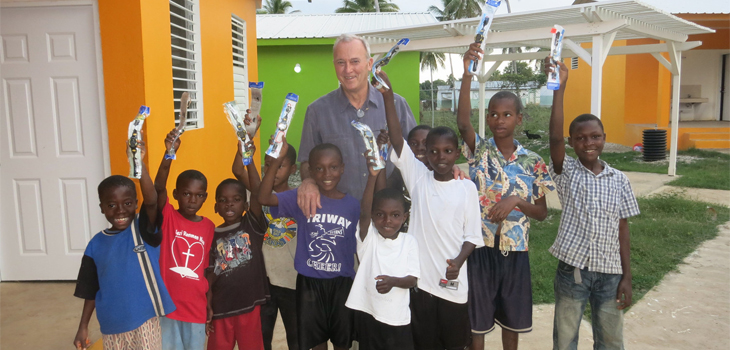
“My wife Barbara and I decided with the help of a group of local citizens who share our vision, to establish our own Non-Government Organization (NGO), Love Takes Root, with the mission to develop charitable, educational and humanitarian support of children of the developing world for a sustainable future.”
“Our vision was to choose an organization or group in need of support, present them with our vision and mission and if they agreed with these principles, to start a 5-year program of funding and mentorship to allow them to become self-sustaining and to no longer be dependent on charitable funding to run their operation.”
“LaConcorde orphanage and school where Junior lived pending his adoption was selected. This project consisted of purchasing land in a more rural area to lower land cost, constructing an orphanage for 68 children, constructing a school with the potential for 400 students, building a dining/kitchen facility, a staff house and a medical/dental clinic to serve the children and those living in the area.”
“With the help of one of our volunteers, Dr. and Mrs. Ed Wojtys, the Ross School of Business at the University of Michigan provided a team of MBA students to develop a business plan for the school and clinic with the Haitian staff that administers LaConcorde.”
“We can happily say, that with their help, we are on our way to self-sustainability of the school and clinic ahead of schedule. We have also been fortunate enough to raise funding for solar power, further lowering the cost of and improving the availability of electricity.”
West Point’s Influence
As for what role his time at West Point played in his international work, Dr. Wilkerson noted, “It gave me a strong curiosity about the wider world. I had a wrestling injury while at school and was fortunate to be treated by the wonderful John Feagin, M.D. Not only did he influence me by advising that I pursue medical school, but his commitment to charitable overseas work laid the groundwork for my future.”
Asked what he would do if Love Takes Root received a $2 million grant, Dr. Wilkerson told OTW, “I would likely put most of it away for future projects and for fundraising. You know, the goal is not to create a “little America” in Haiti.”
“We strive to maintain their culture and find ways for them to live without relying on charity. This is a real shift in perspective for many people…there is no reason to have a budget if you are just trying to find food for tomorrow. We want to empower people with our program so that they have the skills to maintain their own program when we are no longer there.”
Lessons for Other Surgeons
And his message to young orthopedic surgeons interested in serving abroad? “Beyond sharing your expertise with people greatly in need, there are other advantages such as not dealing with insurance companies or electronic medical records. Some of my colleagues are cautious because they are subspecialists and are not sure how, for example, a sports medicine surgeon can help. My message is, ‘They need to learn what you know. And you will make lifelong, rewarding friendships.’”
So what about any cultural or political issues? Dr. Wilkerson is matter-of-fact, stating, “What we hear on the news is frequently misunderstood by generalizing what is reported about a small group of people and applying it to the entire population.”
“This is unfortunate in that accurate perceptions and understanding of a culture or ethnicity is often made incorrect. I have learned that everywhere I have worked in the world, every parent wants the same things for their children—nutrition, and education and health care when needed. We are all much more alike than we are different.”
But Dr. Wilkerson and his entire family are setting an example of true giving. “It has been greatly rewarding to have our children accompany us on many trips, including Uganda, Bhutan, and Haiti. In Kampala, my wife, a pediatric nurse practitioner, developed the pediatric intensive care unit’s standard operating procedures for provision of oxygen for patients at the local hospital. Meanwhile, our children were busy putting together a playroom in the pediatric ward.”
“Everyone has something to give.”
For more information about Love Takes Root (including a chance to volunteer), please visit: https://lovetakesroot.org
Author
React:
Discussion
This is a fascinating development. In my practice we've seen similar outcomes with the revised protocol. The key differentiator seems to be patient selection criteria. Has anyone else noticed the correlation with BMI thresholds?
Great point. I'd push back slightly on the conclusion, the sample size in the cited study is too small to draw population-level inferences. That said, the directional signal is compelling and worth a larger RCT.
We implemented a similar approach last year. Early results are promising but we're still gathering 12-month follow-up data. Happy to share our protocol if anyone is interested.
Join the conversation
Orthopedic professionals are discussing this. Sign in and upgrade to read every comment and add your voice.