
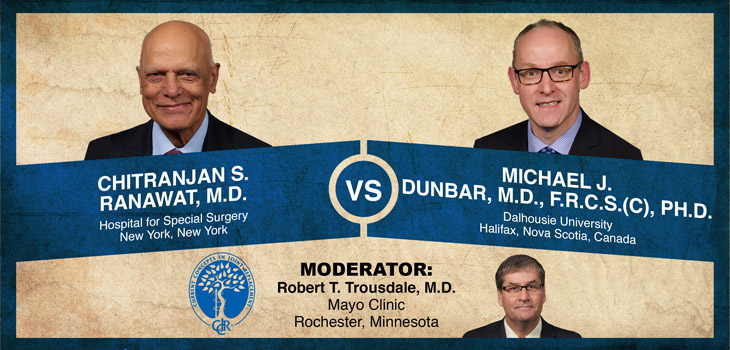
Moderator Trousdale: The next debate is I think one of the hottest topics in knee surgery and that’s where do we put the mechanical axis or align our limbs. Professor Ranawat from New York is going to be in the affirmative of the Neutral Mechanical Alignment: Stickin’ With the One that Brung Ya!
Ranawat v. Dunbar: Neutral Mechanical Alignment: Stickin’ With the One that Brung Ya!
10 min read Premium comments
#kneesurgeryGreat Debates#mechanicalalignment
Dr. Ranawat: The principles of total knee replacement are: Proper alignment in all three planes; soft tissue balance; maintain the joint line; and obviously, proper cement technique.
Neutral position of the proximal tibial cut: I have been practicing this technique for a long time. In extension you have a rectangular space with the soft tissue balanced. Same thing in flexion: you have a rectangular space with the soft tissue balanced. I wrote about this in JBJS in 2012.
Bringing the tibia in front of the femur displaces the neurovascular bundle behind the tibia and avoids injury. And you will not leave cement behind in the posterior part of the knee.
With the tibia exposed I size the tibial component based on the dimension of the lateral tibial plateau. I remove all overhanging bone on the medial side as needed and then put the baseplate back down and check whether the cut is correct.
I don’t use a tourniquet, I do use hypotension and tranexamic acid. I do all my dissection with a cautery and hardly any blood loss. I identify all the significant vessels and cauterize them. I bring the tibia in front. Then identify the axis of the tibia. Align the tibial cutting block and cut at least 8-9mm off the uninvolved side. Size it properly and remove the overhanging bone.
I present to you the results of 68 consecutive varus knees: the postoperative mechanical alignment was 0-3 degrees. There were no outliers.
And here I want to make a point.
When you take a long film, if you don’t control your external rotation of the foot, you can have wrong information.
To summarize, total knees with restored mechanical axis have been proven to last 15-20 years in 90% or more of the patients. The technique is reproducible. Fixation of the tibia with metal-backed or all poly component has been durable and is a matter of choice in the hands of most surgeons.
Moderator Trousdale: Thank you Dr. Ranawat, that’s a strong argument to restore mechanical axis in our total knees as far as durability goes, for sure. Michael Dunbar from Canada is going to talk to us more about some functional results and argue, maybe, against putting the mechanical axis right down the middle on everybody.
Dr. Dunbar: Absolutely. Thanks very much Rob. Thanks to Seth and the organizing committee for the opportunity. My disclosures are relevant particularly with respect to kinematic alignment. So take everything with a grain of salt.
Neutral mechanical axis is the paradigm. It’s really a paradigm of a remarkable development of evolution that we owe a debt of gratitude for to people like Dr. Ranawat for bringing us to where we are. It still remains a standard of care.
But my question would be, framing this argument, is it really the end of the road for the evolution that we’ve come down to? Are we really at a dead end with respect to the evolution of knee arthroplasty?
Consider the remarkable advances that we’re all witnessing as we go into the display area with respect to imaging, robotics, machine learning and all the other wonderful tools and techniques that we are enjoying.
Right now the paradigm is to ignore the variability and treat all patients as if they are the same and put them all in neutral mechanical alignment.
And like everything in the human condition, mechanical alignment falls upon a normal distribution. The first thing you do in grade school when you’re learning about statistics is you take your classmates and you line them up and measure their heights and you realize that they fall on a bell curve. Well, I would submit that clearly alignment is also on a bell curve and there is a lot of evidence to support that.
Consider a paper by Bellemans, et al.: “Is Neutral Mechanical Alignment Normal for All Patients?: The Concept of Constitutional Varus.”
They recruited a cohort of 500 asymptomatic adult volunteers between 20 and 27 years old for this cross-sectional study and all had full-leg standing digital radiographs on which 19 alignment parameters were analyzed.
Thirty-two percent of men and 17% of women had constitutional varus knees with a natural mechanical alignment of 3 degrees varus or more and when they looked at their alignment, indeed it produced a bell curve just as I postulated.
But more interestingly is that the average overall alignment is 1.3 degrees varus for all comers and it’s actually 1.8 degrees of varus for males. And if we look at our plus or minus 3 degree range, and those that are outside of it, it’s actually a full one-third of patients who are outside of this window that we’re looking at. And clearly many are outside of neutral, plumb down the middle 0 degrees mechanical alignment.
The question then posed from this paper is “Are all knees in neutral mechanical alignment?” Clearly the answer from this paper is “No, they are not.” And in fact the conclusion from this paper is restoration of mechanical alignment to neutral in these cases may not be desirable when, in fact, it would unnatural for these knees.
One of the things that I didn’t tell you about this paper is that it is a Knee Society Chitranjan Ranawat Award winning paper, so clearly it demonstrates that Dr. Ranawat has an open mind as he’s endorsing eponymously that this concept of neutral mechanical alignment actually isn’t the case.
Another senior thought leader, Adolph Lombardi, at this meeting in 2011 reiterated the point that aiming for neutral provides the safest margin for error. The foremost objective of total knee arthroplasty is a durable joint. Not necessarily, and this is the important point, one that replicates normal or the patient’s native condition. We’re not reproducing that bell curve that I alluded to and in fact we’re intentionally ignoring it.
So the concept is, if you want to make something last, you make it straight, you make it straight and it’s going to stand up a long time. But there’s a lot of evidence to refute that now.
Another important paper (Parrette, et al.) looking at 390 patients long-term, 15 years plus, using modern prostheses showed that a postoperative mechanical axis within this plus or minus 3 degrees, didn’t provide any improved survivorship.
Patients don’t stand around like the Parthenon columns in a fixed position. They walk, sit in chairs, climb up and down stairs, and they move around functionally. And that’s why I think that we have these issues. We have lingering dissatisfaction of around 18% from multiple jurisdictions around the world.
Again, we’re talking about the patient who looks good, feels bad. But every surgeon says, “No, it’s the way we’ve been taught. Suck it up, you’ve got to get on with it.”
Why would we stick with an operation where the survivorship is not improved over the last 15 years? From 2003 to 2007 we’ve gotten worse, every progressive year.
The younger you are the higher your failure rate. We’re not addressing these groups. The technique is not working for the younger patients.
As Dr. Ranawat mentioned, you need to think of it as three orthogonal planes, but not necessarily translating them into three dimensions. So, if you look at what’s going on, yes, we’re going to cut a rectangular flexion space IF we make a neutral mechanical cut, but as we transpose that to what’s happening in flexion, we have issues, don’t we? Because that’s not physiologic, it’s not anatomic and this is why we go through machinations of externally rotating the cutting block to make asymmetrical cuts.
So, we’re replacing 8mm of bone with implant and this becomes very important when we think about what is happening in the distal femur. Because if you make a neutral cut on the distal femur, you take out 4mm of bone, you add 8mm with your component, you’re actually stuffing the patello-femoral joint on the lateral side in flexion, which is not trivial, I think.
The best we do right now, we think three dimensionally by saying here we are at zero and we’re going to balance the knee at 90, but we kind of ignore everything that happens in between intentionally and it’s not a coincidence that instability is a leading cause of early revision, second behind infection.
We’re missing the boat three dimensionally.
It gets even more interesting when you start to look at computer navigation and other tools that show you that it really is a complex three-dimensional problem and that there are patterns of alignment that are not just static on the two dimensional frontal plane view.
In conclusion, neutral mechanical alignment is based off historic data that intentionally ignores individual variation in alignment, morphology and biomechanics. It oversimplifies a complex three-dimensional issue, by thinking about it in two dimensions. It gets us by for the majority of patients, but not all, and I think that’s part of the driver of the signal of dissatisfaction. And I think the future is to acknowledge assessing all these individual variations and put them into the surgical plan.
I end with this. Dr. Ranawat has awards named after him. I’ll never have an award named after me. He’s someone who has brought us to where we are. We owe him a great deal of respect.
So, I think of Linus Pauling, a double Nobel Prize Laureate who spoke to the students in Sweden after receiving his second Nobel Prize, and he said to the students: “When an old distinguished person speaks to you, listen to him carefully with respect, but do not believe him.” (laughter) “Your elder, no matter whether he has gray hair, or has lost his hair, or whether he’s a Nobel Laureate (or founding member of the Knee Society), may be wrong.”
So, Chit, I would only say to you don’t be afraid of change. Your next career is going to be very exciting as a kinematically aligning surgeon. (lots of applause)
Moderator Trousdale: Michael, that was very good. You didn’t add that Linus Pauling said; ‘Don’t believe the older person unless it’s Chit Ranawat’. Let me see a show of hands from the audience—how many people in the audience are shooting for a neutral mechanical axis—so-called mechanical axis alignment? Okay, so a boatload. How many people are shooting for a kinematic alignment? So a few.
Michael’s got a good point, Chit, we’ve got 10-15% of our patients not satisfied with our total knees. You’ve been around the block a long time, what do you think the major factor is as to why they’re not satisfied? Is it alignment issues or is it other issues that Michael brought up?
Dr. Ranawat: It has nothing to do with alignment. Even if you align properly, about 8% of patients in my practice have some anterior knee symptoms. And that is due to substance-P nerve fibers, which are in the anterior part of the knee, mostly in the infra-patellar area in the soft tissue. It’s because those fibers are still there that you cannot eliminate anterior knee pain. And don’t associate that with alignment or any other particular problem.
Moderator Trousdale: Michael, you want to address that? So, you brought up a nice point Mike, that most of the studies, and a couple of randomized trials about kinematic alignment versus mechanical alignment…we’ll talk about those in a minute, but is alignment a factor? Is it soft tissue balancing? Is it rotation? Is it slope? Is it flexion of the femoral component? I mean there are loads of factors in our total knees. What do you think is the primary driver of dissatisfaction?
Dr. Dunbar: It’s all of these things and it’s probably also the glass ceiling associated with metal and plastic if at the end of the day we’re cutting the bone and sticking metal on it it’s non-physiologic so how satisfied could you be with that. But, it doesn’t mean you can’t start evolving it. I think the point is now that we have tools where you can start to identify that there is an individual variation.
The question now is; what would you choose to do about it?
It’s compelling when you see a boatload of patients for second opinion come in with perfect looking X-rays based on neutral mechanical and they all say the same thing…they say it in different words, but they say, “I don’t care what the surgeon says, that knee’s in there wrong.”
It gets a little wackier when you extrapolate because kinematic alignment is really about how you move. It’s really four-dimensional alignment. How you get up out of a chair. How you walk through time and space.
We don’t have the ability as a modern surgeon to impute that data now. There are too many variables as you’ve alluded too.
But I think the future…the surgeon of the future…will impute the biometrics for that patient, figure out what the flight plan is and then get robots to execute that plan. That’s how we’re going to get to that next level.
Moderator Trousdale: I agree with that. Chit, do you change your alignment based on whether the knee’s a varus knee preop or a valgus knee preop?
Dr. Ranawat: Most of the varus knees—no, but in the valgus knee I can leave 1 to 3 degrees extra valgus because to perfectly align to neutral / slight varus alignment in a valgus knee it requires too much soft tissue release posterolaterally and that kind of release can cause flexion instability sometimes.
Moderator Trousdale: Gentlemen, thank you very much. It was a great debate.
Please visit www.CCJR.com to register for the 2018 CCJR Spring Meeting, – May 20 – 23 in Las Vegas.
Senior Editor: Jay D. Mabrey, M.D., whose 35 year career in orthopedics included residency at Duke University Medical Center, service in the United States Army Medical Corps, Fellowship at the Hospital for Special Surgery and a long, distinguished career at Baylor University Medical Center where, in addition to his overall leadership at that institution, developed the Joint Wellness Program that helped patients get up after surgery more quickly, developed the first virtual reality surgical simulator for knee arthroscopy and chaired the FDA Orthopaedic Device Panel, is Orthopedics This Week’s newest contributing writer and editor.
Author
React:
Discussion
This is a fascinating development. In my practice we've seen similar outcomes with the revised protocol. The key differentiator seems to be patient selection criteria. Has anyone else noticed the correlation with BMI thresholds?
Great point. I'd push back slightly on the conclusion, the sample size in the cited study is too small to draw population-level inferences. That said, the directional signal is compelling and worth a larger RCT.
We implemented a similar approach last year. Early results are promising but we're still gathering 12-month follow-up data. Happy to share our protocol if anyone is interested.
Join the conversation
Orthopedic professionals are discussing this. Sign in and upgrade to read every comment and add your voice.