
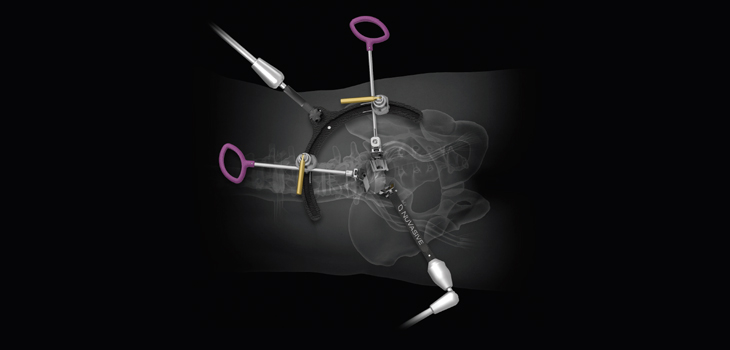
NuVasive, Inc., based in San Diego, California, has launched the ALIF (anterior lumbar interbody fusion) Access, the company’s first-ever MAS (maximum access surgery) ALIF retractor platform for both lateral and supine spine surgery approaches.
NuVasive Launches Retractor for Lateral, Supine Approaches
2 min read Premium comments
#nuvasiveSecondary#anteriorlumbarinterbodyfusion#alif
According to the company, “The retractor system’s features retain the characteristics of a traditional ALIF while giving surgeons options for either a lateral or supine approach based on patient need.”
“For lateral entry, the Lateral ALIF Access System enables single-position surgery for multilevel cases when integrated with the NuVasive XLIF [lateral lumbar interbody fusion] procedure, increasing O.R. efficiency by reducing the number of times a patient has to be repositioned and expanding the benefits of lateral surgery to more spinal levels.”
“Accessing L5/S1 laterally has historically had its shortcomings, specifically because the existing systems on the market were not designed from the ground up for these approaches,” said J. Alex Thomas, M.D. “Access systems used in the past were lacking in various clinically necessary areas. NuVasive has addressed these clinical concerns with their new ALIF Access platform, whether it is a traditional supine approach or as the surgeon moves towards single-position surgery, they’ve created a real game changer for ALIF approaches.”
Asked to elaborate on the repositioning issue, Dr. Thomas told OTW, “By performing the ALIF in the lateral position the surgeon has access to both the back and the front of the patient. This allows the surgeon to perform the ALIF and then place bilateral pedicle screw fixation without having to reposition the patient to the prone position as is typically done.”
“At a typical institution repositioning prone, as well as re-prepping and re-draping the patient, can take upwards of 30 minutes—that’s at least 30 minutes of time under anesthesia that you’re saving the patient! Not only is repositioning the patient time consuming, it can increase risk to the patient and is also burdensome on OR staff. I’m certain that this lateral ALIF procedure vastly improves patient safety and OR efficiency.”
“I think that the most exciting thing for a typical orthopedic spine surgeon is the vast increases in efficiency you can see by employing this single-position strategy for lumbar fusions.”
“If you’re doing three lumbar fusions a day that’s nearly two hours that you’re saving by not repositioning the patient to the prone position after XLIF or ALIF. That gives you more time to do an extra case or two if you like, or, even better, more time to spend at home with your family.”
“Lastly, I cannot underestimate the value of shaving off that extra time under anesthesia in terms of patient outcomes. With our standard L5/S1 lateral ALIF and percutaneous pedicle screw case now taking less than 90 minutes, our patients are up walking right away with less pain and no ileus. Also, nearly all of our patients will go home this next morning. The results that we’re achieving with this new single-position strategy continue to amaze me.”
Author
React:
Discussion
This is a fascinating development. In my practice we've seen similar outcomes with the revised protocol. The key differentiator seems to be patient selection criteria. Has anyone else noticed the correlation with BMI thresholds?
Great point. I'd push back slightly on the conclusion, the sample size in the cited study is too small to draw population-level inferences. That said, the directional signal is compelling and worth a larger RCT.
We implemented a similar approach last year. Early results are promising but we're still gathering 12-month follow-up data. Happy to share our protocol if anyone is interested.
Join the conversation
Orthopedic professionals are discussing this. Sign in and upgrade to read every comment and add your voice.