
New Ortho Stem Cell Discovery
New Ortho Stem Cell Discovery; AAOS Diversity Award Winner; Silver Nylon Cuts Infection Rates
8 min read Premium comments
#jointinfection#mdscs#tissuerepair
Johnny Huard, Ph.D. has figured out why women outlive men. Dr. Huard, distinguished professor and vice chair for research in the department of orthopedic surgery at the University of Texas Health Science Center at Houston (UTHealth), says it has much to do with young blood and young stem cells…and little to do with men’s love of motorcycles.
But more on that later.
Dr. Huard, also director of the Center for Regenerative Sports Medicine and the chief scientific officer at the Steadman Philippon Research Institute in Vail, Colorado, was recently honored with the Kappa Delta Ann Doner Vaughan award for his unique regenerative medicine approach using muscle-derived stem cells (MDSCs).
Dr. Huard told OTW, “What a huge honor and a wonderful recognition for our work. I am so pleased to be able to get the word out about this exciting path that will ultimately lead to improvements in tissue repair.”
Detailing the exciting trail of his research, Dr. Huard notes, “In 1999 scientists began cell transplantation using muscle cells and found that the cell transplantation wasn’t working because 99% of the cells were dying at the injection site. That set off a great race to discover why those cells were dying.”
But Dr. Huard, then at the University of Pittsburgh, asked a different question, namely, “Why are the 1% surviving?”
“I wanted to know what made those particular cells different,” says Dr. Huard. We found that the 1% of the cells that were surviving were indeed stem cells.
Dr. Huard began collaborating with new “Pitt” faculty member Bruno Peault, Ph.D. Together, they asked, “Where do those stem cells originate?”
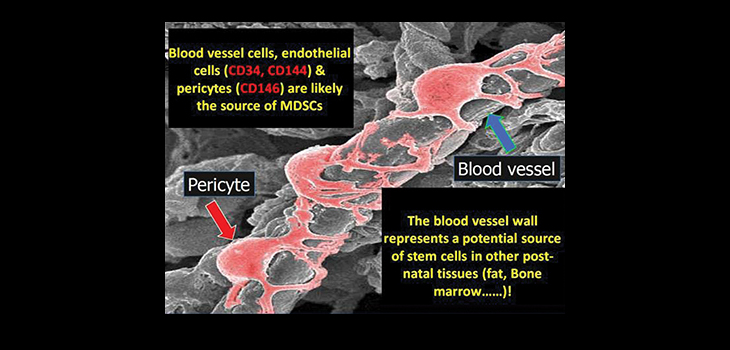
Dr. Huard told OTW, “We went on a fishing expedition and found out that those muscle stem cells come from blood vessels…and that blood vessels are likely probably the origin of other stem cells such as fat derived stem cells and bone marrow stem cells.
They then postulated that if MDSCs come from blood vessels then perhaps the next step should be to promote angiogenesis.
“Eureka!” said Dr. Huard. “We determined that if you want to improve tissue repair then you need to promote angiogenesis. By transplanting MDSCs into injured skeletal muscle we fostered better muscle healing by promoting angiogenesis.”
And perhaps the most tantalizing part of all of this is the implication for aging cells. Dr. Huard told OTW, “As we age, stem cells decline in number and function. We took young stem cells and injected them into older mice and found that the lifespan/healthspan of those animals was greatly extended. So, this made us ask, ‘Can we isolate factors secreted by young stem cells that can be used to make humans age better?’”
So, they brought in some new blood…literally.
“We started to ‘stitch together’ young and old mice,” said Dr. Huard, “and found that the young mice shared their blood with the old mice—and the old ‘folks’ began to age slower! The idea is that when you get old your blood and cells get old as well. And this is why women live longer than men…even in mice, rabbits, etc., females always live longer. When a woman is pregnant the fetus is sending her its young blood and stem cells. We believe this is the reason why women live longer than men on average.”
“There is great promise for the use of these autologous adult stem cells to improve the healing of numerous tissue types. I have great hope for the future of tissue engineering and regenerative medicine.”
AAOS Diversity Award Winner Announced
Mark C. Gebhardt, M.D., an orthopedic oncologist in Boston, has been presented with the 2018 Diversity Award from the American Academy of Orthopaedic Surgeons (AAOS).
According to AAOS, “For more than 40 years, Dr. Gebhardt has acted on his strong conviction that recruiting women and minorities into orthopaedics is fundamental to advancing the field. As a medical student at the University of Cincinnati College of Medicine, he was acutely aware of the small number of women and minority students in his class. Upon beginning his residency at Harvard in 1978, Dr. Gebhardt saw the hurdles women and minorities had to go through to succeed. He chose to follow the lead of his iconic mentors—Drs. Gus White, Henry Mankin and Dempsey Springfield—and made a vow to shape change.”
“As a long-standing member of the Ruth Jackson Orthopaedic Society (RJOS) and J. Robert Gladden Orthopaedic Society (JRGOS), Dr. Gebhardt has mentored numerous medical students, orthopaedic residents and young orthopaedic surgeons, and is directly responsible for encouraging women to successfully pursue and prosper in orthopaedic surgery.”
“Beyond mentoring, Dr. Gebhardt is a long-time advocate for recruiting and hiring women and minorities into the Harvard Combined Orthopaedic Residency Program—both as residents and as faculty. In fact, his orthopaedic faculty contains the largest number of women in the Harvard orthopaedic system. He chaired two search committees for department leaders and recently appointed a female director of the department’s Center for Advanced Orthopaedic Studies.”
“Dr. Gebhardt has been successful in creating a culture of diversity and multi-culturalism and is committed to social justice in developing culturally competent care,” said Augustus A. White, III, M.D., Ph.D., a past AAOS Diversity Award recipient.
Asked about the biggest obstacle to women and minority participation in orthopedics, Dr. Gebhardt told OTW, “I think it is the lack of female and underrepresented minority role models [URM]in orthopaedics. When young women and URMs in medical school consider options for residency, they do not have sufficient numbers of role models (either residents or faculty) to mentor and council them toward an orthopaedic career. The white male dominated “jock” mentality still prevails in orthopaedics more than other specialties and this is not always welcoming to women and minorities considering the field. There are many factors, but I think these are major obstacles for both groups. In addition, many women (and I suspect minority) students in college and medical school never get exposed to orthopaedics as a field to consider.”
Asked what gives him hope for the future of diversity in orthopedics, Dr. Gebhardt said, “We are slowly increasing the ranks of women and URMs in orthopaedic residency and faculty. Groups like RJOS and JRGS are working hard to provide avenues to encourage women and minorities to enter the specialty from high school and medical school (e.g., the Perry Initiative, Nth Dimension).”
“This has led to an increase of women and minorities applying to orthopaedic residencies and this translates to more women and minorities entering the ranks of faculty and private practice. Eventually, women and minorities considering orthopaedics will ‘see’ people in the specialty with whom they can identify. In addition, I think old school faculty are ‘waking up’ and there is more encouragement from medical school faculty and orthopaedic residency programs to make the environment of training more welcoming to female and minority applicants. We aren’t there yet, but we are making progress.”
Silver Nylon Cuts Postoperative Infection Rate
Harvard researchers have determined that using a silver nylon dressing—originally developed for the military by Massachusetts-based Silverson Machines, Inc.—helps reduce superficial and deep prosthetic joint infections (PJI) following total joint replacement.
The Harvard study, “Use of Silver Nylon Dressing Following Total Hip and Knee Arthroplasty Decreases the Postoperative Infection Rate,” was published in the Journal of the American Academy of Orthopaedic Surgeon Global Research & Review.
“This important research demonstrates in a large group of total joint-replacement patients, surgical site infections can be significantly reduced by the simple use of a silver-nylon dressing postoperatively,” said David Barillo, M.D. FACS, FCCM, wound specialist, burn surgeon and silver researcher.
“In total joint replacement, protecting the surgical wound is critical. PJI is devastating when it occurs, causing increased patient suffering as well as substantial economic burden associated with prolonged antibiotic use, repeat surgical procedures, and extended hospital readmissions.”
Representatives from Silverson Machines told OTW, “Surgical site infection (SSI) is one of the key patient safety challenges in U.S. healthcare today. In general, the costs associated with a SSI exceed $22,000 per event, and in total joint replacement can exceed $70,000. Prosthetic joint infection (PJI) is a devastating complication for the patient; in addition, management of these infections is no longer reimbursed, and the cost must be borne directly by the hospital.”
“Though extensive study and effort has gone into pre-op and intra-op infection prevention measures, there has been an absence of data on best practices for post-op surgical wound care. The investigators/authors wanted to conduct a study that was independent of industry funding and evaluated the impact of a novel silver-plated nylon dressing (Silverlon) as an important element of PJI and wound complication prevention. This study contributed valuable data in support of evidence-based approaches to post-operative wound care, and it demonstrates a simple, cost-effective measure that can have a significant impact on the risk and number infections associated with total hip and total knee replacement surgeries.”
“Few studies have been performed to evaluate the impact of antimicrobial dressings in orthopedic surgery, and even fewer have been done without an industry sponsor. The study investigators wanted to do a truly independent and robust retrospective/prospective study and indicated that they believe this is the first study of its kind.”
“Additionally, the study was designed to be large enough to develop statistical significance, a key factor in developing actionable information for surgeons. This approach of using retrospective data to establish an infection baseline based on records analysis, then doing everything possible to reduce variables and make a single practice change (introduction of the silver-nylon dressing) and tracking infections prospectively, creates robust evidence that can be relied upon.”
“Additionally, the study tracked the patients in the study group for a full year, which is significantly longer than the typical 30-day infection tracking done in many studies. This point is critical—total joint replacement patients are not safe from infection upon discharge, and half or more of all infections occurred after patients were released from hospital. The prospective nature of the study cohort, the limiting of practice changes to just one variable—the dressing—the long-term follow-up and the independence from industry support make this study unique in the literature and of great value to clinicians.”
“The most important question that needed to be answered, was ‘Does the use of the silver-plated nylon dressing (Silverlon) reduce infections in total joint replacement surgery?’ The finding was a statistically significant ‘Yes.’ The data showed a strong correlation between the use of Silverlon and reducing both superficial and deep prosthetic joint infections.”
“The study showed a statistically significant reduction of PJI associated with Silverlon use. This represented a 54% reduction of prosthetic joint infections. Additionally, it showed a drop of deep prosthetic joint infections from 2.3% in the control group to 0.0% in the Silverlon group over the course of all procedures for an entire year. The reduction of both superficial and deep prosthetic joint infection is clinically important to orthopedic surgeons and their patients.”
“Though much work has gone into standardization of pre-op and intra-op infection prevention measures, there has not been much attention on standardization of post-operative surgical wound care. This study highlights a simple, cost-effective approach to post-op wound care that can help address the risk of surgical site infection and wound complications associated with total hip and total knee replacement surgery.”
“Surgeons need evidence-based decision making to determine best practices for standardization, and this study provides robust, statistically significant and actionable data on a post-operative wound care regimen associated with improved results (reduced prosthetic joint infections).”
Author
React:
Discussion
This is a fascinating development. In my practice we've seen similar outcomes with the revised protocol. The key differentiator seems to be patient selection criteria. Has anyone else noticed the correlation with BMI thresholds?
Great point. I'd push back slightly on the conclusion, the sample size in the cited study is too small to draw population-level inferences. That said, the directional signal is compelling and worth a larger RCT.
We implemented a similar approach last year. Early results are promising but we're still gathering 12-month follow-up data. Happy to share our protocol if anyone is interested.
Join the conversation
Orthopedic professionals are discussing this. Sign in and upgrade to read every comment and add your voice.