
Warsaw, Indiana-based Zimmer Biomet Holdings, Inc. has announced that a new study (seven-year follow up) has affirmed earlier studies that Mobi-C Cervical Disc fares better than anterior cervical discectomy and fusion (ACDF).
Mobi-C: Lower Pain, Less Adjacent Level Degeneration
2 min read Premium comments
Secondary#anteriorcervicaldiscectomyandfusion#mobic
The study, “Long-term Evaluation of Cervical Disc Arthroplasty with the Mobi-C® Cervical Disc: A Randomized, Prospective, Multicenter Clinical Trial with Seven-Year Follow-up,” appears in the January 2018 edition of the International Journal of Spine Surgery.
According to Zimmer Biomet, the study “reports on the continuation of a prospective, randomized clinical trial of cTDR [cervical total disc replacement] with Mobi-C compared to the previous standard of care, anterior cervical discectomy and fusion (ACDF), and follows the nearly 600 patients through seven years.”
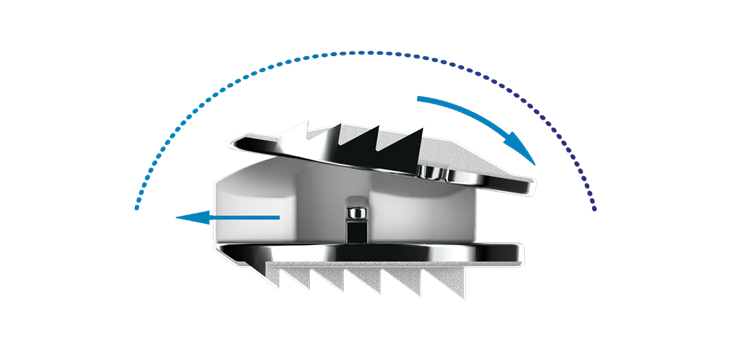
“Researchers found that cTDR with Mobi-C was associated with lower pain scores, maintained range of motion, less adjacent level degeneration and adjacent level subsequent surgery, as well as a lower rate of secondary surgery compared to ACDF.”
“The published article discusses the Investigational Device Exemption/Post-Approval Study that evaluated 599 patients, including 164 treated with one-level cTDR, 225 treated with two-level cTDR, 81 treated with one-level ACDF and 105 treated with two-level ACDF.”
“At seven years, follow-up rates ranged from 73.5 percent to 84.4 percent (overall 80.2 percent). Overall success rates for two-level patients were 60.8 percent for cTDR and 34.6 percent for ACDF. Overall success rates for one-level patients were 55.2 percent for cTDR and 50.0 percent for ACDF…”
Rebecca Whitney, General Manager of Spine, told OTW, “The data from the long-term, seven-year, follow-up study further highlight cervical arthroplasty with Mobi-C as a safe, effective, and durable solution for indicated patients.”
“There were particularly significant, clinical benefits shown for Mobi-C patients in two-level procedures, as compared to patients who received cervical fusion. In addition, compared to patients that received ACDF, patients treated with Mobi-C in one-level procedures had lower pain scores, maintained a greater range of motion, showed less adjacent level degeneration and adjacent level subsequent surgery, and had a lower rate of secondary surgery.”
“Following this study, we will continue to focus on demonstrating to the spine surgeon community the reproducibility of these positive results and the clinical benefits of Mobi-C in cTDR as compared to fusion.”
Author
React:
Discussion
This is a fascinating development. In my practice we've seen similar outcomes with the revised protocol. The key differentiator seems to be patient selection criteria. Has anyone else noticed the correlation with BMI thresholds?
Great point. I'd push back slightly on the conclusion, the sample size in the cited study is too small to draw population-level inferences. That said, the directional signal is compelling and worth a larger RCT.
We implemented a similar approach last year. Early results are promising but we're still gathering 12-month follow-up data. Happy to share our protocol if anyone is interested.
Join the conversation
Orthopedic professionals are discussing this. Sign in and upgrade to read every comment and add your voice.