
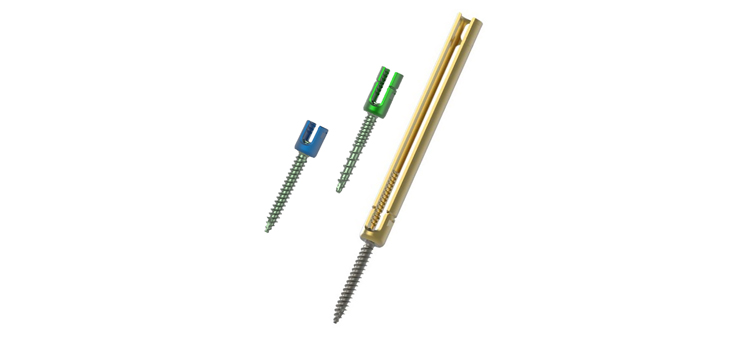
Dallas, Texas-based CTL Medical Corporation has secured FDA 510(k) clearance to market its SEURAT Universal Pedicle Screw System.
FDA Clearance for CTL Medical Pedicle Screw System
2 min read Premium comments
Secondary#pediclescrewsystem#fdaclearance#ctlmedicalcorp
A March 29, 2018 company press release said this is the second FDA clearance for the company in the first quarter of 2018. CTL Medical’s in-house research and development team designed the new system after working closely with surgeons.
According to FDA documents, the system is intended to provide immobilization and stabilization of the spinal segments, (T1 – S2/ilium) or as an anterolateral fixation system (T8 – L5), in skeletally mature patients as an adjunct to fusion.
Furthermore, the system “is a posterior, non-cervical, pedicle system indicated for degenerative disc disease (defined as back pain of discogenic origin with degeneration of the disc confirmed by history and radiographic studies); spondylolisthesis; trauma (i.e., fracture or dislocation); spinal stenosis; curvatures (i.e., scoliosis, kyphosis, and/or lordosis); tumor, pseudarthosis; and failed previous fusion.”
Additionally, the system can be used in an open approach and percutaneous approach with MIS instrumentation.
Danny Chon, CTL Medical’s CEO said, “As the general population continues to age and the reported degenerative spine cases increase, it is inevitable that the pedicle screw market and related instrumentation challenges will continue to grow, ultimately demanding a one-stop solution. As an answer to this need, we designed the SEURAT Universal Pedicle Screw System to be a truly comprehensive pedicle screw offering unlike any other in the market today.”
SEURAT “Unlike Any Other”
So how is this system unlike others?
The company said the system is a compilation and consolidation of the best features from each of CTL Medical’s already cleared pedicle screw systems, “boasting the addition of true intraoperative versatility.”
“The modular housing assembly option enables surgeons to intraoperatively build the most appropriate implant for the present indication, and the option to select a standard or reinforced-ring locking set screw ensures the SEURAT Universal Pedicle Screw System will accommodate a broader range of anatomical challenges and usage preferences. This comprehensive single system includes polyaxial and monoaxial; open and MIS; single and dual thread profile; solid and cannulated; and hex and hexalobe screws of all diameters and lengths.”
The primary predicate for the SEURAT is the company’s Raphael Pedicle Screw System. Additional predicates included the company’s PICASSO MIS Spinal System, DALI Spinal Fixation System and the PICASSO II MIS Spinal System.
The FDA cleared the device in a little over four months. The company expects to launch the system in the second half of 2018.
Author
React:
Discussion
This is a fascinating development. In my practice we've seen similar outcomes with the revised protocol. The key differentiator seems to be patient selection criteria. Has anyone else noticed the correlation with BMI thresholds?
Great point. I'd push back slightly on the conclusion, the sample size in the cited study is too small to draw population-level inferences. That said, the directional signal is compelling and worth a larger RCT.
We implemented a similar approach last year. Early results are promising but we're still gathering 12-month follow-up data. Happy to share our protocol if anyone is interested.
Join the conversation
Orthopedic professionals are discussing this. Sign in and upgrade to read every comment and add your voice.