
Warrington, Pennsylvania-based CurveBeam LLC has won CE Mark approval for its LineUP and InReach orthopedic extremity computed tomography scanning systems.
CE Mark for CurveBeam Weight-Bearing CT Imaging
2 min read Premium comments
Secondary#curvebeam#weightbearingimaging#ctimaging
In an April 5, 2018 press release, the company said the compact systems provide radiology and orthopedic specialists with three-dimensional bone detail of the orthopedic extremities. “The systems can be plugged into a standard wall outlet and have minimal shielding requirements; hence they can be placed in locations convenient to the patient. Radiation dose to the patient is also significantly less than a conventional CT scan.”
Stand-Up Scanning
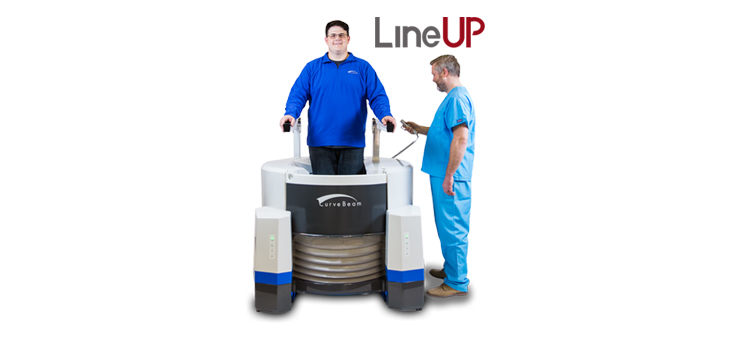
The LineUP system is designed to allow “the patient to stand during scanning to assess ‘weight-bearing’ or ‘load-bearing’ positions.” The system “can perform bilateral scans of legs from below the heel to above the knee. An adaptive chair permits scanning of the hand, wrist and elbow as well.”
“Weight bearing CT imaging for body extremities first became commercially available in 2012. Since then, lower extremity specialists and radiologists have published numerous journal articles on the value of a three-dimensional weight bearing views for conditions ranging from complex hindfoot misalignment to a routine bunion deformity. Published research also suggests a three-dimensional weight bearing view of the knees could be instrumental in early detection of osteoarthritis.”
The InReach system was cleared by the FDA May 2017 and multiple systems have been installed in hand surgery centers in the U.S. since the clearance. The company claims specialists “extol the ability to confirm a scaphoid fracture diagnosis or distal radius fracture diagnosis at the point-of-care, among other crucial diagnostic details.”
Company President and CEO Arun Singh said “Worldwide anticipation for the LineUP system has been “clamorous, and CurveBeam is confident the LineUP will make an even larger impact than the pedCAT did in understanding of lower extremity conditions.”
The pedCAT system permits bilateral weight bearing scans of the foot and ankle and was introduced in 2012. The system has been implemented in “many” foot and ankle orthopedic and podiatric facilities in the U.S, Europe, Australia and China, according to the company.
CurveBeam
CurveBeam was founded in 2009 by Singh and others with experience the advanced and compact 3D imaging technology for the dental, maxillofacial and ENT specialties. That technology, according to the company, “revolutionized” that industry and was instrumental in the advent of custom dental implants and improved practices in orthodontics and oral surgery. The company designs and manufactures Cone Beam CT imaging equipment for the orthopedic and podiatric specialties. CurveBeam is privately owned and operated.
Author
React:
Discussion
This is a fascinating development. In my practice we've seen similar outcomes with the revised protocol. The key differentiator seems to be patient selection criteria. Has anyone else noticed the correlation with BMI thresholds?
Great point. I'd push back slightly on the conclusion, the sample size in the cited study is too small to draw population-level inferences. That said, the directional signal is compelling and worth a larger RCT.
We implemented a similar approach last year. Early results are promising but we're still gathering 12-month follow-up data. Happy to share our protocol if anyone is interested.
Join the conversation
Orthopedic professionals are discussing this. Sign in and upgrade to read every comment and add your voice.