
Wow. San-Diego, California-based Reflexion Health’s innovative virtual assistant for exercise rehabilitation—named “VERA”—is now hard at work at North Carolina-based Greensboro Orthopaedics.
Virtual Exercise ‘Avatar’ Latest Rehabilitation Innovation
2 min read Premium comments
Secondary#knee#totaljoints#rehabilitationtherapy
VERA will be part of Greensboro’s postoperative rehabilitation team for total-joint replacement patients.
According to Reflexion, “VERA is a digital platform that brings the guidance of a physical therapist into the home along with tools that help clinicians remotely monitor patient progress beyond the traditional in-clinic setting. Greensboro Orthopaedics is a forward-thinking orthopaedic medical practice specializing in same-day total-joint replacements, serving Greensboro, North Carolina, and the surrounding communities.”
Frank V. Aluisio, M.D., orthopedic surgeon at Greensboro Orthopaedics, told OTW, “I first worked with Reflexion Health’s virtual therapy model as part of the Duke Clinical Research Institute VERITAS study. And the early results were off the charts, both in terms of recovery and patient satisfaction.”
“One of my biggest concerns with digital physical therapy was that patients might have difficulty achieving full range of motion with this model. But much to my surprise, they were not only achieving full extension, but doing so way ahead of schedule—and much earlier than with standardized therapy.”
“Another nice thing about Reflexion Health is that they offer their own therapists, or they’ll come in and train the physical therapists from your own facility to monitor patients’ virtual exercises. They go the extra mile to help ensure that the best possible results are achieved, during every step of the process.”
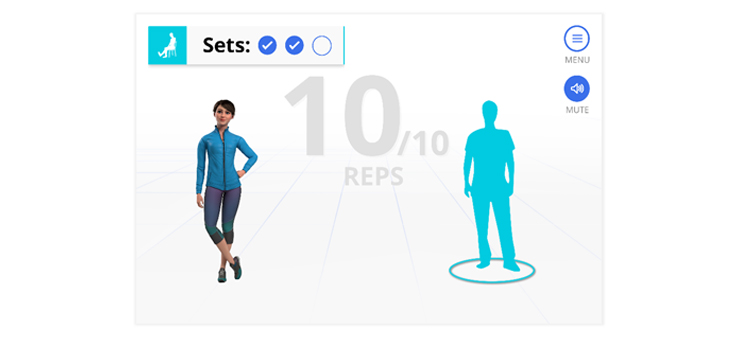
Asked to describe how the avatars work, Dr. Aluisio told OTW, “The avatars provide an easy-to-use, on-screen representation of each exercise, in terms that are as simple as possible. By offering a visual representation of what needs to be done, the avatar gives patients something to relate to, as well as a model for performing these exercises that doesn’t require listening to or understanding lengthy verbal explanations.”
“Results have shown that patients are finding this easy to use, and their overall rates of satisfaction have been phenomenal. They really enjoy the technology and are enthusiastic about doing their exercises, and best of all, they come back with results that are equivalent or even better than what’s typically achieved with standard physical therapy.”
Joseph Smith, M.D., Ph.D., chief executive officer, Reflexion Health, said in the news release, “We’re proud to help Greensboro innovate and enhance their post-operation offerings by leveraging our technology to build upon their capabilities and deliver value for patients. The enthusiasm for VERA continues to grow and we look forward to helping patients across the country recover in the safety, comfort, and convenience of their own homes.”
Author
React:
Discussion
This is a fascinating development. In my practice we've seen similar outcomes with the revised protocol. The key differentiator seems to be patient selection criteria. Has anyone else noticed the correlation with BMI thresholds?
Great point. I'd push back slightly on the conclusion, the sample size in the cited study is too small to draw population-level inferences. That said, the directional signal is compelling and worth a larger RCT.
We implemented a similar approach last year. Early results are promising but we're still gathering 12-month follow-up data. Happy to share our protocol if anyone is interested.
Join the conversation
Orthopedic professionals are discussing this. Sign in and upgrade to read every comment and add your voice.