
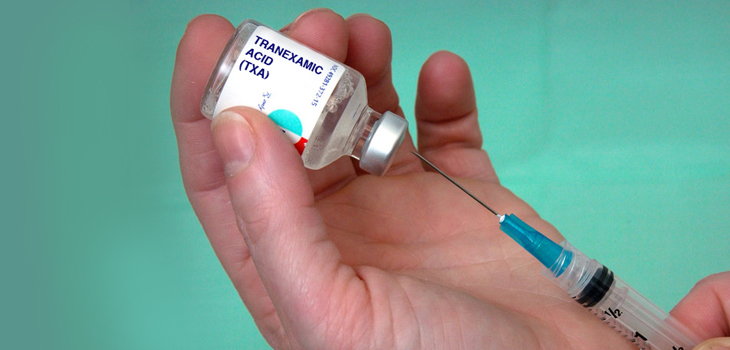
New research from Mount Sinai in New York has found that orthopedic surgeons performing shoulder arthroplasty may want to consider tranexamic acid (TXA).
TXA Linked to Decrease in Transfusion Risk, Complications
1 min read Premium comments
#arthroplastySecondary#tranexamicacid#shoulder
The research, “Utilization and Real-World Effectiveness of Tranexamic Use In Shoulder Arthroplasty: A Population-Based Study,” was presented at the recent meeting of the American Academy of Orthopaedic Surgeons in New Orleans.
Shawn G. Anthony, M.D., M.B.A., assistant professor of orthopedics at the Icahn School of Medicine at Mount Sinai and shoulder and sports medicine surgeon at Mount Sinai West, told OTW, “We are seeking to maximize safety of shoulder arthroplasty in our patients.”
“Blood loss requiring transfusion is less common than in total knee or total shoulder but still required in some patients. We utilized the Premier Perspective database that includes approximately 20% of all shoulder arthroplasties performed in U.S. We chose 2010-2016 to analyze current TXA utilization in available, complete datasets.”
The authors wrote, “Overall, TXA was used in 5.2% (n=2,636) of patients with a strong increasing trend. After adjustment for relevant covariates, TXA use (compared to no TXA use) was associated with a 38% decrease in transfusion risk (OR 0.62 CI 0.46-0.84 P<0.05) and a 45% decreased risk for combined complications (OR 0.55 CI 0.33-0.90 P<0.05). Moreover, TXA use was associated with 8.0% shorter length of hospital stay (CI -10.0%;-5.8% P<0.05) while no difference was observed for cost of hospitalization.”
Dr. Anthony told OTW, “While utilization of TXA has become very common in total hip and knee arthroplasty, TXA is still used in less than 50% of patients undergoing shoulder arthroplasty as of 2016. Utilization is increasing but continued education is important. The use of TXA presents one more way to improve the safety of shoulder arthroplasty for patients.”
Author
React:
Discussion
This is a fascinating development. In my practice we've seen similar outcomes with the revised protocol. The key differentiator seems to be patient selection criteria. Has anyone else noticed the correlation with BMI thresholds?
Great point. I'd push back slightly on the conclusion, the sample size in the cited study is too small to draw population-level inferences. That said, the directional signal is compelling and worth a larger RCT.
We implemented a similar approach last year. Early results are promising but we're still gathering 12-month follow-up data. Happy to share our protocol if anyone is interested.
Join the conversation
Orthopedic professionals are discussing this. Sign in and upgrade to read every comment and add your voice.