
For the first time, titanium fiber plates have been tested in an animal model.
Titanium Fiber Out-Performs the Original
2 min read Premium comments
Secondary#boneembrittlement#titaniumfiberplates
Japanese researchers from Shinshu University found that, unlike conventional plates, the titanium fiber plates do not cause bone embrittlement after close contact with the bone for prolonged periods. The practical significance of this is that plates would not need to be removed from a patient avoiding the risks of additional surgery.
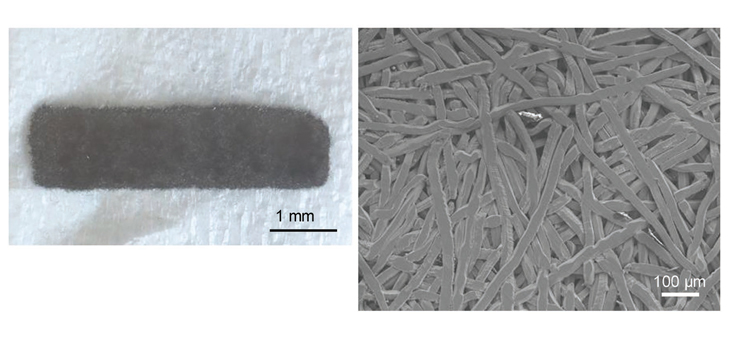
Takashi Takizawa, M.D., the paper’s first author from the department of orthopedic surgery at the Shinshu University School of Medicine, said, “Our titanium fiber plates, unlike conventional titanium plates, are prepared by compressing titanium fibers at normal room temperature into plates without changing the fiber shape. This compensates for the major drawback of conventional titanium plates and finds application in a range of fixation and bone tissue repair uses at various sites of the body.”
“Researchers from Shinshu University found that, unlike conventional plates, the titanium fiber plates do not cause bone embrittlement after close contact with the bone for prolonged periods. This could eliminate the need for plate extraction and the associated surgical risks.”
Titanium plates are most often used to hold bones in place while they heal. In their favor is the fact that “…the plates resist erosion and are strong enough to hold mending bones in place. Doctors may elect to implant a titanium plate in a patient with a bad fracture, severe skull injury or a bone degenerative disease.”
Titanium plates, however, while useful also present some problems. They must be removed after the healing process is completed because they can “cause stress shielding in which the bones become brittle.” It was to deal with this problem in titanium plates that Noboru Nakayama, an associate professor of engineering at Japan’s Shinshu University, developed the titanium fiber plate in 2014. He received patents for this from both Japan and the United States.
“The titanium fiber plates share an important characteristic with natural bone, according to Takizawa. They both have a nearly identical measurement of stiffness.” This measurement is known as Young’s modulus.
“Conventional plates have a Young’s modulus four to ten times higher than that of bone which eventually causes bone embrittlement while the bone and plate are in contact.”
Researchers “also tested the use of titanium fiber plates in regenerative medicine. Since the shape of the titanium fibers remains unchanged, as the plates are prepared at room temperature, a unique porous environment is created throughout the plates.”
“We’ve seen how regenerated bone penetrates into the titanium fiber,” Takizawa said. “We are going to apply the plates to clinical bone tissue repair. I believe that titanium fiber plates can be permanently placed without removal surgery,” he said.
Author
React:
Discussion
This is a fascinating development. In my practice we've seen similar outcomes with the revised protocol. The key differentiator seems to be patient selection criteria. Has anyone else noticed the correlation with BMI thresholds?
Great point. I'd push back slightly on the conclusion, the sample size in the cited study is too small to draw population-level inferences. That said, the directional signal is compelling and worth a larger RCT.
We implemented a similar approach last year. Early results are promising but we're still gathering 12-month follow-up data. Happy to share our protocol if anyone is interested.
Join the conversation
Orthopedic professionals are discussing this. Sign in and upgrade to read every comment and add your voice.