
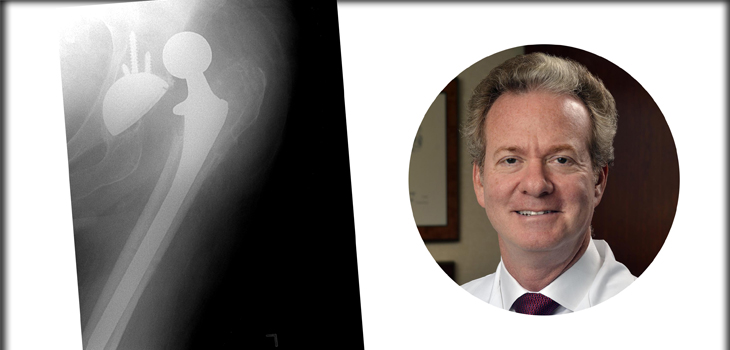
New work from Hospital for Special Surgery (HSS) has determined that patients under 55 years old receiving a dual mobility hip replacement had zero—ZERO—dislocations.
THR Dual Mobility Implant: ZERO Dislocations
2 min read Premium comments
Secondary#hipdysplasia#hss#hip
Those who received a traditional fixed bearing hip implant had a dislocation rate of 5%.
The study, “Dual-Mobility vs Fixed-Bearing Total Hip Arthroplasty in Patients Under 55 Years of Age: A Single-Institution, Matched-Cohort Analysis,” appeared in the October 2017 online version of The Journal of Arthroplasty. The research was recently presented at the American Academy of Orthopaedic Surgeons annual meeting in New Orleans.
Geoffrey H. Westrich, M.D., research director of the Adult Reconstruction and Joint Replacement Service at HSS and co-author of the study, commented to OTW, “Dislocation is one of the most common complications following THR [total hip replacement] surgery and is quite disheartening for both the patient and the surgeon. Now that we have an implant that can greatly reduce the incidence of dislocation following THR (one previous publication that I did in Hip International showed NO DISLOCATIONS in a multicenter study of 485 patients with 2-year follow up), surgeons have a tool that can provide all the benefits of THR without the same risk of dislocation.”
According to HSS, “Dr. Westrich and colleagues compared the dual mobility system with the traditional fixed bearing system in two age-matched groups of patients who had a primary total hip replacement over the same time period. There were 136 patients in each group with a mean age of 48.”
Dr. Westrich told OTW, “First, the striking lack of dislocations in the under 55-year old patients with dual mobility THRs was quite encouraging. Also, in the matched control group of patients under 55 years old with traditional fixed bearing THRs, we found that these patients (1) had a much higher dislocation rate than we normally anticipated and (2) that 5 of the 7 patients who dislocated had their implants in what is considered the ‘safe zone.’ These latter two findings indicated that patients under 55 with traditional (non-dual mobility) THRs are at higher risk for a problem, and despite our best efforts, surgical technique alone with fixed bearing THRs cannot prevent dislocation. Dual mobility THRs may be the answer in this younger, more active patient population.”
“Further study of dual mobility THR’s with longer follow up would be helpful, but so far, it looks like there are many benefits without any increased risks or concerns.”
Author
React:
Discussion
This is a fascinating development. In my practice we've seen similar outcomes with the revised protocol. The key differentiator seems to be patient selection criteria. Has anyone else noticed the correlation with BMI thresholds?
Great point. I'd push back slightly on the conclusion, the sample size in the cited study is too small to draw population-level inferences. That said, the directional signal is compelling and worth a larger RCT.
We implemented a similar approach last year. Early results are promising but we're still gathering 12-month follow-up data. Happy to share our protocol if anyone is interested.
Join the conversation
Orthopedic professionals are discussing this. Sign in and upgrade to read every comment and add your voice.