
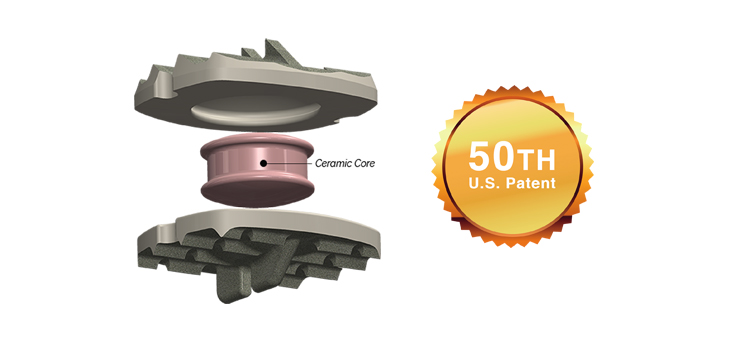
San Francisco Bay area Simplify Medical Ltd, maker of the Simplify cervical artificial disc, has received its 50th U.S. patent for its cervical motion preservation intellectual property (IP) portfolio.
Simplify Medical Earns 50th U.S. Patent
2 min read Premium comments
Secondary#neckpain#simplifymedical#certicalartificialdisc
The ‘945 Patent
According to a February 27, 2018 company press release, U.S. Patent No. 9,883,945, is entitled “Artificial Intervertebral Disc with Lower Height” and relates to the unique low-profile and more anatomically-shaped disc design. Other recent patents for the company include U.S. Patent No. 9,839,532, covering the company’s proprietary methods for inserting intervertebral discs “in a less traumatic manner,” and U.S. Patent No. 9,839,525, relating to implanting intervertebral discs “with a movable core and a protrusion for holding the core captive between endplates.”
The company said its disc is designed to “minimize patient risk associated with radiation, optimize long-term durability, simplify implantation and increase access to cervical disc replacement for patients with smaller anatomies.”
“Largest” IP Portfolio
David Hovda, Simplify Medical’s CEO and Minnesota native, said he believes the company has the “largest and most impactful IP portfolio in the spine motion preservation space, and we continue to invest in technology to further optimize patient outcomes and surgical ease of use.”
The disc, according to the company, is primarily composed of non-metal materials (PEEK-on-ceramic) and is designed to be viewed on magnetic resonance imaging (MRI) “in order to minimize post-operative patient exposure to radiation from computed tomography (CT) scans currently necessary to view metal discs.” The company notes that MRIs are widely used pre-operatively for surgical planning, but that spine surgeons often switch to CT scans post-operatively to accommodate metal components.
This switching can make it difficult to view the devices, as well as the facets and adjacent disc levels. However, the company adds that CT scans have been shown to expose patients to ionizing radiation that equates to 400 to 550 chest X-rays per scan. “The device is considered MRI-conditional, posing no known hazard in an MRI environment within prescribed conditions of use,” according to the company.
Two U.S. Pivotal Trials
The company also noted that the disc is being studied in two U.S. pivotal trials.
The first, is a one-level, prospective trial comparing the disc with cervical fusion surgery at one level between C3 to C7 which has completed enrollment.
The second, which is about 40% enrolled, is looking at the use of the disc in two levels of the spine. Enrollment is expected to be completed by the end of 2018. The two-level, prospective pivotal trial will encompass up to 200 patients at up to 18 centers, comparing cervical implantation of the device in two contiguous discs from C3 to C7 with two-level cervical fusion surgery.
The Simplify Disc has received the CE Mark and is commercially available in select European markets but is still an investigational device in the U.S. and is limited by law to investigational use.
Author
React:
Discussion
This is a fascinating development. In my practice we've seen similar outcomes with the revised protocol. The key differentiator seems to be patient selection criteria. Has anyone else noticed the correlation with BMI thresholds?
Great point. I'd push back slightly on the conclusion, the sample size in the cited study is too small to draw population-level inferences. That said, the directional signal is compelling and worth a larger RCT.
We implemented a similar approach last year. Early results are promising but we're still gathering 12-month follow-up data. Happy to share our protocol if anyone is interested.
Join the conversation
Orthopedic professionals are discussing this. Sign in and upgrade to read every comment and add your voice.