
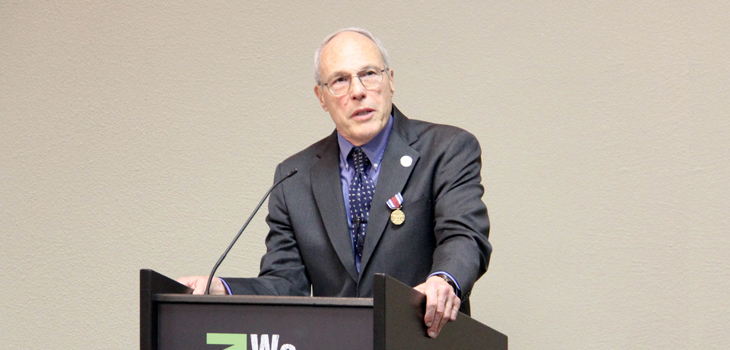
Lewis Zirkle, MD, an orthopedic surgeon affiliated with Kadlec Regional Medical Center, was awarded the U.S. Department of Defense’s Medal for Distinguished Public Service by U.S. Defense Secretary James Mattis at a recent ceremony in Richland, Washington, for his work bringing modern fracture care and training to developing nations through his nonprofit organization, SIGN Fracture Care International.
SIGN Founder Zirkle Receives DOD Distinguished Medal
2 min read Premium comments
Secondary#lewiszirkle
According to a press release, this is the highest honorary award presented by the Secretary of Defense to non-career federal employees, private citizens and foreign nationals.
“Dr. Lewis G. Zirkle is recognized for distinguished public service for his continuing dedication to provide the injured poor around the world with the ability and the freedom to walk again. While serving the Nation during the Vietnam War, Dr. Zirkle was first inspired to help his overseas counterparts bridge the gap and create equitable orthopaedic treatment for citizens of impoverished nations,” Mattis said in the release.
“The distinctive accomplishments of Dr. Zirkle and his spirit and commitment in defending and caring for his fellowmen reflect great credit upon himself and the Department of Defense [DOD].”
After completing his military service Zirkle continued to make trips back to Vietnam and other developing nations to help the local doctors develop successful techniques for fracture treatment. He established SIGN, headquartered in Richland, Washington, in 1999 in order to manufacture and donate medical-grade surgical implants that allow surgeons in developing countries to still treat fracture patients effectively despite the limited availability of more sophisticated technologies like live-view X-ray equipment.
The SIGN IM Nail System consists of intramedullary nails (implants) which are held in place with interlocking screws and is easy to use in medical facilities that do not have expensive equipment or even power. Since its inception, SIGN has trained 5,000 surgeons in 50 countries who have treated more than 210,000 patients.
One particular patient he met during his trips overseas had a big impact on his life. On one of his trips to Indonesia he discovered a patient who had laid in retraction for three years because of lack of resources to treat his condition properly. He took a photo of this patient and hung it on the walls at SIGN as a reminder of the urgent need for not only proper training but also proper resources.
“I accept this award on behalf of the SIGN family because all of you have helped, all of the surgeons overseas have contributed, and I’m very honored to have the chance to work with you,” Zirkle said in the release.
Author
React:
Discussion
This is a fascinating development. In my practice we've seen similar outcomes with the revised protocol. The key differentiator seems to be patient selection criteria. Has anyone else noticed the correlation with BMI thresholds?
Great point. I'd push back slightly on the conclusion, the sample size in the cited study is too small to draw population-level inferences. That said, the directional signal is compelling and worth a larger RCT.
We implemented a similar approach last year. Early results are promising but we're still gathering 12-month follow-up data. Happy to share our protocol if anyone is interested.
Join the conversation
Orthopedic professionals are discussing this. Sign in and upgrade to read every comment and add your voice.