
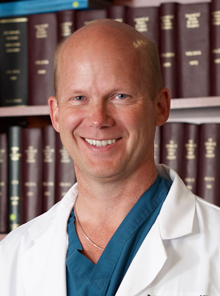
Robert LaPrade, M.D., Ph.D., a complex orthopedic knee and sports medicine surgeon at The Steadman Clinic in Vail, Colorado, has hit a unique milestone with the publication of over 400 peer reviewed studies. He joins an elite (and small) group of clinician-scientists to reach this milestone.
Robert LaPrade Surpasses 400 Peer-Reviewed Study Milestone
2 min read Premium comments
#knee#sportsmedicine#robertlaprade
According to the Steadman Clinic, “Most recently, Dr. LaPrade was selected for the Cabaud Memorial Award at the 2017 American Orthopaedic Society for Sports Medicine Annual Meeting for his work, ‘Use of Platelet-Rich Plasma Immediately Post-injury to Accelerate Ligament Healing was not Successful in an In Vivo Animal Model.’”
Asked about the greatest challenges for orthopedic researchers, Dr. LaPrade told OTW, “Finding time to work on research projects on a regular basis with the increasing documentation and technical challenges with taking care of patients-for example, our new electronic medical record requires an extra 4-5 hours of work from me a week-that takes away from my ability to perform research.”
“The other area that is concerning for all researchers is finding funding to answer these important clinical questions; biologics projects or animal studies which answer an important question can be very expensive.”
He continued, “My advice to young researchers find a topic for research that you have a passion for in answering an important clinical question—then planning to spend at least five minutes day working on it. If one lets things go for over a week, sometimes when one picks up the project again, it is almost like starting over.”
“My other main advice is to focus on one topic and try and become an expert in that area-then one can eventually be involved with teaching at Instructional Course Lectures and Symposia over time—if one jumps around on multiple different topics on multiple different pathologies, then one becomes a jack of all trades and a master of none for research.”
Mark R. Hutchinson M.D., professor of Orthopaedics and Sports Medicine at the University of Illinois at Chicago, said this about Dr. LaPrade, “Dr. Robert LaPrade has been the most impressive and prolific clinical research scientist in the field of sports medicine over the last decade.”
“His teachings and research regarding posterolateral knee injuries, meniscus injuries, and knee instability have become the gold standard reference for clinicians and students around the globe.”
“He has not only impacted the thousands of patients he has cared for but hundreds of thousands across the globe who have benefited from the knowledge he has imparted to sports medicine practitioners across the globe. Kudos to Dr. LaPrade and his team for attaining the prestigious level of over 400 publications listed on Pubmed.gov.”
“We are particularly proud to claim him as an alumnus of the University of Illinois College of Medicine.”
Author
React:
Discussion
This is a fascinating development. In my practice we've seen similar outcomes with the revised protocol. The key differentiator seems to be patient selection criteria. Has anyone else noticed the correlation with BMI thresholds?
Great point. I'd push back slightly on the conclusion, the sample size in the cited study is too small to draw population-level inferences. That said, the directional signal is compelling and worth a larger RCT.
We implemented a similar approach last year. Early results are promising but we're still gathering 12-month follow-up data. Happy to share our protocol if anyone is interested.
Join the conversation
Orthopedic professionals are discussing this. Sign in and upgrade to read every comment and add your voice.