
Foothill Ranch, California-based Össur has launched its Rebound Post-Op Knee brace.
Ossur Launches Rebound Post-Op Knee Brace
2 min read Premium comments
Secondary#ossur#knee#reboundpostopkneebrace
According to the company, the brace is “… for patients who require controlled range of motion for a variety of knee-related issues, including ligament or meniscal repairs, tibial plateau fractures, patellar tendon or osteochondral repairs, condylar fractures, knee sprains and strains, as well as high tibial osteotomy.”
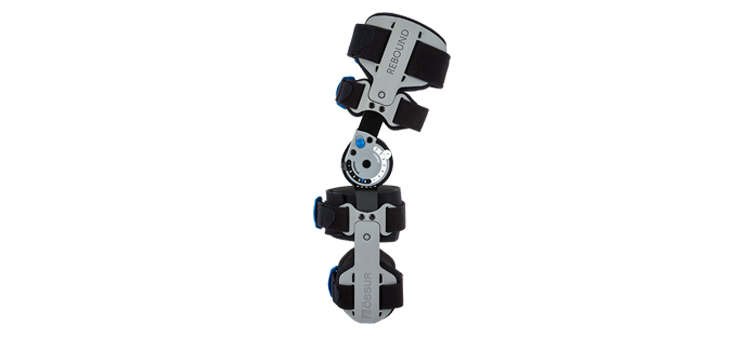
“The new Rebound Post-Op Knee brace features ergonomic paddles and contouring struts that hug the patient’s anatomy and promote comfort, in a brace that is as much as 30 percent lighter than others available on the market.”
“It also capitalizes on innovations featured in other Össur products, including an Anti-Migration System wrap and quick-fit buckle system that help further ensure secure suspension.”
“The Rebound Post-Op Knee brace’s design includes Smart-Fit packaging and a numbered frame with quick-fit gripping buckles, making it efficient and easy for clinicians to fit, as well as for patients to don at home. Clinicians can educate their patients on using the color-coded blue patient touch-points with the simple term, ‘Blue is You.’”
“Össur’s Rebound Post-Op Knee brace is intended to provide controlled knee range-of-motion with a range from -10° to 120°, promotes additional support with a secure drop-lock feature, and offers optional lockout clips to limit patient self-adjustments.”
“The brace is available in universal adult and pediatric models as well as specific left- and right-contoured configurations when a more anatomical fit is required. An easy-to-engage button with secure locking feature enables the telescoping frame to be sized from 18.5 to 27 inches in the adult models, while the pediatric version accommodates sizing from 15 to 21 inches.”
Asked about the paddles and struts, Jason Thorne, Össur’s vice president of Global Marketing, Osteoarthritis and Injury Solutions, told OTW, “You’ll notice a more anatomical fit with the contoured, telescoping paddles on the Rebound Post-Op Knee. Easy-to-read markings under the paddles help practitioners to quickly make slide-to-size adjustments for individual patients. The Rebound Post-Op knee has malleable, aluminum struts that can be contoured by practitioners, or save time during fittings by using the pre-contoured versions which are left/right specific.”
“The Rebound Post-Op Knee was designed with both the patient and practitioner in mind, and covers the variances in patient anatomies with pediatric, XL, left contoured, and right contoured versions alongside a one-size-fits all universal. Blue patient touch-points and numbered buckles are unique, intuitive features that assist with ease of use for the patient while they don or doff their brace.”
Author
React:
Discussion
This is a fascinating development. In my practice we've seen similar outcomes with the revised protocol. The key differentiator seems to be patient selection criteria. Has anyone else noticed the correlation with BMI thresholds?
Great point. I'd push back slightly on the conclusion, the sample size in the cited study is too small to draw population-level inferences. That said, the directional signal is compelling and worth a larger RCT.
We implemented a similar approach last year. Early results are promising but we're still gathering 12-month follow-up data. Happy to share our protocol if anyone is interested.
Join the conversation
Orthopedic professionals are discussing this. Sign in and upgrade to read every comment and add your voice.