
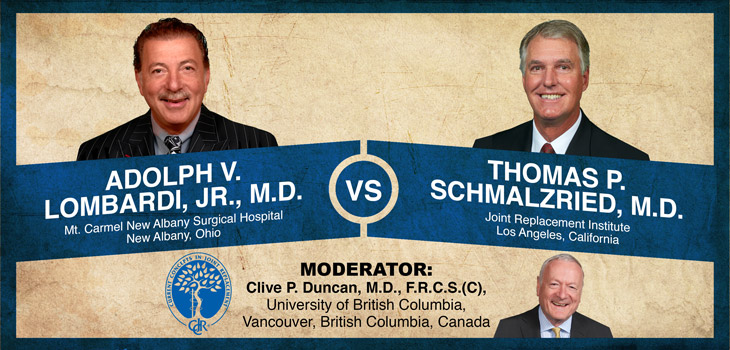
This week’s Orthopaedic Crossfire® debate was part of the 33rd Annual Current Concepts in Joint Replacement® (CCJR®), Winter meeting, which took place in Orlando. This week’s topic is “Ceramic-XLPE in Patients <60: The New Standard.” For is Adolph V. Lombardi, Jr., M.D., Mt. Carmel New Albany Surgical Hospital, New Albany, Ohio. Opposing is Thomas P. Schmalzried, M.D., Joint Replacement Institute, Los Angeles, California. Moderating is Clive P. Duncan, M.D., F.R.C.S.(C), University of British Columbia, Vancouver, British Columbia, Canada.
Lombardi v. Schmalzried: Ceramic-XLPE in Patients <60: The New Standard
7 min read Premium comments
#hipreplacementGreat Debates#hip
Dr. Lombardi: Ceramic seems to be becoming a more significant trend in the United States. Although I would give it to Tom that there are more metal-on-polyethylene performed.
Why ceramics? Because they’re hard, they’re scratch-resistant, they’re excessively wettable. They have very low wear and they’re inherently stable. There’s been extensive experience with BIOLOX, for example. From 1974—40 years of experience. A lot of publications. Ten-plus years of published clinical results. And if you’re worried about fracture, a manufacturer database and three registries show it’s 0.001%. Fracture of these devices is minimum for femoral heads and certainly less as you get to the larger heads.
Now, if you look at wear it’s a pretty significant difference.
In a simulator study, a smooth ceramic head resulted in 34% less wear and 90% less wear with a rough ceramic head when compared to matched metal heads on cross-linked polyethylene. Further, the ceramic on conventional polyethylene is much better than the metal on conventional polyethylene, but not as dramatic a difference between ceramic versus metal on highly cross-linked polyethylene.
In one RCT [randomized control trial] published in 2009, which looked at zirconia on non-cross-linked polyethylene versus two types of zirconia on cross-linked polyethylene and stainless steel on highly cross-linked polyethylene, there was a significant decrease in wear between the polyethylenes and a slight difference between the types of zirconia.
One paper which looked at 102 cementless hips; 51 in each group, zirconia versus chrome cobalt; 6.7 years and they found no difference between these two.
So, wear, we can argue, may not be as significant an issue, but what about tribocorrosion, which is now a pretty significant challenge. We’re all talking about it. It’s been reported anywhere from 1.1 to 4.3% metal-on-polyethylene versus 12% metal-on-metal.
Looking at actual material loss in a retrieval analysis (Kocagoz, CORR, 2016)—50 ceramic and 50 metal—and there was a lot more material loss with metal, both on the stem and, obviously, in the femoral head than with the ceramic.
And then look at chrome cobalt…chromium cobalt release (White, J Arthroplasty, 2016). Comparing 30 patients in each group demonstrated that 57% had elevated cobalt with the metal heads on polyethylene. Seven of them had received MRI, 4 cases of adverse reaction to metal debris where there is none in the ceramic.
A paper by McGrory, et al. (J Arthroplasty, 2015) seemed to suggest that there was definitely an increase of incidence of corrosion and that they recommended ceramic heads until this problem with corrosion is solved.
Another point to think about is periprosthetic infection. Looking at 9 registries, you see a much lower incidence of infection with ceramic-on-ceramic and ceramic-on-polyethylene in addition to a 1.5 hazard ratio for the metal versus the ceramic. Also, Jay Parvizi looked at his series and reported a hazard ratio of 2.6.
Perhaps this is because there is a higher incidence of biofilm on metal and polyethlyene versus ceramic.
So why do I use ceramic on polyethylene? I want to avoid taperosis, I want to avoid adverse reaction, metal debris and squeaky ceramic on ceramic. It’s forgiving. It’s an extremely low wear couple. It’s a bearing of choice in my mind for high demand patients. I use it for all revisions for failed metal on metal and taperosis and, quite frankly Tom, I’m not afraid to wear pink, so I suggest that you think pink.
Dr. Schmalzried: Age is often used as a surrogate for activity. For an individual patient BMI [body mass index] is a better predictor of post-operative activity. More specific, what bearing will meet the needs of this patient with an acceptable risk of revision surgery during their lifetime and with a justifiable cost?
Concerns of taper corrosion and adverse local tissue reactions, not wear and osteolysis, have driven increased utilization of ceramic heads. The launching point for this was reported in 2012 and it represented 1.8% of 569 revisions. There is no doubt that more research is needed into the etiology of taper corrosion, especially surgeon variability in taper assembly. It’s my hypothesis that the biggest source of variability leading to this problem is assembly.
The Australian Registry reports that there’s no difference in the cumulative percent revision of cross-linked polyethylene whether it’s metal or ceramic. No difference. So, in a very large population, out to 13 years, no difference in the risk of revision whether you had a metal head or a ceramic head, if it was on cross-linked polyethylene.
Cross-linked polyethylene is the key ingredient. Our own data has shown a low linear penetration rate and low volumetric wear. The issue about wear through…in a normal patient’s lifetime is not going to happen because the linear wear is so low. We don’t see evidence of radiographic osteolysis out to 15 years.
Now ceramic heads are invariably more expensive. The ability to recoup the increased cost through diminished lifetime revision costs depends on the price premium and the age of the patient. A wholesale switch to ceramic bearings could result in an economic burden to the health care system. One measure of “standard” is simply “the most frequently used”. In this regard, market data alone makes a determination of standard without regard to clinical or economical outcomes. In the United States we’ve hit that tipping point. The sale of ceramic heads in this country right now has just passed the sale of metal heads. However, longer follow-ups including financial data is necessary to better assess the relative value of the available bearing couples.
Moderator Duncan: Let me ask you this question. Should we bring the price of ceramic down equal to metal?
Dr. Schmalzried: Oh no, I use ceramic heads frequently.
Moderator Duncan: That’s not my question.
Dr. Schmalzried: I use it already when it’s higher, Clive.
Moderator Duncan: Would you use it exclusively if it was the same price?
Dr. Schmalzried: Yeah.
Dr. Lombardi: I think that sometimes the decision is price, but I agree with one thing that Tom says, well I agree with more than one, but one important point that Tom made which I would say is very important is the assembly of the taper. I don’t think we take enough time to dry it and we don’t impact it with enough force.
Dr. Schmalzried: That is important for ceramic heads as well. If you look at the ceramic literature, everybody says the same thing—you don’t want any fat, you don’t want any blood, because that increases the taper stresses and can be associated with ceramic head fracture. So whether you’re using a metal head or a ceramic head, careful attention and proper taper assembly are key regardless of the material.
Moderator Duncan: And the same force. So, just to get the figures correct, Adolph, it’s 1 in 10,000 and you’re referring to the head alone? The fracture risk at this point with the Delta ceramic.
Dr. Lombardi: Yes, from the registries and from the manufacturer databases.
Dr. Schmalzried: It’s actually better than that—3 in 100,000—for just the head. And larger heads have a lower fracture risk than smaller heads, so the 36mms rarely break.
Moderator Duncan: So, when we’re matching a 28mm head with a dual mobility plus a titanium adapter sleeve, you’ve got a pretty thin ceramic. No information on that for the risk of that fracture. But you do agree that the thinner the ceramic, the higher the risk?
Dr. Lombardi: That’s indisputable. The smaller the head, the greater the fracture risk.
Moderator Duncan: Something for us to keep an eye on. When we talked about the revision, just to bring things up to speed, after fracture of the ceramic head…what’s the current state of the art on that? Must it be ceramic-ceramic forever? Can we go ceramic-on-polyethylene?
Dr. Schmalzried: Dr. Ranawat made a very good point about the thoroughness of the debridement. I think that is very important. Under those circumstances I think that putting a ceramic head against polyethylene is probably going to be okay. But there is a tremendous amount of data at this point in time for ceramic-on-cross-linked polyethylene in that abrasive environment.
Moderator Duncan: Metal-on-poly in that environment, no?
Dr. Schmalzried: I would recommend against it. I would want to use a ceramic head.
Moderator Duncan: You’re thoughts on that Adolph.
Dr. Lombardi: Yeah, I have two cases of ceramic fracture in my practice, both were 28mm heads. One was zirconia, one was Biolox Delta. They were at a -6 in our system which has a high propensity for fracture. They were difficult revisions and I’m worried about both of those patients from the perspective of now following them up with osteolysis. I did not have cross-linked polyethylene at that time. They have a fair amount of osteolysis. Neither one is symptomatic. I did ceramic-on-polyethylene. Question is should I have done ceramic-on-ceramic.
Dr. Schmalzried: A property we forgot about, but remember when the early wear testing was done, cross-linked polyethylene wasn’t just better in a clean wear test, it was significantly better in an abrasive wear test. So cross-linked polyethylene does better than conventional polyethylene in an abrasive environment. We’ll find out, I guess, whether it’s good enough in that environment.
Moderator Duncan: Please join me in thanking the debaters.
Please visit www.CCJR.com to register for the 2018 CCJR Spring Meeting, – May 20 – 23 in Las Vegas.
Senior Editor: Jay D. Mabrey, M.D., whose 35 year career in orthopedics included residency at Duke University Medical Center, service in the United States Army Medical Corps, Fellowship at the Hospital for Special Surgery and a long, distinguished career at Baylor University Medical Center where, in addition to his overall leadership at that institution, developed the Joint Wellness Program that helped patients get up after surgery more quickly, developed the first virtual reality surgical simulator for knee arthroscopy and chaired the FDA Orthopaedic Device Panel, is Orthopedics This Week’s newest contributing writer and editor.
Author
React:
Discussion
This is a fascinating development. In my practice we've seen similar outcomes with the revised protocol. The key differentiator seems to be patient selection criteria. Has anyone else noticed the correlation with BMI thresholds?
Great point. I'd push back slightly on the conclusion, the sample size in the cited study is too small to draw population-level inferences. That said, the directional signal is compelling and worth a larger RCT.
We implemented a similar approach last year. Early results are promising but we're still gathering 12-month follow-up data. Happy to share our protocol if anyone is interested.
Join the conversation
Orthopedic professionals are discussing this. Sign in and upgrade to read every comment and add your voice.