
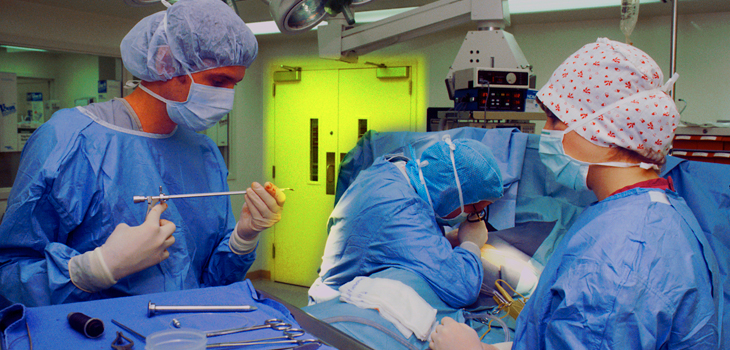
Double doors, double trouble…new research finds that opening two operating room (OR) doors simultaneously may allow contaminated air into the operating room.
Double OR Doors = Infection Risk!
2 min read Premium comments
Secondary#operatingroom#orairflow
The study, “The Effect of Door Opening on Positive Pressure and Airflow in Operating Rooms,” was published in the March 1, 2018 edition of the Journal of the American Academy of Orthopaedic Surgeons.
Co-author Mitchell C. Weiser, M.D., with the Montefiore Medical Center and Albert Einstein College of Medicine in Bronx, New York, told OTW, “Several studies in the last decade or so have suggested that door opening events during orthopaedic surgery are concerning for possibly increasing postoperative surgical site infection.”
“It is still unclear whether these risks are related to a change in operating room airflow patterns due to the door opening event, a possible loss of operating room positive pressure with resultant influx of contaminated air from the hallway outside the OR during door opening, or are door opening events simply markers of personnel entry into the room with bacterial shedding from these individuals as a cause of increased risk of postoperative surgical site infections (SSIs).”
“Our study was interested in evaluating if there were negative pressure events during door opening. Does the door used for entry into the OR affect the risk of negative pressure events? How do airflow patterns change with door opening?”
“This study utilized a block of empty operating rooms used for orthopaedic surgery. Door opening was simulated and pressure changes were monitored using handheld digital manometers. Changes in airflow patterns with door opening were visualized with smoke studies from a theatrical fog machine.”
“When only a single door was open at one time, there was no loss of positive pressure in the operating room. If two doors were open simultaneously (the main door and a substerile door), there was a loss of positive pressure with influx of contaminated air from the hallway.”
“Over 50% of door opening events take place during room and sterile tray set up. During this time, access to the OR is typically not restricted to the use of a single door. It is possible that there are simultaneous double door opening events during this time, allowing contaminated air into the operating room with possible contamination of the trays.”
“Operating rooms are supposed to be under positive pressure to prevent influx of contaminated air. The ability for the OR to maintain positive pressure is based on how well the operating room heating, ventilation, and air conditioning (HVAC) system is working. The HVAC system operation should be checked daily by the charge nurse and engineering. Access to the OR should be restricted to a single door during both room set up and the actual surgical procedure. Sterile instrument trays should be covered with sterile towels after opening until they are ready for use, in order to reduce the risk of contamination.”
Author
React:
Discussion
This is a fascinating development. In my practice we've seen similar outcomes with the revised protocol. The key differentiator seems to be patient selection criteria. Has anyone else noticed the correlation with BMI thresholds?
Great point. I'd push back slightly on the conclusion, the sample size in the cited study is too small to draw population-level inferences. That said, the directional signal is compelling and worth a larger RCT.
We implemented a similar approach last year. Early results are promising but we're still gathering 12-month follow-up data. Happy to share our protocol if anyone is interested.
Join the conversation
Orthopedic professionals are discussing this. Sign in and upgrade to read every comment and add your voice.