
Tom Waddell, a graduate of two Wisconsin universities (at Stout and Madison) and an electrical engineer was, for several years, project manager for a long list of industrial and medical device companies, among them Honeywell and Medtronic, before he branched out to form his own 12-person medical device consulting firm—Waddell Group.
System Stops Cheating at Physical Therapy
2 min read Premium comments
#physicaltherapySecondary#mobiledigitaltherapy
His company’s stated purpose is to “lead difficult projects…’
Over the 19 years his company has been in business he and his team have chewed through 600+ projects for 80+ clients.
Not bad.
But now Waddell, who obviously doesn’t shy away from a challenge, is thinking about changing patient behavior.
And his vehicle is an emerging growth company named TheraTec (www.theratec.com).
Waddell’s goal with TheraTec is to bring about behavior change in patients in the physical therapy world.
Good luck with that, right?
The Problems With Physical Therapy
Where to start…the field of physical therapy is one in which patients often fail to perform their full schedule of prescribed exercises. They forget how a particular exercise should be done, or they do them incorrectly or don’t bother to perform them at all.
Most patients do try to comply with their therapist’s instructions.
But human nature is, usually, in control.
And then there’s the moment when the therapist and patient confront reality. Because of embarrassment, patients usually do not report honestly to their therapist about their non-compliance. But, of course, the therapist already knows.
The Answer Is on the Phone
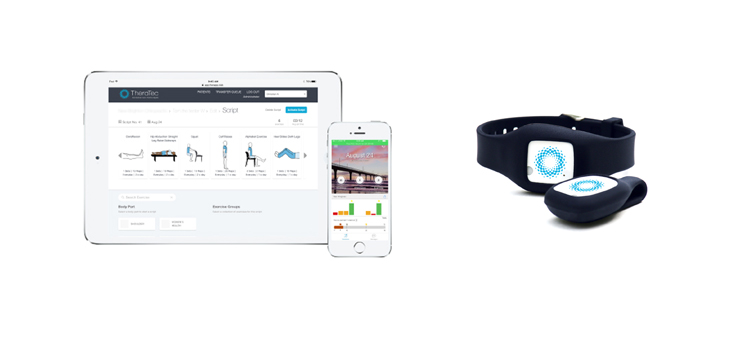
TheraTec’s product is a phone app married to a separate and powerful motion sensing device.
Most importantly, it is designed with human behavior in mind.
As Waddell explains, “TheraTec is the first company to focus on a proprietary mobile digital therapy with patented technology specific for the orthopaedic market. It offers a promising way to hold patients accountable, improve patient outcomes, and lower costs.”
Besides the app for the patient’s smart phone, the patient carries a half-dollar sized device that measures “range of motion.” The device, which comes in a very small case, can be carried in a pocket, hooked on a belt loop or worn like a watch on the wrist. The app is able to connect to the sensor, sense how a patient is performing his exercises, notes if she is doing them incorrectly, and advises her how to change and improve.
For example, if a patient is not raising their arms as high as the exercise requires or calls for, the app will alert the patient and even provides an illustration of the proper technique.
The app reminds patients daily when to do their exercises, shows motion illustrations of how each exercise should be performed, shows a visual on the patient’s watch of a figure performing the prescribed exercises, keeps track of repetitions, and reports to the therapist and/or the physician on the patient’s compliance with the therapist’s and doctor’s orders.
The device is called TherApp™ PT.
The inventor, Tom Waddell, can be reached at twaddell@theratec.com.
Author
React:
Discussion
This is a fascinating development. In my practice we've seen similar outcomes with the revised protocol. The key differentiator seems to be patient selection criteria. Has anyone else noticed the correlation with BMI thresholds?
Great point. I'd push back slightly on the conclusion, the sample size in the cited study is too small to draw population-level inferences. That said, the directional signal is compelling and worth a larger RCT.
We implemented a similar approach last year. Early results are promising but we're still gathering 12-month follow-up data. Happy to share our protocol if anyone is interested.
Join the conversation
Orthopedic professionals are discussing this. Sign in and upgrade to read every comment and add your voice.